
AI Avatars Explained: Types, How They Work and Where They're Used (2026)
Short answer
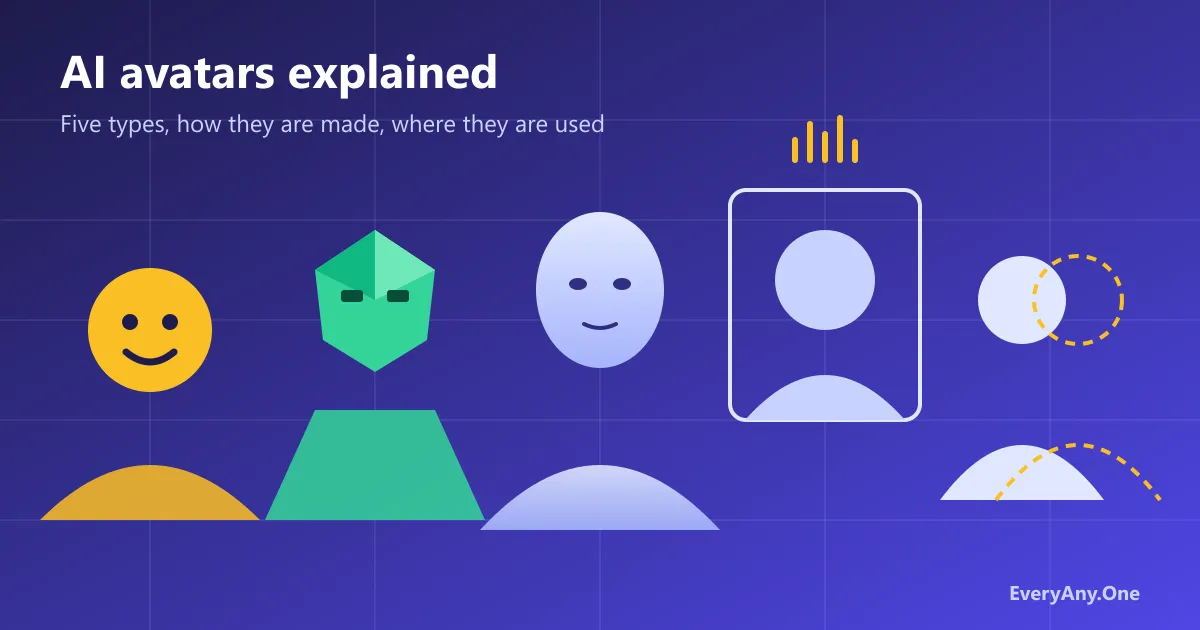
An AI avatar is a digital likeness of a person or character created with machine learning. It can be a stylised profile picture, a photorealistic image, a talking presenter that reads a script, a digital twin of a real person, or a 3D character for games and streaming. Most are made from photos, video or text prompts.
Key takeaways
- "AI avatar" covers five different things: stylised profile avatars, photoreal avatars, talking-avatar video, digital twins and game or VTuber avatars.
- Avatars of real people are built from photos or video of that person, which is why the major talking-avatar platforms require the person to give consent on camera.
- In the EU, AI Act transparency rules that require deepfakes to be disclosed apply from 2 August 2026.
- No single check reliably spots synthetic media. NIST says people judge it at close to chance, so treat any verdict as a likelihood.
- This domain once hosted Metaphysic's Every Anyone avatar project. EveryAny.One is independent and has no connection to Metaphysic.
What is an AI avatar?
An AI avatar is a likeness of a person or character that a machine-learning model has generated or animates. The word covers a cartoon profile picture made from your selfies and a video presenter that speaks in a real executive’s face and voice, and those two things have almost nothing in common beyond the label.
It helps to separate them by two questions. How realistic is it meant to look? And does it stay still, move, or respond live? Those two answers decide what the avatar is good for, what it needs from you to make, and how much harm it could do in the wrong hands.
The five types of AI avatar
Most AI avatars fall into one of five types. The diagram places them by realism and movement; the table sets out what each is for and where it stops.
| Type | What it is | Typical uses | Typical limits |
|---|---|---|---|
| Stylised profile avatars | An illustrated or stylised picture of you, made from selfies or a text prompt | Profile pictures, social accounts, gaming handles | Resemblance varies by style; you are still uploading photos of your face |
| Photoreal avatars | Images, and sometimes video, realistic enough to pass as photographs or film | Headshots, advertising, film and visual effects | The type most open to misuse; reputable tools restrict real-person likenesses |
| Talking-avatar video | A presenter that speaks a script you type, either a stock actor or a custom one | Training, marketing, product explainers, translation | A narrower range of gesture and emotion than a filmed presenter; usage rules on likeness |
| Digital twins | A personal avatar of one specific real person, often with a clone of their voice | Creators and executives delivering more video than they can film | Built from that person’s own footage; the platforms we checked require their on-camera consent |
| Game and VTuber avatars | 2D or 3D characters driven by a player or a live performer | Games, virtual worlds, live streaming | Moving an avatar between platforms depends on shared formats, and platforms can close |
Talking-avatar video and digital twins are the fastest-growing commercial use. Synthesia describes its avatar as a digital presenter that speaks your script, and says a personal avatar needs a live on-camera consent check from an adult. HeyGen offers stock presenters, photo avatars made from one image, and personal avatars made from one short video, and calls a personal avatar a digital twin that appears only with the person’s verified permission.
Game and VTuber avatars depend on file formats more than on any single app. The VRM format, maintained by the VRM Consortium since 2019, is a platform-independent file format for 3D avatars built on glTF 2.0, so one character can move between apps that support it. Platforms still come and go: Ready Player Me, a popular cross-game avatar service, was acquired by Netflix, and PocketGamer.biz reported that its public services would end on 31 January 2026.
How AI avatars are made
In plain terms, an avatar tool learns what a face, a voice or a body looks and sounds like from very large collections of examples, and then generates new frames that match what you asked for. What changes between types is the input.
- From a prompt. For fictional characters and stylised avatars, a text description is enough. The model draws something consistent with it.
- From photos. For a profile picture or headshot of you, the tool takes a handful of your photos and generates new images that keep your features.
- From video. For a talking avatar or digital twin, the tool needs footage of the person speaking. HeyGen says a personal avatar is ready in 10 to 20 minutes in most cases.
- From a voice sample. A voice clone is a separate model trained on recordings, then paired with the face.
- Live. Some systems run in real time, mapping a performer’s movements onto another face as they happen. That is how VTubers stream, and it is also how the deepfake act on America’s Got Talent worked in 2022.
Every one of these routes starts with data about a person when the avatar is of a real person. That is the source of most of the risks below.
Where AI avatars are used
Avatars are now ordinary in several places:
- Social and professional profiles, as stylised pictures or generated headshots.
- Workplace video, where a talking avatar presents training, onboarding or product updates without a film crew.
- Translation and localisation, where the same presenter delivers a script in many languages. Synthesia and HeyGen each claim support for more than 140 languages.
- Games, virtual worlds and live streaming, through 3D and 2D characters.
- Film and advertising, where photoreal techniques de-age actors or place a performer’s likeness in a scene. Fast Company reported in 2023 that Metaphysic’s models were built into the Tom Hanks film Here and ran in real time so the director could review shots on set.
Risks: deepfakes, consent, biometric data and impersonation
The same techniques that make a useful presenter make a convincing fake. Four risks matter most.
- Deepfakes. Synthetic media showing a real person saying or doing something they did not. Fortune reported in 2022 that free software already let people with little skill make live deepfakes, and quoted Hany Farid of UC Berkeley calling them “like phishing scams on steroids.”
- Consent. An avatar of a real person should exist only with that person’s agreement. The major talking-avatar platforms build this into sign-up; many smaller tools do not.
- Biometric data. Photos and video used to build a likeness can count as biometric data. Illinois’ Biometric Information Privacy Act, for example, covers scans of face geometry and requires written consent before collection.
- Impersonation and fraud. Cloned faces and voices are used to impersonate executives, officials and family members.
The rules are catching up, unevenly. The table summarises the main ones as of 28 October 2026.
| Rule | Where | What it requires | Status |
|---|---|---|---|
| AI Act transparency rules (Article 50) | European Union | Deepfakes must be disclosed as AI-generated; generative systems must mark their output | The Commission says they apply from 2 August 2026; a voluntary code of practice was finalised in June 2026 |
| Impersonation rule | United States (FTC) | Bans impersonating government agencies and businesses | In effect since 1 April 2024; an extension to impersonating individuals was proposed in February 2024 and is not final |
| TAKE IT DOWN Act | United States | Covered platforms must remove nonconsensual intimate images, and known copies, within 48 hours of a valid request | The FTC began enforcing the removal duty on 19 May 2026 |
| Biometric Information Privacy Act | Illinois, US | Written release before collecting face geometry, with damages of $1,000 or $5,000 per violation | In force; an amendment passed in 2024 limits how violations are counted |
| Content Credentials (C2PA) | Global standard, not a law | An open standard for attaching provenance information to media | Backed by companies including Adobe, Google, Microsoft, OpenAI and Sony |
How to spot synthetic media
There is no single reliable test. Work through the checks in order, and treat what you conclude as a likelihood rather than proof.
| Check | What to look for | Why it is not proof |
|---|---|---|
| Source | Who posted it first, and whether a reliable outlet has reported it | Real accounts can share fakes |
| Credentials and labels | A Content Credentials mark or a platform’s AI label | Metadata is often stripped when files are shared, so its absence proves nothing |
| Skin, cheeks and forehead | Skin that is too smooth or too wrinkled, or that looks older or younger than the hair and eyes | Filters and makeup produce the same effects |
| Eyes, glasses and blinking | Shadows that do not fit, glare on glasses that does not shift, blinking too little or too much | Newer generators handle these better |
| Lips and speech | Mouth movement that drifts out of sync with the sound | Poor video compression causes the same drift |
| Context | A reverse image search, other angles of the same event | A new fake may have no other copies yet |
The face cues come from the MIT Media Lab’s Detect Fakes project, which ran from 2020 to January 2025 and itself says there is no single tell-tale sign. NIST’s 2024 report on synthetic content is blunter: automated detectors often work well only on the generators they were trained against, and studies have found people’s judgements of synthetic media close to chance. NIST also warns that wrongly labelling genuine content as AI-made can be extremely damaging, so be careful before accusing anyone.
A short history of hyperreal avatars
The idea that an AI avatar could pass for a real person reached a mass audience in the early 2020s, and much of that story ran through one company.
Metaphysic was founded in London in 2021, according to NVIDIA, and was best known for DeepTomCruise, a TikTok account on which the actor Miles Fisher animated an AI-generated Tom Cruise. Fast Company credits the account to Fisher and the visual effects artist Chris Umé. In 2022 the company took real-time deepfakes onto America’s Got Talent, where singers performed as avatars of the judges Simon Cowell, Howie Mandel and Terry Crews. NVIDIA, whose hardware Metaphysic used, described it as the first AI act to reach the show’s finals.
In March 2022 Metaphysic launched Every Anyone, a consumer project for photoreal personal avatars, on this domain. At launch it offered a collection of AI-generated fictional people as NFTs, with personal avatars marked as coming soon; Fortune later described uploading a selfie to generate a realistic avatar linked to an NFT. By December 2023 the site offered avatar creation from a photo. It is no longer available, and we found no formal shutdown notice.
Metaphysic moved toward film work, including Here, and in February 2025 it was acquired by Brahma AI, a subsidiary of the visual effects group DNEG. The old metaphysic.ai address now redirects to Brahma’s site.
For a practical next step, see our list of the best free AI image generators, or browse the AI Avatars and Synthetic Media hubs. How we research is set out in our methodology.
Frequently asked questions
What is an AI avatar in simple terms?
It is a picture, video or 3D character of a person or a made-up character that was created or animated by AI. It can be as simple as a cartoon profile picture made from a selfie, or as complex as a video presenter that speaks any script in a real person's face and voice.
Is an AI avatar the same as a deepfake?
Not always. A deepfake is synthetic media that shows a real person doing or saying something they did not do. An avatar of a fictional character is not a deepfake. An avatar of a real person, used without their knowledge, can be one. The EU AI Act treats deepfakes as content that must be disclosed.
Can someone make an AI avatar of me without my permission?
The large talking-avatar platforms say they will not make a personal avatar without the person's own on-camera consent; Synthesia and HeyGen both require it. Other tools may not check. Depending on where you live, laws on biometric data, impersonation and intimate images may apply, and platforms in the US must now remove nonconsensual intimate images within 48 hours of a valid request.
What is a digital twin in AI avatars?
A digital twin is an avatar of one specific real person, usually built from a short video of them and often paired with a clone of their voice, so it can deliver new scripts as that person. HeyGen uses the term for its personal avatars and says they appear only with the person's verified permission.
How can I tell if a video uses an AI avatar?
Check who first posted it, look for a platform label or Content Credentials, then look closely at the face, especially skin texture, eyes, glasses, blinking and lip-sync. None of these is proof. Missing credentials prove nothing either, because metadata is often stripped when files are shared.
Are AI avatars legal?
Making and using an avatar of yourself, or of a fictional character, is generally legal. The legal risk comes from using a real person's likeness without consent, deceiving people, collecting biometric data without permission, or creating intimate imagery. Rules differ by country and some are new, so check the law where you live.
What are AI avatars used for?
Common uses include profile pictures and professional headshots, training and marketing videos with a presenter, translating a speaker's videos into other languages, characters in games and live streams, and visual effects in film and advertising.
What happened to Metaphysic's Every Anyone?
Every Anyone was a consumer avatar project from Metaphysic that launched in 2022 on this domain. It is no longer available, and we found no formal shutdown notice. Metaphysic was acquired by DNEG's Brahma AI in February 2025. EveryAny.One has no connection to either company.
Sources
- AI on the Stars: Hyperrealistic Avatars Propel Startup to 'America's Got Talent' Finals , NVIDIA Blog (Isha Salian, 13 September 2022). Accessed 28 October 2026.
- Deepfakes are stealing the show on 'America's Got Talent.' Will they soon steal a lot more too? , Fortune (Jeremy Kahn, 6 September 2022). Accessed 28 October 2026.
- How generative AI got cast in its first Hollywood movie , Fast Company Middle East (Nicole LaPorte, 13 February 2023). Accessed 28 October 2026.
- Every Anyone homepage, archived 25 March 2022 , Internet Archive Wayback Machine. Accessed 28 October 2026.
- Every Anyone homepage, archived 4 December 2023 , Internet Archive Wayback Machine. Accessed 28 October 2026.
- Metaphysic Acquired by DNEG's Brahma AI , Simpson Thacher & Bartlett (19 February 2025). Accessed 28 October 2026.
- AI avatars , Synthesia. Accessed 28 October 2026.
- AI avatars , HeyGen. Accessed 28 October 2026.
- VRM Consortium , VRM Consortium. Accessed 28 October 2026.
- Netflix acquires avatar creation platform Ready Player Me , PocketGamer.biz (22 December 2025). Accessed 28 October 2026.
- AI Act, regulatory framework for AI , European Commission. Accessed 28 October 2026.
- Code of Practice on transparency of AI-generated content , European Commission. Accessed 28 October 2026.
- FTC Proposes New Protections to Combat AI Impersonation of Individuals , US Federal Trade Commission (15 February 2024). Accessed 28 October 2026.
- Impersonation of Government and Businesses Rule , US Federal Trade Commission. Accessed 28 October 2026.
- FTC Begins Enforcing the TAKE IT DOWN Act , US Federal Trade Commission (19 May 2026). Accessed 28 October 2026.
- Illinois Legislature Amends BIPA to Limit Damages and Expand Consent Options , Thompson Hine LLP (20 May 2024). Accessed 28 October 2026.
- Coalition for Content Provenance and Authenticity , C2PA. Accessed 28 October 2026.
- Reducing Risks Posed by Synthetic Content (NIST AI 100-4) , US National Institute of Standards and Technology (November 2024). Accessed 28 October 2026.
- Detect DeepFakes: How to counteract misinformation created by AI , MIT Media Lab. Accessed 28 October 2026.
How we research and what "tested" means: our methodology. Back to AI Avatars.