

Clay builds prospect lists in a spreadsheet-like table, then enriches each row by running it through dozens of data providers and AI research steps until it finds an answer. Seats and tables are unlimited on every plan, including free; what you pay for is data credits.
Clay: the short answer
Every line below is drawn from facts verified on 9 August 2026.
- What it is
- Data enrichment as a spreadsheet, billed by credit rather than seat
- Best for
- Outbound teams building highly targeted prospect lists
- Starts at
- Free with 100 data credits/month; Launch $167/month
- Free option
- Free plan available, 14 days trial
- Biggest strength
- Waterfall enrichment finds data single providers miss
- Biggest drawback
- Credits are consumed by failed lookups as well as successful ones
- Closest alternative
- Apollo.io - Cheaper and simpler if you just need a contact database to search
- True annual cost
- from $1200 a year at the cheapest paid tier
Clay at a glance
| Best for | Outbound teams building highly targeted prospect lists, Research that needs many data sources tried in sequence, Signal-based prospecting on hiring, funding or tech changes |
|---|---|
| Category | Sales, Marketing, AI |
| Starting price | Free with 100 data credits/month; Launch $167/month |
| Free plan | Yes |
| Free trial | 14 days |
| Pricing model | usage based |
| Company | Clay Labs, Inc. |
| Founded | 2017 |
| Headquarters | New York, New York, United States |
| Founders | Kareem Amin, Varun Anand, Nicolae Rusan |
| Platforms | Web |
| Public API | Yes |
| Browser extension | Yes |
| Mobile apps | None |
| Self-hosting | No |
| Affiliate programme | No |
| Data source | Vendor pricing page and public records |
| Last checked | August 2026 |
Clay pricing
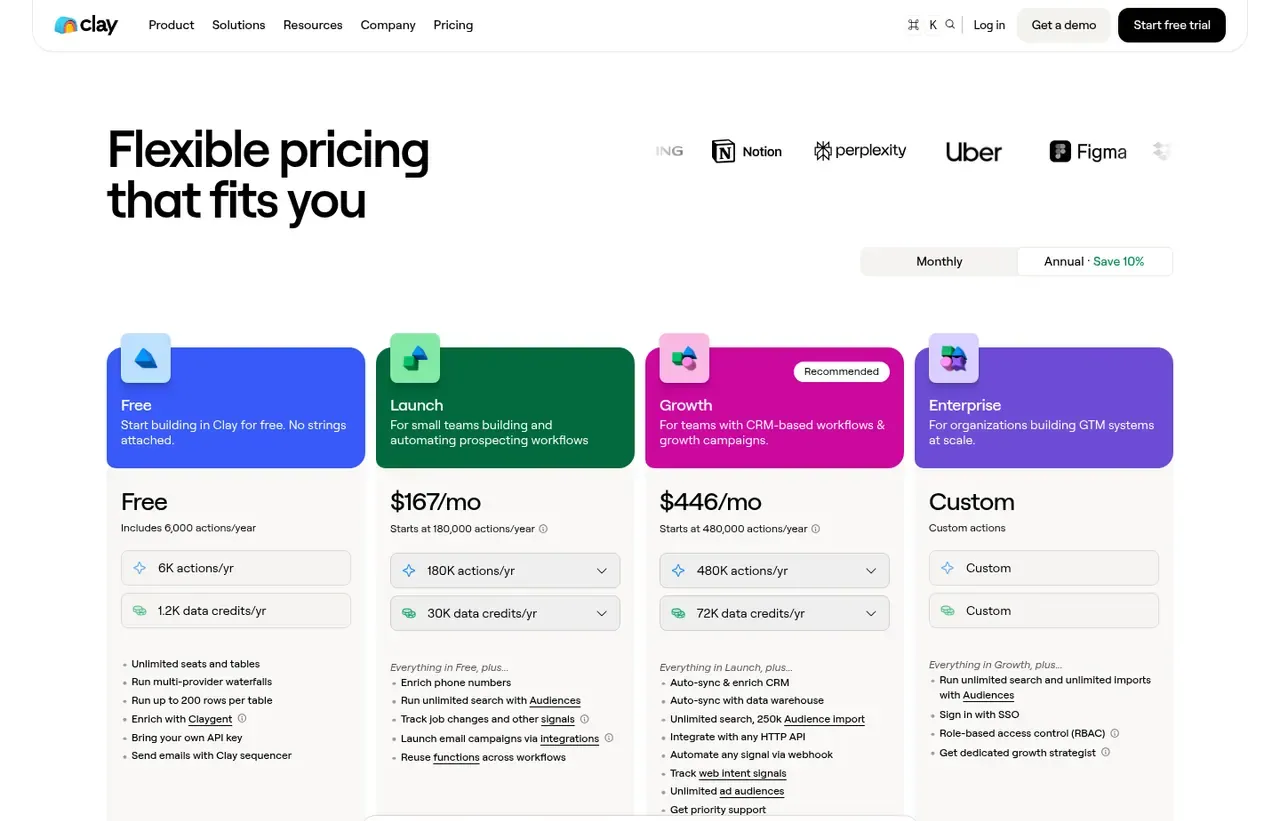
Prices below were read from the vendor's own pricing page on 9 August 2026. Pricing model: usage based. Free trial: 14 days.
| Plan | Price | Billing | Notes |
|---|---|---|---|
| Free | $0 | per month | 100 data credits/month, 1.2K a year. Unlimited seats and tables |
| Launch | $167 | per month | 30K data credits per year at the entry credit tier |
| Growth | $446 | per month | 72K data credits per year at the entry credit tier |
| Enterprise | Contact sales | Negotiated | Custom credit volumes, security review and support |
What Clay actually costs over a year
A monthly price is not the same thing as a monthly contract. These are the plans above multiplied out to twelve months, per seat or unit where the plan is charged that way.
| Plan | Monthly | Over 12 months |
|---|---|---|
| Launch | $167 | $2004 |
| Growth | $446 | $5352 |
Which Clay plan should you buy?
| Your situation | Recommended | Why |
|---|---|---|
| You want to learn whether waterfall enrichment helps you | Free | 100 credits a month with unlimited seats. Enough to test on a small list. |
| You have a defined outbound motion and modest volume | Launch | $167 a month for 30K credits a year at the entry credit tier. |
| You enrich at scale across several signals | Growth | $446 a month for 72K credits a year, again at the entry tier. |
| Your volume is high | Set the credit selector before comparing | Every published price is the smallest credit tier. "Clay starts at $167" is true and nearly meaningless without your own volume. |
| You just need a searchable contact database | Consider Apollo.io instead | Cheaper, simpler, and sufficient if generic lists work for your market. |
Verdict by who you are
Outbound team with specific targetingYes
Waterfall enrichment achieves coverage no single vendor matches, and coverage is what outbound economics turn on.
Growth engineer or RevOpsYes
Unlimited seats plus credits means the whole team can build without per-user cost.
Founder doing first outbound experimentsCompare first
Powerful but demanding. Without a defined motion it becomes an expensive way to research people you never contact.
Team wanting predictable monthly costsNo
Credits burn on failed lookups as well as successful ones, so spend follows how well your tables are built.
Anyone needing a simple contact searchNo
Apollo does this for far less. Clay's depth would be unused.
Should you buy Clay?
Buy Clay if…
- Outbound teams building highly targeted prospect lists
- Research that needs many data sources tried in sequence
- Signal-based prospecting on hiring, funding or tech changes
Do not buy Clay if…
- Teams wanting a simple contact database to search
- Anyone without a defined outbound motion
- Buyers who need predictable monthly costs
Key features
- Waterfall enrichment across dozens of providers in sequence
- Unlimited seats and tables on every plan, including free
- AI research agent that reads sources to answer a question
- Signal triggers on hiring, funding and technology changes
- Spreadsheet interface with formulas and columns as steps
- Lookalike company and contact discovery
- Email finding and verification chained across vendors
- Writes enriched records back into your CRM
Integrations
- HubSpot and Salesforce
- Apollo, Clearbit and dozens of data providers
- Outreach, Salesloft and Smartlead
- Slack
- Clay API and webhooks
Clay screenshots
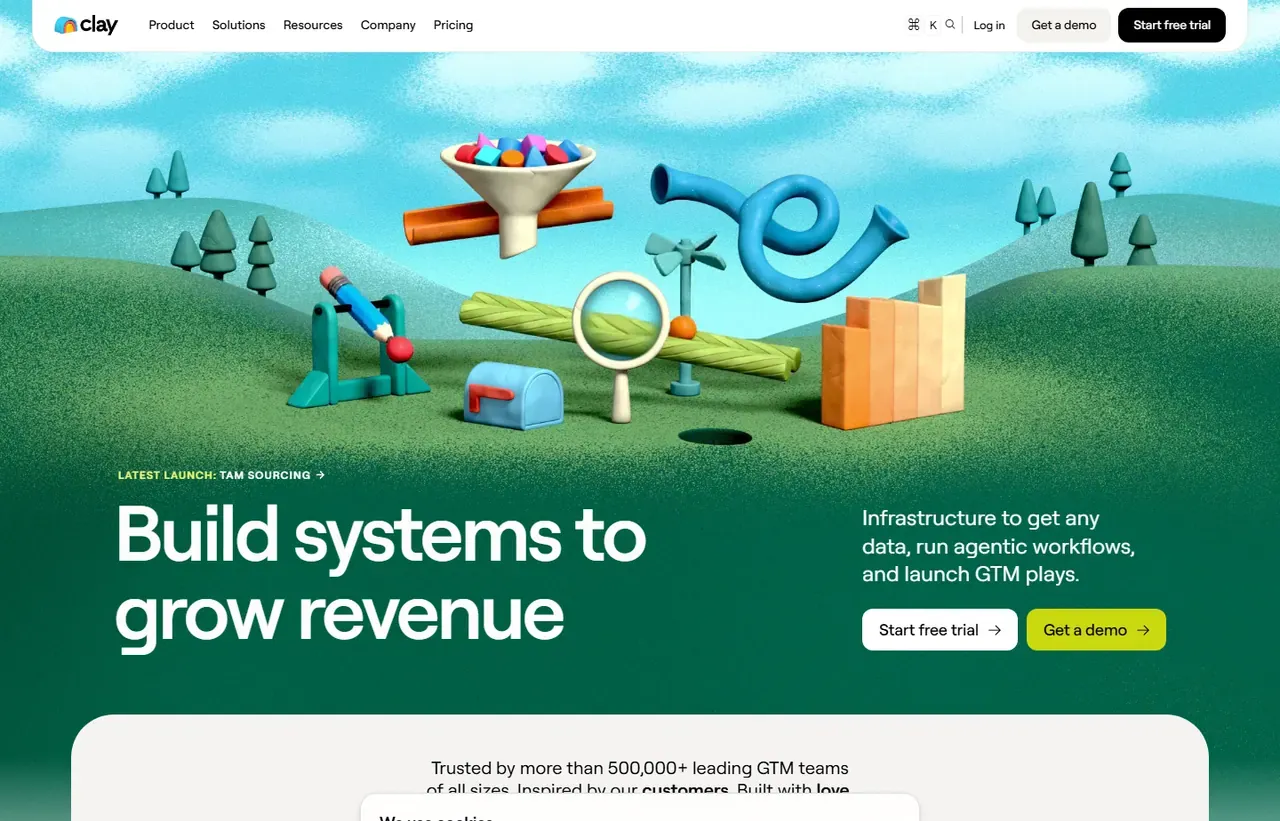
Captured by us in August 2026 at 1440px, unedited. Interfaces change, so these show the product as it looked on the date we verified this profile. Pricing pages are captured from a US vantage point, so the currency shown matches the USD figures recorded above.
Our assessment
Clay is the most powerful prospecting tool available and the easiest to waste money on. Waterfall enrichment is the genuine innovation: rather than accepting one provider's blank field, Clay tries provider after provider until something returns a value, which produces materially better coverage than any single vendor. Charging for credits instead of seats is also correct, since it lets a whole team use it while costs follow actual research. The risk is that credits are consumed by every attempted step, including the ones that fail and the AI columns that run on every row, so an inefficient table burns budget producing nothing. Clay rewards teams with a defined outbound motion and punishes experimentation without one.
What works in Clay
- Waterfall enrichment finds data single providers miss
- Unlimited seats and tables on every plan, including free
- AI research agent answers questions no database contains
- Signal triggers surface timing, not just contacts
What doesn't
- Credits are consumed by failed lookups as well as successful ones
- Prices scale with credit volume, so headline figures are entry rates
- Steep learning curve before it produces value
- Easy to spend heavily on badly designed tables
EveryAny Decision Score
Scored by dimension rather than averaged into one number, because the trade-offs are the useful part. 3 of these 8 dimensions are calculated from verified facts by published formula; the rest are editorial judgement, labelled as such. How each score is calculated.
- Cost position0/10
derivedentry tier at $100 a month against a category median of $25 across 7 comparable tools
- Portability5/10
derivedpublic API
- Subscription flexibility8/10
derivedfree plan, free trial, usage based, monthly billing
- Feature depth9/10
editorialeditorial judgement, reviewed at last check
- Ease of learning4/10
editorialeditorial judgement, reviewed at last check
- Collaboration8/10
editorialeditorial judgement, reviewed at last check
- AI capability9/10
editorialeditorial judgement, reviewed at last check
- Professional adoption7/10
editorialeditorial judgement, reviewed at last check
What leaving Clay would cost
moderate lock-in
Calculated as 10 minus a portability score of 5, built from four signals (self-hosting, a public API, open-source licensing and a documented export path) . Clay scores on: public API. Formula.
Clay competitors and alternatives
| Alternative | Why you might pick it instead |
|---|---|
| Apollo.io | Cheaper and simpler if you just need a contact database to search. |
| Instantly | Focused on sending at volume rather than research depth. |
| LinkedIn Sales Navigator | The primary source Clay often enriches against anyway. |

Credits, not seats, and that cuts both ways
Clay gives every plan unlimited seats and unlimited tables, including the free one. You are billed for data credits, consumed when a row runs through an enrichment or research step.
| Plan | Price | Credits |
|---|---|---|
| Free | $0 | 100/month, 1.2K/year |
| Launch | $167/month | 30K/year |
| Growth | $446/month | 72K/year |
| Enterprise | Quote | Custom |
Those prices are the entry point of a credit selector that runs much higher, so “Clay starts at $167” is true only at the smallest paid volume. Set the credit level to your expected usage before comparing.
The upside of this model is real: a ten-person sales team costs the same as one person. The downside is that cost becomes a function of how carefully your tables are built, which is a skill your team may not have yet.
Credits burn on failure too
This is the thing to understand before committing. A waterfall that tries eight providers to find an email consumes credits at each attempt, whether or not it finds one. An AI research column runs on every row you point it at, including the 400 rows that were never good fits.
So a poorly targeted list of 5,000 companies with four enrichment columns can consume a month’s credits and return mostly blanks. The discipline that makes Clay cheap is filtering hard before enriching, not after.
Teams new to it should start with small batches and check credit consumption per useful record, not per row.
Waterfall enrichment is the actual innovation
Every data vendor has gaps. Ask Apollo for a mobile number and sometimes it has one. Clay’s answer is to ask Apollo, then a second provider, then a third, stopping at the first success.
The result is coverage no single vendor achieves, which matters because outbound is a coverage problem: a list where you can reach 70% of targets is worth far more than one where you can reach 40%. That is the argument for Clay over Apollo.io alone, and it is a good one.
When to buy Apollo instead
If what you need is a searchable database of contacts with reasonable data and a sequencing tool attached, Apollo is cheaper, simpler and sufficient. Clay is for teams whose targeting is specific enough that generic lists do not work, and who have someone willing to learn to build tables properly.
Without a defined outbound motion, Clay becomes an expensive way to research prospects you were never going to contact.
Clay questions, answered
- Is Clay worth it?
- Clay is the most powerful prospecting tool available and the easiest to waste money on.
- How much does Clay cost?
- Free with 100 data credits/month; Launch $167/month. The cheapest paid tier we recorded works out at $100 a month, or $1200 over a year. Verified against the vendor's pricing page.
- Does Clay have a free plan or free trial?
- Clay has a free plan. A free trial is available: 14 days.
- What is the best Clay alternative?
- It depends on the job. Apollo.io: Cheaper and simpler if you just need a contact database to search. Instantly: Focused on sending at volume rather than research depth. LinkedIn Sales Navigator: The primary source Clay often enriches against anyway.
- Can I self-host Clay?
- No. Clay is a hosted service only, so your data lives on the vendor's infrastructure.
Provenance and freshness
When each fact was last checked
- Pricing ·
- Plans ·
- Free trial
- Features
- Platforms
- Integrations
- Affiliate programme
- Company details
What has changed
-
August 2026
- Credit tiers verified at the entry band for Launch and Growth
- Added plan picker and verdicts
Sources & verification
Facts on this page were read from the sources below on the dates shown. Where a vendor does not publish a figure, we record it as not disclosed rather than estimating it.
- Clay pricing - checked 9 August 2026
Spotted something out of date? Email [email protected] and we will re-check it. Corrections are logged on the page.


