

GitHub
Where most of the world's code, and most of its collaboration, actually lives.
- Development
- AI
- Productivity
- from $4/mo
GitHub hosts Git repositories with pull requests, issues, CI/CD through Actions, package registries and security scanning. Owned by Microsoft since 2018, it is less a tool than the default social and operational layer of software development, which is why its network effects matter more than its feature list.
GitHub: the short answer
Every line below is drawn from facts verified on 9 August 2026.
- What it is
- Where most of the world's code, and most of its collaboration, actually lives
- Best for
- Almost any team writing software collaboratively
- Starts at
- Free for unlimited public and private repositories; Team $4 per user/month
- Free option
- Free plan available, 30 days on Enterprise trial
- Biggest strength
- Universal adoption, so integration and onboarding cost is near zero
- Biggest drawback
- Actions minutes and storage are metered and easy to overspend
- Closest alternative
- GitLab - A more complete built-in DevOps pipeline, and self-hostable at every tier
- True annual cost
- from $48 a year at the cheapest paid tier
GitHub at a glance
| Best for | Almost any team writing software collaboratively, Open-source projects and public developer presence, Teams wanting CI/CD without running their own runners |
|---|---|
| Category | Development, AI, Productivity |
| Starting price | Free for unlimited public and private repositories; Team $4 per user/month |
| Free plan | Yes |
| Free trial | 30 days on Enterprise |
| Pricing model | freemium |
| Company | GitHub, Inc. (Microsoft Corporation) |
| Founded | 2008 |
| Headquarters | San Francisco, California, United States |
| Founders | Tom Preston-Werner, Chris Wanstrath, PJ Hyett, Scott Chacon |
| Platforms | Web, Windows, macOS, Linux, iOS, Android, CLI |
| Public API | Yes |
| Browser extension | No |
| Mobile apps | iOS + Android |
| Self-hosting | Yes |
| Affiliate programme | No |
| Data source | Vendor pricing page and public records |
| Last checked | August 2026 |
GitHub pricing
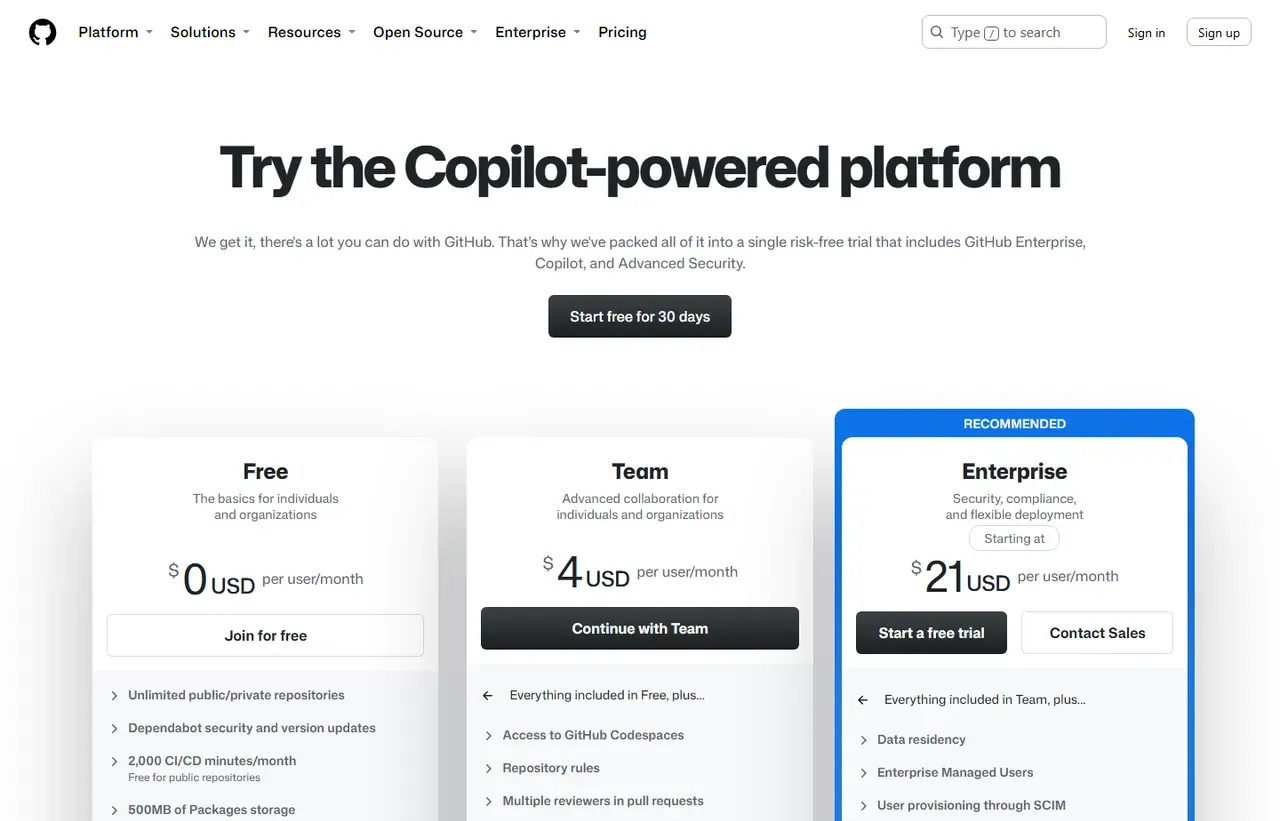
Prices below were read from the vendor's own pricing page on 9 August 2026. Pricing model: freemium. Free trial: 30 days on Enterprise.
| Plan | Price | Billing | Notes |
|---|---|---|---|
| Free | $0 | per month | per user - Unlimited public and private repos, 2,000 Actions minutes per month |
| Team | $4 | per month | per user - Protected branches, code owners, 3,000 Actions minutes per month |
| Enterprise | $21 | per month | per user - SAML SSO, audit log, GitHub Advanced Security available |
| Actions overage | $0.008 per minute | per usage | Standard Linux runners; other runner types cost more |
| Storage overage | $0.25 per GB | per usage | Packages and Actions artifacts beyond the included allowance |
What GitHub actually costs over a year
A monthly price is not the same thing as a monthly contract. These are the plans above multiplied out to twelve months, per seat or unit where the plan is charged that way.
| Plan | Monthly | Over 12 months |
|---|---|---|
| Teamper user | $4 | $48 |
| Enterpriseper user | $21 | $252 |
Which GitHub plan should you buy?
| Your situation | Recommended | Why |
|---|---|---|
| You are an individual or small team, public or private | Free | Unlimited public and private repositories with unlimited collaborators and 2,000 Actions minutes. The most generous free tier in this category. |
| You need protected branches and code owners | Team | $4 per user a month. Cheap, and the usual reason to leave Free is review enforcement. |
| You need SAML SSO and audit logs | Enterprise | $21 per user. A large step, driven by identity and compliance requirements. |
| Your CI runs constantly | Watch Actions minutes | Overage is $0.008 per minute on standard Linux runners and more on others. This is where GitHub bills grow unnoticed. |
| You must self-host for compliance | Consider GitLab instead | GitLab can be self-hosted at every tier; GitHub's equivalent is enterprise-only. |
Verdict by who you are
Almost any software teamYes
The default for a reason. Unlimited private repos with unlimited collaborators free, and every tool you might add integrates with it first.
Open-source maintainerYes
This is where contributors are. Nothing else is close for public projects.
Regulated organisation needing on-premiseCompare first
Possible only at enterprise level. GitLab is the more natural fit for self-hosting.
Team wanting predictable CI costsCompare first
Actions is excellent and metered. Without someone watching minutes, the bill surprises people.
Team wanting integrated project managementCompare first
Projects has improved but is not a substitute for Jira or Linear.
Should you buy GitHub?
Buy GitHub if…
- Almost any team writing software collaboratively
- Open-source projects and public developer presence
- Teams wanting CI/CD without running their own runners
Do not buy GitHub if…
- Organisations requiring on-premise hosting on lower tiers
- Teams wanting integrated project management as the primary tool
- Anyone who needs predictable CI costs without monitoring usage
Key features
- Git hosting with pull requests and code review
- GitHub Actions for CI/CD in the same repository
- Issues and Projects for lightweight planning
- Dependabot alerts and automated dependency updates
- Code scanning and secret scanning
- Codespaces cloud development environments
- Packages registry for containers and language packages
- GitHub Copilot AI code completion and chat, sold separately
Integrations
- Slack and Microsoft Teams
- Jira and Linear
- Vercel, Netlify and most deployment platforms
- Datadog and Sentry
- GitHub REST and GraphQL APIs
- Thousands of Actions in the marketplace
GitHub screenshots
Captured by us in August 2026 at 1440px, unedited. Interfaces change, so these show the product as it looked on the date we verified this profile. Vendors localise pricing by visitor region, so a pricing screenshot may display a different currency to the USD figures recorded above.

Our assessment
GitHub's real product is the network. Contributors already have accounts, tooling already integrates, and hiring assumes familiarity, so choosing anything else imposes a cost that has nothing to do with features. On merit it is also strong: pull requests remain the best code-review experience, and Actions removed the need to run build infrastructure for most teams. The pricing needs attention rather than the licence: Team at $4 per user is cheap, but Actions minutes and storage are metered, and a chatty CI pipeline can generate a bill that dwarfs the seats.
What works in GitHub
- Universal adoption, so integration and onboarding cost is near zero
- Pull requests and code review remain best in class
- Actions provides capable CI/CD without separate infrastructure
- Free tier is genuinely generous, including unlimited private repositories
What doesn't
- Actions minutes and storage are metered and easy to overspend
- Projects is weaker than dedicated planning tools
- Advanced Security is a significant extra cost on top of Enterprise
- Self-hosting is Enterprise Server only, not available lower down
EveryAny Decision Score
Scored by dimension rather than averaged into one number, because the trade-offs are the useful part. 3 of these 8 dimensions are calculated from verified facts by published formula; the rest are editorial judgement, labelled as such. How each score is calculated.
- Cost position7.9/10
derivedentry tier at $4 a month against a category median of $15 across 14 comparable tools
- Portability8/10
derivedself-hostable, public API
- Subscription flexibility9/10
derivedfree plan, free trial, freemium, monthly billing
- Feature depth9/10
editorialeditorial judgement, reviewed at last check
- Ease of learning8/10
editorialeditorial judgement, reviewed at last check
- Collaboration10/10
editorialeditorial judgement, reviewed at last check
- AI capability8/10
editorialeditorial judgement, reviewed at last check
- Professional adoption10/10
editorialeditorial judgement, reviewed at last check
What leaving GitHub would cost
low lock-in
Calculated as 10 minus a portability score of 8, built from four signals (self-hosting, a public API, open-source licensing and a documented export path) . GitHub scores on: self-hostable, public API. Formula.
GitHub competitors and alternatives
| Alternative | Why you might pick it instead |
|---|---|
| GitLab | A more complete built-in DevOps pipeline, and self-hostable at every tier. |
| Bitbucket | The natural choice if your organisation already lives in Atlassian tools. |
| Gitea or Forgejo | Lightweight self-hosted Git when you want to own the whole thing. |

The free tier is the story
Unlimited private repositories with unlimited collaborators, plus 2,000 Actions minutes a month, at no cost. For most small teams that is the whole product. The paid tiers exist for organisations that need enforcement: protected branches, required reviewers, code owners and, at Enterprise, SSO and audit logs.
Where the bill actually comes from
Seats are cheap. Compute is not. Actions bills per minute beyond the included allowance, and rates differ sharply by runner: Linux is the cheapest, Windows costs more, macOS considerably more again. A test matrix that fans out across operating systems on every push can cost more per month than the entire team’s licences. Set spending limits before you need them, not after.
GitHub or GitLab?
Choose GitHub when collaboration and ecosystem matter most, which is nearly always for teams that work with outside contributors or hire regularly. Choose GitLab when you want a complete DevOps pipeline in one product, or when self-hosting is a requirement rather than a preference. The gap on core Git workflow is small; the gap on network effects is not.
Copilot is a separate purchase
GitHub Copilot is licensed on its own, not bundled into Team or Enterprise. If AI assistance is part of the reason you are evaluating GitHub, price it as an additional per-seat cost rather than assuming the platform tier includes it.
GitHub questions, answered
- Is GitHub worth it?
- GitHub's real product is the network. Contributors already have accounts, tooling already integrates, and hiring assumes familiarity, so choosing anything else imposes a cost that has nothing to do with features.
- How much does GitHub cost?
- Free for unlimited public and private repositories; Team $4 per user/month. The cheapest paid tier we recorded works out at $4 a month, or $48 over a year. Verified against the vendor's pricing page.
- Does GitHub have a free plan or free trial?
- GitHub has a free plan. A free trial is available: 30 days on Enterprise.
- What is the best GitHub alternative?
- It depends on the job. GitLab: A more complete built-in DevOps pipeline, and self-hostable at every tier. Bitbucket: The natural choice if your organisation already lives in Atlassian tools. Gitea or Forgejo: Lightweight self-hosted Git when you want to own the whole thing.
- Can I self-host GitHub?
- Yes. GitHub can be run on your own infrastructure, so the data stays under your control.
Provenance and freshness
When each fact was last checked
- Pricing ·
- Plans ·
- Free trial
- Features
- Platforms
- Integrations
- Affiliate programme
- Company details
What has changed
-
August 2026
- Per-user pricing and Actions overage rates verified
- Added plan picker and verdicts
Sources & verification
Facts on this page were read from the sources below on the dates shown. Where a vendor does not publish a figure, we record it as not disclosed rather than estimating it.
- GitHub pricing - checked 9 August 2026
Spotted something out of date? Email [email protected] and we will re-check it. Corrections are logged on the page.


