

Tableau is a business intelligence platform for connecting to data, exploring it visually and publishing interactive dashboards. Owned by Salesforce since 2019, it remains the strongest tool for open-ended visual analysis, where the question changes as you look at the data rather than being fixed in advance.
Tableau: the short answer
Every line below is drawn from facts verified on 9 August 2026.
- What it is
- Visual analysis for people who explore data rather than report it
- Best for
- Analysts doing exploratory visual analysis
- Starts at
- Tableau Standard starting at $15 per user/month, annual contract required
- Free option
- No free plan, 14 days trial
- Biggest strength
- Best visual exploration and analysis experience in the category
- Biggest drawback
- Materially more expensive than Power BI for comparable use
- Closest alternative
- Microsoft Power BI - Much cheaper and better integrated if you run Microsoft 365
- True annual cost
- from $180 a year at the cheapest paid tier
Tableau at a glance
| Best for | Analysts doing exploratory visual analysis, Organisations already running Salesforce, Teams where dashboard quality is scrutinised |
|---|---|
| Category | Analytics, Sales |
| Starting price | Tableau Standard starting at $15 per user/month, annual contract required |
| Free plan | No |
| Free trial | 14 days |
| Pricing model | subscription |
| Company | Tableau Software (Salesforce, Inc.) |
| Founded | 2003 |
| Headquarters | Seattle, Washington, United States |
| Founders | Christian Chabot, Pat Hanrahan, Chris Stolte |
| Platforms | Web, Windows, macOS, iOS, Android |
| Public API | Yes |
| Browser extension | No |
| Mobile apps | iOS + Android |
| Self-hosting | Yes |
| Affiliate programme | No |
| Data source | Vendor pricing page and public records |
| Last checked | August 2026 |
Tableau pricing
Prices below were read from the vendor's own pricing page on 9 August 2026. Pricing model: subscription. Free trial: 14 days.
| Plan | Price | Billing | Notes |
|---|---|---|---|
| Tableau Standard | $15 | per month | per user, billed annually - Tableau Cloud. Explore and understand data |
| Tableau Enterprise | $35 | per month | per user, billed annually - Adds governance, security and scale features |
| Tableau Cloud+ | Contact sales | Negotiated | Adds Tableau Agent, Tableau Pulse and Premier Success, 50 sites |
| Tableau+ Bundle | Contact sales | Negotiated | Marked Recommended. Combines Tableau Cloud+ with Tableau Next |
| Licence types | Varies | per month | Creator, Explorer and Viewer seats priced differently within a deployment |
What Tableau actually costs over a year
A monthly price is not the same thing as a monthly contract. These are the plans above multiplied out to twelve months, per seat or unit where the plan is charged that way.
| Plan | Monthly | Over 12 months |
|---|---|---|
| Tableau Standardper user, billed annually | $15 | $180 |
| Tableau Enterpriseper user, billed annually | $35 | $420 |
Which Tableau plan should you buy?
| Your situation | Recommended | Why |
|---|---|---|
| You want to explore and understand data visually | Tableau Standard | Starting at $15 per user a month, annual contract required. |
| You need governance, security and scale | Tableau Enterprise | Starting at $35 per user a month, annual contract required. |
| You want Tableau Agent and Pulse | Tableau Cloud+ | Quote only, and where the agentic analytics features live. |
| You are quoting a deployment | Ask for edition and licence type separately | Every deployment needs at least one Creator licence, and Creator, Explorer and Viewer seats are priced differently underneath the edition. The two multiply. |
| You already pay for Microsoft 365 | Consider Power BI instead | $14 a seat, stronger modelling, and bundled into an estate you own. |
| You need a few basic dashboards | Consider Metabase instead | Free self-hosted, and non-analysts will actually use it. |
Verdict by who you are
Analyst doing exploratory researchYes
Still the best tool for moving through data when you do not yet know the question. Nothing matches the fluidity.
Salesforce organisationYes
The integration is genuine, and Tableau is increasingly the analytics layer for Salesforce data.
Microsoft-estate reporting teamNo
Power BI is cheaper, better at modelling, and already licensed.
Small team needing simple dashboardsNo
The annual contract and licence structure are disproportionate to the need.
Buyer wanting a simple quoteCompare first
Published prices are "starting at", the upper tiers are quote-only, and an annual contract is mandatory.
Should you buy Tableau?
Buy Tableau if…
- Analysts doing exploratory visual analysis
- Organisations already running Salesforce
- Teams where dashboard quality is scrutinised
Do not buy Tableau if…
- Small teams needing a few basic dashboards
- Organisations already paying for Power BI through Microsoft 365
- Buyers wanting simple, single-tier pricing
Key features
- Drag-and-drop visual analysis with instant feedback
- Very wide connector library across databases and SaaS
- Calculated fields, level-of-detail expressions and table calculations
- Interactive dashboards with actions and parameters
- Tableau Prep for data cleaning and shaping
- Tableau Pulse for metric monitoring and digests
- Tableau Agent for AI-assisted preparation and visualisation
- Tableau Server or Cloud deployment options
Integrations
- Salesforce and Slack
- Snowflake, BigQuery, Redshift and most warehouses
- Excel and Google Sheets
- R and Python for advanced analytics
- Tableau REST and Metadata APIs
Tableau screenshots
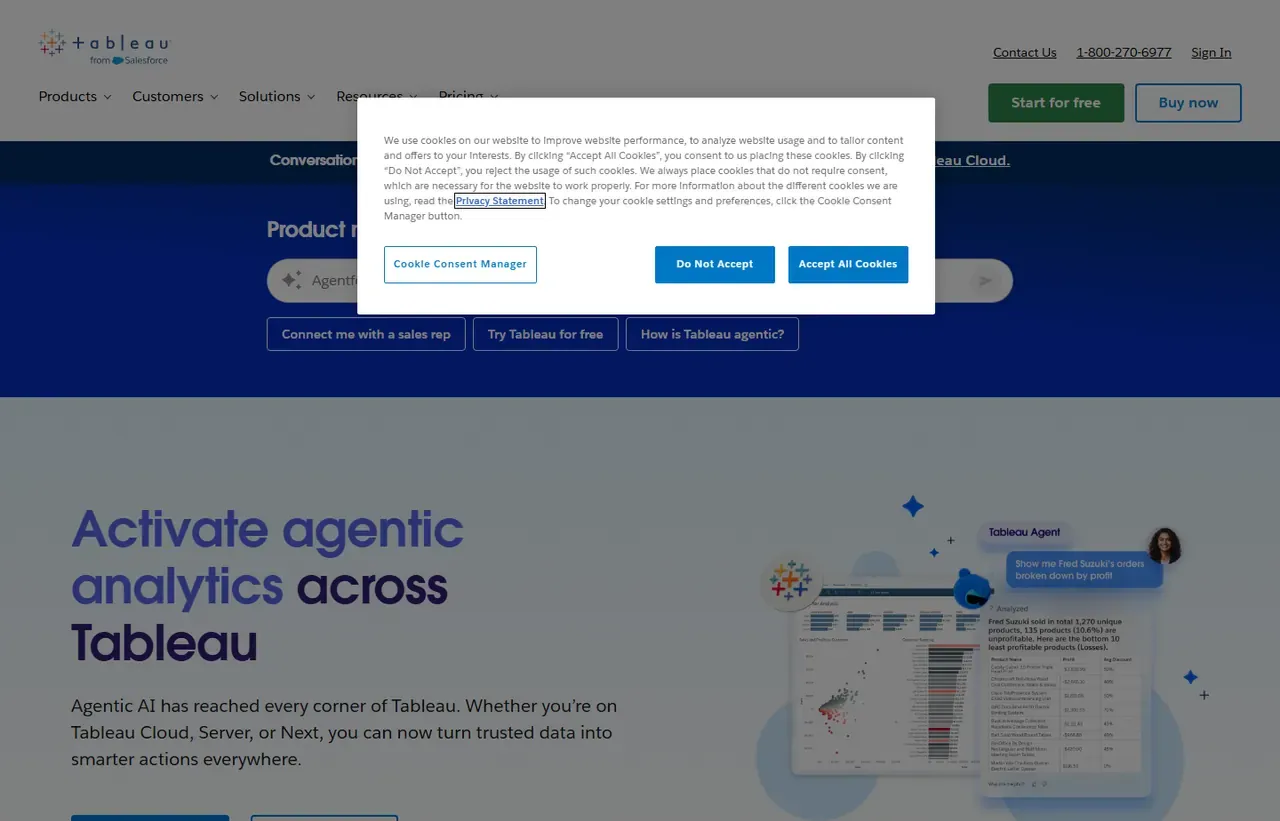
Captured by us in August 2026 at 1440px, unedited. Interfaces change, so these show the product as it looked on the date we verified this profile. Vendors localise pricing by visitor region, so a pricing screenshot may display a different currency to the USD figures recorded above.

Our assessment
Tableau is still the best tool for genuine visual exploration. Where Power BI excels at modelled, governed reporting, Tableau excels at the moment an analyst does not yet know the question and needs to move through the data quickly, and the fluidity of that experience is not matched. Two things have changed the calculus. Power BI undercut it dramatically on price and arrives bundled with Microsoft, and Tableau's own structure has been reorganised into Standard, Enterprise and Cloud+ with Creator, Explorer and Viewer licence types underneath, which makes a quote harder to model than it used to be.
What works in Tableau
- Best visual exploration and analysis experience in the category
- Very wide connector coverage across databases and warehouses
- Dashboards hold up under executive scrutiny
- Server and Cloud deployment, including self-hosting
What doesn't
- Materially more expensive than Power BI for comparable use
- Licence types layered under editions make quotes hard to model
- Weaker semantic modelling than Power BI or Looker
- Every deployment requires at least one Creator licence
- Annual contract required, with no monthly option
- Published prices are "starting at"; the upper tiers are quote-only
EveryAny Decision Score
Scored by dimension rather than averaged into one number, because the trade-offs are the useful part. 3 of these 8 dimensions are calculated from verified facts by published formula; the rest are editorial judgement, labelled as such. How each score is calculated.
- Cost position3.3/10
derivedentry tier at $15 a month against a category median of $15 across 3 comparable tools
- Portability8/10
derivedself-hostable, public API
- Subscription flexibility6/10
derivedfree trial, subscription, monthly billing
- Feature depth10/10
editorialeditorial judgement, reviewed at last check
- Ease of learning5/10
editorialeditorial judgement, reviewed at last check
- Collaboration7/10
editorialeditorial judgement, reviewed at last check
- AI capability7/10
editorialeditorial judgement, reviewed at last check
- Professional adoption10/10
editorialeditorial judgement, reviewed at last check
What leaving Tableau would cost
low lock-in
Calculated as 10 minus a portability score of 8, built from four signals (self-hosting, a public API, open-source licensing and a documented export path) . Tableau scores on: self-hostable, public API. Formula.
Tableau competitors and alternatives
| Alternative | Why you might pick it instead |
|---|---|
| Microsoft Power BI | Much cheaper and better integrated if you run Microsoft 365. |
| Looker | Stronger governed semantic modelling, and a Google Cloud commitment. |
| Metabase | Open source, self-hostable and far simpler for basic reporting. |

The structure changed, so re-read the quote
Tableau Cloud is now sold as Standard at $15 per user per month, Enterprise at $35, and Cloud+ on request, all billed annually. Underneath those editions sit the familiar licence types, and this is where cost accumulates: every deployment requires at least one Creator licence, with Creator, Explorer and Viewer seats priced differently for everyone else.
If you last priced Tableau against the old Creator, Explorer and Viewer ladder, that is no longer how the page presents it. Ask for the quote broken down by edition and by licence type, because the two multiply.
Three further terms are set out in the page’s own footnote and are easy to miss: the solution requires an annual contract, billed annually; the advertised $15 and $35 are “starting at” figures; and there is a fourth option above Cloud+, the Tableau+ Bundle, which adds Tableau Next and is the tier Tableau marks as recommended. Both Cloud+ and the bundle are quote-only, so the published prices describe the bottom of the range rather than what a governed deployment costs.
Where it beats Power BI
Exploration. An analyst who does not yet know what they are looking for can move through a Tableau workbook faster than any competitor, changing dimensions and marks without breaking flow. That matters enormously for research and analysis, and hardly at all for a monthly operations dashboard.
Where Power BI wins
Price and distribution. Power BI Pro is $14 per user per month, arrives with a Microsoft estate most organisations already own, and has stronger semantic modelling through DAX. For governed reporting on data that lives in Azure or Excel, it is the rational choice and Tableau has to argue against a bundled incumbent.
The Salesforce factor
Since the acquisition, Tableau is increasingly positioned as the analytics layer for Salesforce data, with Agentforce and Tableau Agent extending that. If your organisation runs Salesforce, that integration is genuine and worth weighing. If it does not, you are buying a general BI tool from a CRM company, which is a fair thing to be slightly cautious about.
Tableau questions, answered
- Is Tableau worth it?
- Tableau is still the best tool for genuine visual exploration.
- How much does Tableau cost?
- Tableau Standard starting at $15 per user/month, annual contract required. The cheapest paid tier we recorded works out at $15 a month, or $180 over a year. Verified against the vendor's pricing page.
- Does Tableau have a free plan or free trial?
- Tableau has no free plan. A free trial is available: 14 days.
- What is the best Tableau alternative?
- It depends on the job. Microsoft Power BI: Much cheaper and better integrated if you run Microsoft 365. Looker: Stronger governed semantic modelling, and a Google Cloud commitment. Metabase: Open source, self-hostable and far simpler for basic reporting.
- Can I self-host Tableau?
- Yes. Tableau can be run on your own infrastructure, so the data stays under your control.
Provenance and freshness
When each fact was last checked
- Pricing ·
- Plans ·
- Free trial
- Features
- Platforms
- Integrations
- Affiliate programme
- Company details
What has changed
-
August 2026
- Recorded the restructure into Standard, Enterprise and Cloud+ with licence types beneath
- Verified the annual contract requirement and the quote-only Tableau+ Bundle
- Added plan picker and verdicts
Sources & verification
Facts on this page were read from the sources below on the dates shown. Where a vendor does not publish a figure, we record it as not disclosed rather than estimating it.
- Tableau pricing for teams and organisations - checked 9 August 2026
Spotted something out of date? Email [email protected] and we will re-check it. Corrections are logged on the page.


