

Slack
Channel-based messaging that replaced internal email at a lot of companies.
- Productivity
- Development
- AI
- from $7.25/mo
Slack is a workplace messaging platform organised around channels rather than inboxes, with a large app directory, workflow automation and searchable history. Owned by Salesforce since 2021, it remains the tool most teams prefer when the choice is theirs rather than their IT department's.
Slack: the short answer
Every line below is drawn from facts verified on 9 August 2026.
- What it is
- Channel-based messaging that replaced internal email at a lot of companies
- Best for
- Teams that want fast, well-organised internal communication
- Starts at
- Free tier available; Pro from $7.25 per user/month billed annually
- Free option
- Free plan available, no trial
- Biggest strength
- Fastest, best-organised chat client in the category
- Biggest drawback
- A second line item for organisations that already own Teams
- Closest alternative
- Microsoft Teams - Usually already paid for, and includes real telephony
- True annual cost
- from $105 a year at the cheapest paid tier
Slack at a glance
| Best for | Teams that want fast, well-organised internal communication, Engineering and product organisations with heavy tool integration, Working with external partners through shared channels |
|---|---|
| Category | Productivity, Development, AI |
| Starting price | Free tier available; Pro from $7.25 per user/month billed annually |
| Free plan | Yes |
| Free trial | No trial offered |
| Pricing model | freemium |
| Company | Slack Technologies (Salesforce, Inc.) |
| Founded | 2009 |
| Headquarters | San Francisco, California, United States |
| Founders | Stewart Butterfield, Cal Henderson, Eric Costello, Serguei Mourachov |
| Platforms | Web, Windows, macOS, Linux, iOS, Android |
| Public API | Yes |
| Browser extension | No |
| Mobile apps | iOS + Android |
| Self-hosting | No |
| Affiliate programme | No |
| Data source | Vendor pricing page and public records |
| Last checked | August 2026 |
Slack pricing
Prices below were read from the vendor's own pricing page on 9 August 2026. Pricing model: freemium. No free trial is offered.
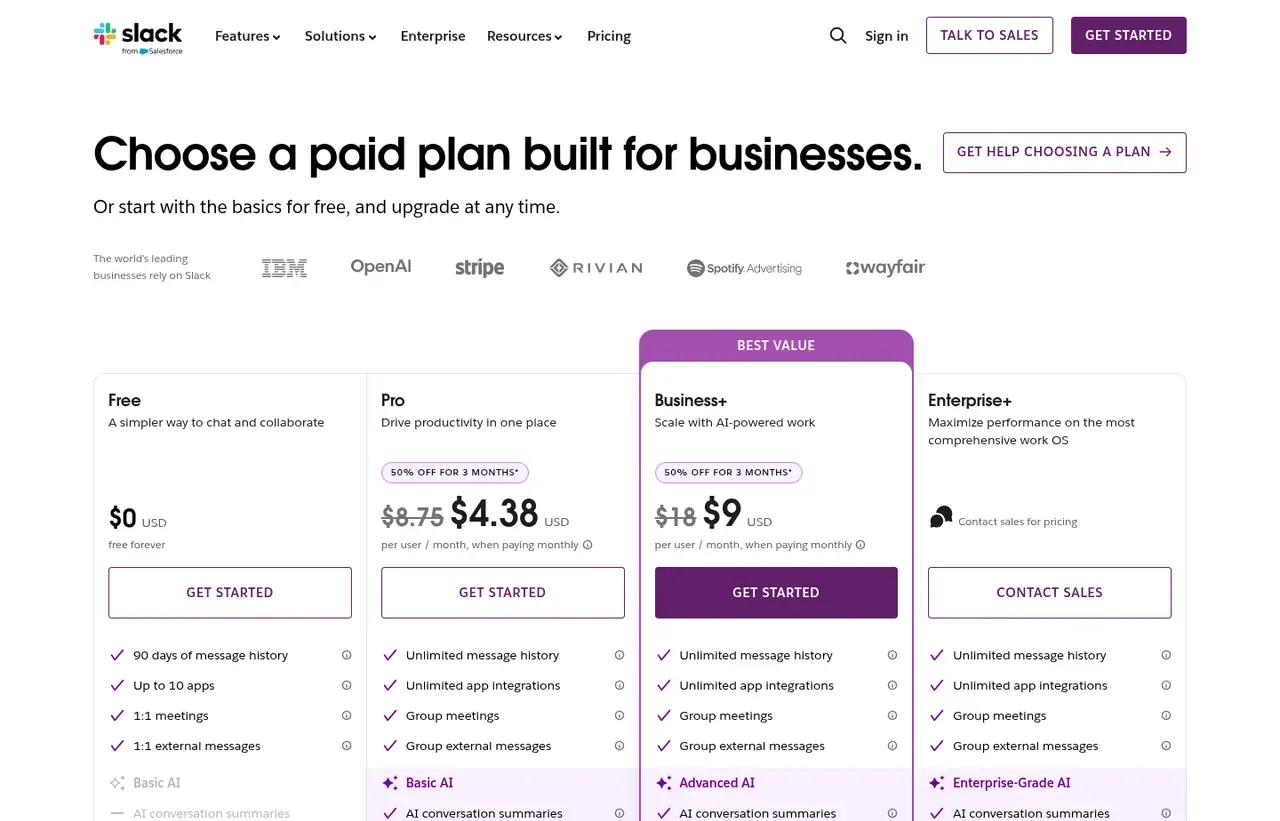
| Plan | Price | Billing | Notes |
|---|---|---|---|
| Free | $0 | per month | 90 days of message history, 10 app integrations |
| Pro | $8.75 | per month | per user, paying monthly - $7.25 per user/month billed annually. Full history and unlimited apps |
| Business+ | $18 | per month | per user, paying monthly - $15 per user/month billed annually. Adds SAML SSO and compliance exports |
| Enterprise Grid | Custom | Negotiated | Multiple workspaces, advanced compliance and HIPAA support |
What Slack actually costs over a year
A monthly price is not the same thing as a monthly contract. These are the plans above multiplied out to twelve months, per seat or unit where the plan is charged that way.
| Plan | Monthly | Over 12 months |
|---|---|---|
| Proper user, paying monthly | $8.75 | $105 |
| Business+per user, paying monthly | $18 | $216 |
Which Slack plan should you buy?
| Your situation | Recommended | Why |
|---|---|---|
| A small team wanting to try it | Free | Works well, but only the last 90 days of messages are searchable, which is the real constraint. |
| You need your message history to be permanent | Pro | $7.25 per user billed annually. History, not features, is why almost everyone upgrades. |
| You need SAML SSO or compliance exports | Business+ | $15 per user billed annually, and unavoidable if legal or IT mandate either. |
| You run several business units, or need HIPAA support | Enterprise Grid | Multiple connected workspaces under central administration. |
| You already pay for Microsoft 365 | Consider Teams instead | Teams is included in a licence you already hold, so Slack is a second bill for messaging. |
| You are running a community rather than a company | Do not buy Slack | Discord is free, keeps unlimited history and charges nothing per person. |
Verdict by who you are
Startup or scale-up teamYes
Slack is the best chat product and its integration ecosystem is unmatched. Pro at $7.25 is easy to justify.
Microsoft 365 organisationCompare first
Teams is already paid for. Slack is better, but you are choosing to pay twice for messaging.
Open-source project or communityNo
The 90-day free history limit destroys a community archive, and per-user pricing does not suit thousands of members. Discord costs nothing and keeps everything.
Regulated enterpriseYes
Business+ and Enterprise Grid provide the retention, compliance export and identity controls auditors ask about.
Two-person teamCompare first
Free is adequate at this size, since the history limit matters less when you can remember every conversation.
Should you buy Slack?
Buy Slack if…
- Teams that want fast, well-organised internal communication
- Engineering and product organisations with heavy tool integration
- Working with external partners through shared channels
Do not buy Slack if…
- Organisations already paying for Microsoft Teams
- Teams needing built-in video conferencing at scale
- Anyone who cannot enforce norms about channels and notifications
Key features
- Channels, threads and searchable message history
- Slack Connect for shared channels with other organisations
- Huddles for lightweight audio and video calls
- Canvas documents attached to channels
- Workflow Builder automation without code
- Very large app directory with deep third-party integrations
- Slack AI for channel recaps and conversation search
- Granular notification and do-not-disturb controls
Integrations
- Salesforce
- Google Workspace and Microsoft 365
- GitHub and GitLab
- Jira and Asana
- Zoom
- Zapier
- Slack API, bots and webhooks
Slack screenshots
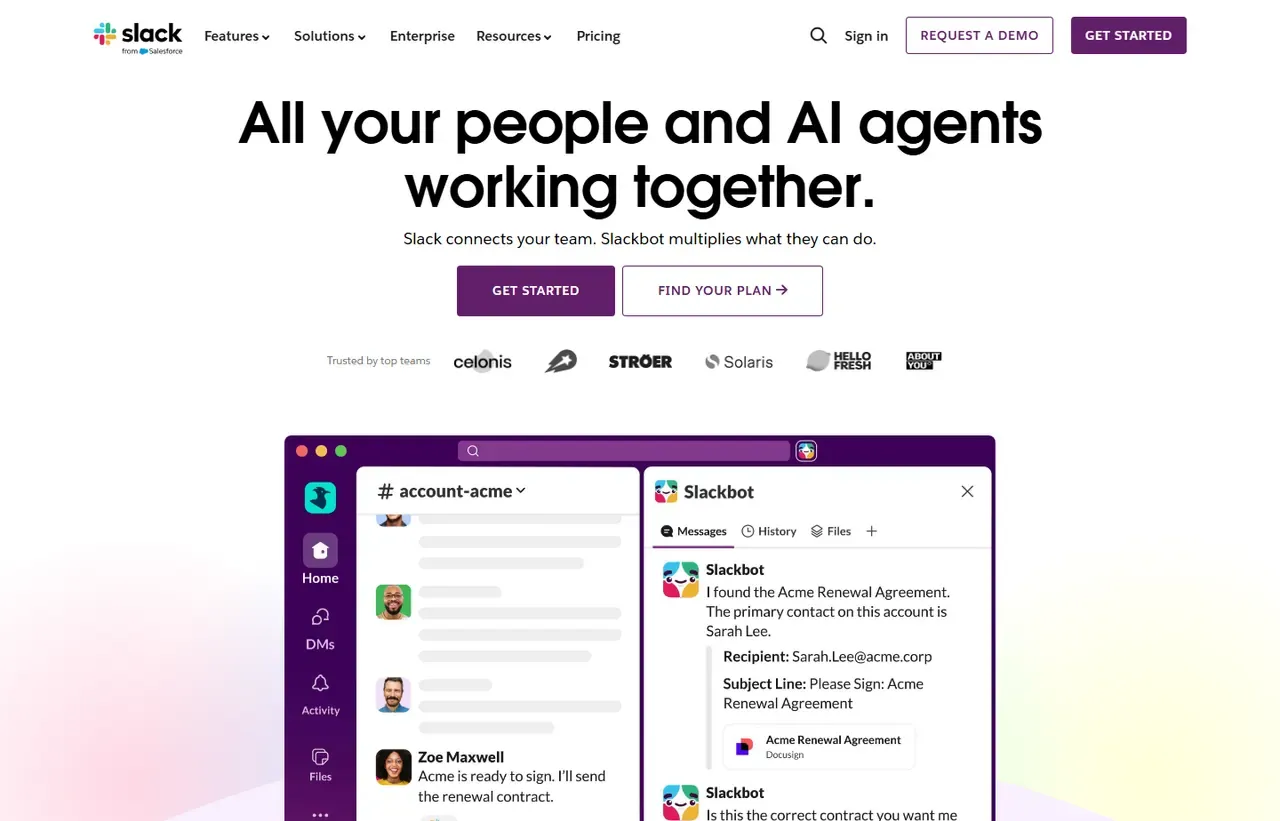
Captured by us in August 2026 at 1440px, unedited. Interfaces change, so these show the product as it looked on the date we verified this profile. Pricing pages are captured from a US vantage point, so the currency shown matches the USD figures recorded above.
Our assessment
Slack is the best pure messaging tool in the category and has been for a decade: faster than its rivals, better organised, and supported by an app ecosystem that turns it into a genuine control surface for other software. The difficulty is entirely commercial. Most organisations already own Microsoft Teams, so Slack has to be justified as an additional per-seat cost, and the free tier's 90-day history limit is a hard cliff that pushes teams to pay sooner than they planned. Where it is worth the money is engineering-heavy organisations and anyone working in shared channels with clients.
What works in Slack
- Fastest, best-organised chat client in the category
- App ecosystem is unmatched, particularly for engineering workflows
- Slack Connect makes external collaboration genuinely easy
- Search across full history is fast and reliable on paid tiers
What doesn't
- A second line item for organisations that already own Teams
- Free tier hides messages after 90 days, which is a real trap
- Video and audio calling is deliberately lightweight
- Channel sprawl and notification fatigue arrive without active management
EveryAny Decision Score
Scored by dimension rather than averaged into one number, because the trade-offs are the useful part. 3 of these 8 dimensions are calculated from verified facts by published formula; the rest are editorial judgement, labelled as such. How each score is calculated.
- Cost position5.8/10
derivedentry tier at $8.75 a month against a category median of $9.99 across 24 comparable tools
- Portability4/10
derivedpublic API, documented migration friction averaging 2 of 3
- Subscription flexibility7/10
derivedfree plan, freemium, monthly billing
- Feature depth8/10
editorialeditorial judgement, reviewed at last check
- Ease of learning9/10
editorialeditorial judgement, reviewed at last check
- Collaboration9/10
editorialeditorial judgement, reviewed at last check
- AI capability6/10
editorialeditorial judgement, reviewed at last check
- Professional adoption10/10
editorialeditorial judgement, reviewed at last check
What leaving Slack would cost
moderate lock-in
Calculated as 10 minus a portability score of 4, built from four signals (self-hosting, a public API, open-source licensing and a documented export path) then reduced by 1 for documented migration friction. Slack scores on: public API, documented migration friction averaging 2 of 3. Formula.
| What you would move | Friction | Risk |
|---|---|---|
| Message history | Moderate | Exportable on paid plans, but the archive is JSON rather than anything readable in another tool. |
| Files shared in channels | Moderate | Exported as links, so years of shared documents end up scattered rather than organised. |
| Integrations and Workflow Builder automations | High | Every app connection and automation must be rebuilt from scratch. |
| Channel structure and conventions | Moderate | Not technical friction, but naming habits and etiquette are real institutional knowledge. |
| Custom emoji and team culture | Low | Easy to dismiss and genuinely felt. Teams resist migration over this more than admins expect. |
The technical export is decent; the behavioural lock-in is the strong part. People hold years of muscle memory in a chat tool, which is why these migrations stall rather than fail outright.
Slack competitors and alternatives
| Alternative | Why you might pick it instead |
|---|---|
| Microsoft Teams | Usually already paid for, and includes real telephony. |
| Discord | Free and excellent for communities, weaker on business administration. |
| Google Chat | Included with Google Workspace, and considerably less capable. |

The 90-day cliff
Slack’s free tier does not delete your messages, it hides them. Everything older than 90 days becomes unsearchable until you upgrade, at which point it reappears. This is the single most effective conversion mechanic in business software, and it catches teams roughly one quarter after adoption, usually while looking for a decision nobody wrote down anywhere else.
What the app directory is actually for
The reason engineering organisations defend Slack is not the chat. It is that deploys, alerts, incidents, pull requests, support tickets and customer signups can all land in the channel where the relevant people already are, with enough interactivity to act without switching tools. That is a different product from a messaging app, and it is what makes migration painful once established.
Slack Connect changes the external calculation
Shared channels with clients, agencies and suppliers work well enough that many companies now run whole relationships in them instead of email. Microsoft Teams can do this, but the cross-tenant experience is materially clumsier, and for agencies in particular that difference alone justifies the licence.
Pricing notes
Pro is $8.75 per user per month paying monthly, or $7.25 billed annually. Business+ is $18 or $15 on the same basis. Slack also runs frequent introductory discounts of around 50% for the first three months on new teams, which is worth checking at signup but should not be modelled as your ongoing price. Since the Salesforce acquisition, expect steadily tighter CRM integration to be part of the enterprise pitch.
Slack questions, answered
- Is Slack worth it?
- Slack is the best pure messaging tool in the category and has been for a decade: faster than its rivals, better organised, and supported by an app ecosystem that turns it into a genuine control surface for other software.
- How much does Slack cost?
- Free tier available; Pro from $7.25 per user/month billed annually. The cheapest paid tier we recorded works out at $8.75 a month, or $105 over a year. Verified against the vendor's pricing page.
- Does Slack have a free plan or free trial?
- Slack has a free plan. No free trial is offered.
- What is the best Slack alternative?
- It depends on the job. Microsoft Teams: Usually already paid for, and includes real telephony. Discord: Free and excellent for communities, weaker on business administration. Google Chat: Included with Google Workspace, and considerably less capable.
- Can I self-host Slack?
- No. Slack is a hosted service only, so your data lives on the vendor's infrastructure.
Provenance and freshness
When each fact was last checked
- Pricing ·
- Plans ·
- Free trial
- Features
- Platforms
- Integrations
- Affiliate programme
- Company details
What has changed
-
August 2026
- Per-user pricing verified, annual and monthly
- Added plan picker, verdicts and switching-cost breakdown
Sources & verification
Facts on this page were read from the sources below on the dates shown. Where a vendor does not publish a figure, we record it as not disclosed rather than estimating it.
- Slack pricing - checked 9 August 2026
Spotted something out of date? Email [email protected] and we will re-check it. Corrections are logged on the page.


