

Substack
Free to publish, 10% if you get paid, and the network is the product.
- Marketing
- Productivity
- Free
Substack is a publishing platform for newsletters, podcasts and video that charges nothing to start and takes a percentage only when writers charge for subscriptions. Its distinguishing asset is the network: recommendations, the app and the Explore feed send readers between publications, which no self-hosted newsletter tool can offer.
Substack: the short answer
Every line below is drawn from facts verified on 9 August 2026.
- What it is
- Free to publish, 10% if you get paid, and the network is the product
- Best for
- Writers who want distribution as well as software
- Starts at
- Free to publish; Substack takes 10% of paid subscription revenue
- Free option
- Free plan available, no trial
- Biggest strength
- Genuinely free until you charge, with no subscriber limits
- Biggest drawback
- 10% of revenue forever becomes the priciest option at scale
- Closest alternative
- beehiiv - Flat monthly fee and 0% take rate on paid subscriptions above Launch
- True annual cost
- from $120 a year at the cheapest paid tier
Substack at a glance
| Best for | Writers who want distribution as well as software, Anyone testing whether readers will pay before investing in tooling, Publications where the writing is the product |
|---|---|
| Category | Marketing, Productivity |
| Starting price | Free to publish; Substack takes 10% of paid subscription revenue |
| Free plan | Yes |
| Free trial | No trial offered |
| Pricing model | usage based |
| Company | Substack Inc. |
| Founded | 2017 |
| Headquarters | San Francisco, California, United States |
| Founders | Chris Best, Hamish McKenzie, Jairaj Sethi |
| Platforms | Web, iOS, Android |
| Public API | No |
| Browser extension | No |
| Mobile apps | iOS + Android |
| Self-hosting | No |
| Affiliate programme | No |
| Data source | Vendor pricing page and public records |
| Last checked | August 2026 |
Substack pricing
Prices below were read from the vendor's own pricing page on 9 August 2026. Pricing model: usage based. No free trial is offered.
| Plan | Price | Billing | Notes |
|---|---|---|---|
| Publishing | $0 | per month | Free to write, send and grow a free list, with no subscriber limit |
| Paid subscriptions | 10% | per usage | Writers keep 90% of revenue, before credit card processing fees |
| Payment processing | Additional | per usage | Card fees are deducted on top of the 10%, charged by Stripe |
Which Substack plan should you buy?
| Your situation | Recommended | Why |
|---|---|---|
| You are starting and do not know if anyone will pay | Publishing, free | No subscriber cap and no cost. Paying 10% of nothing is better than paying $96 a month to discover nobody subscribes. |
| You have turned on paid subscriptions | Accept the 10% | Writers keep 90% before card fees. Reasonable while revenue is small, and it never stops scaling. |
| You earn a few thousand a month from subscriptions | Do the arithmetic against beehiiv | At $5,000 a month you pay Substack $500. beehiiv's Max plan is roughly $96 and takes nothing from subscriptions. |
| You need automation or segmentation | Do not use Substack | There is almost none. Kit or beehiiv if your publication is a funnel. |
| You want to leave later | You can, and lists export properly | Subscriber export works cleanly, which is the most important thing about any list tool. |
Verdict by who you are
Writer with no existing audienceYes
Free until you charge, and the recommendation network and app genuinely introduce readers. Nothing else offers distribution as well as software.
Writer earning meaningful subscription revenueNo
10% forever becomes the most expensive option in the category. Move once the fee exceeds a flat platform cost.
Podcaster or video creatorYes
Hosting for both is included at no extra cost, which is unusual.
Business with a marketing funnelNo
No automation, no segmentation, no real API. This is a publication tool.
Should you buy Substack?
Buy Substack if…
- Writers who want distribution as well as software
- Anyone testing whether readers will pay before investing in tooling
- Publications where the writing is the product
Do not buy Substack if…
- Businesses needing marketing automation and segmentation
- Large paid lists, where 10% becomes the most expensive option
- Anyone needing full control of design or subscriber data
Key features
- No cost until you charge readers
- Recommendation network that grows lists between publications
- Substack app with a dedicated reader feed
- Paid, free and founding-member subscription tiers
- Podcast and video hosting included
- Comments and subscriber-only discussion threads
- Notes, a short-form feed for discovery
- Full subscriber list export
Integrations
- Stripe for payments
- Custom domains
- RSS
- Zapier, through limited third-party connectors
Substack screenshots
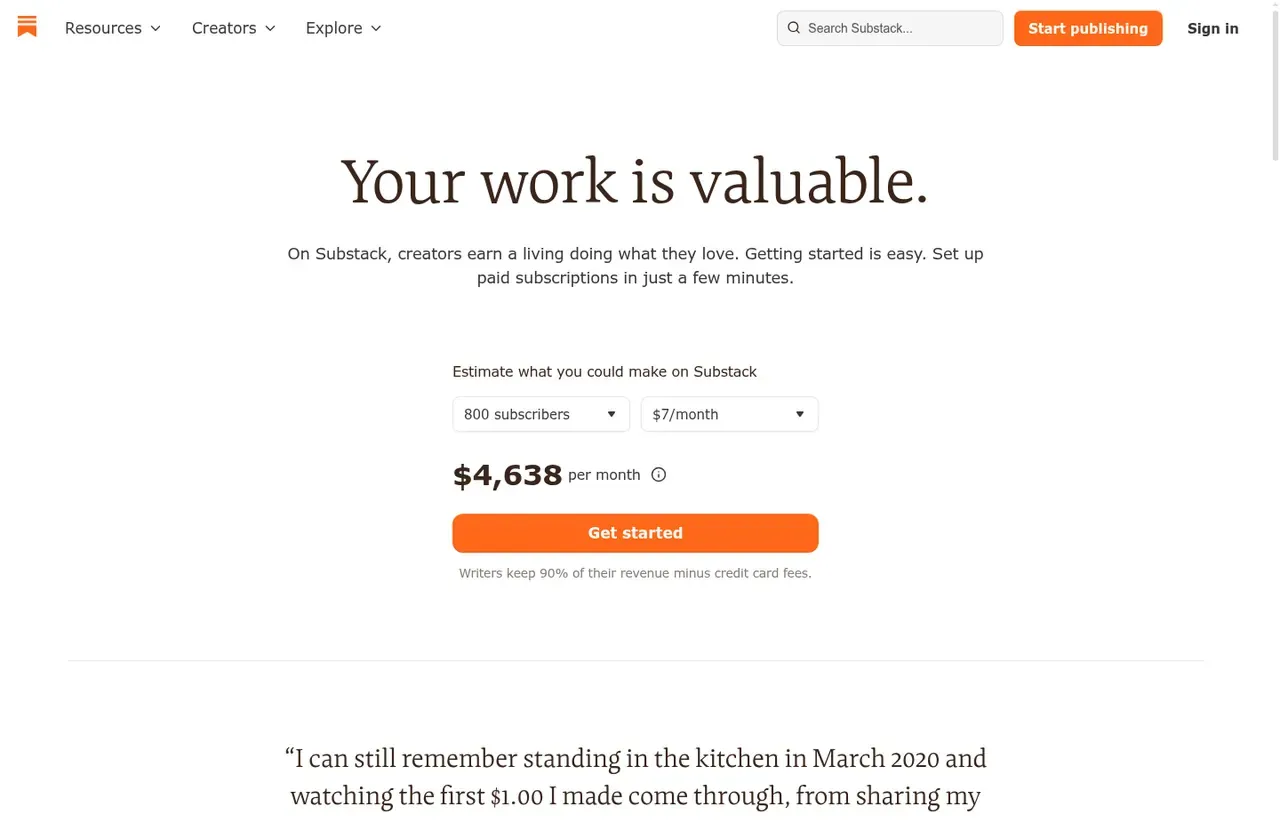
Captured by us in August 2026 at 1440px, unedited. Interfaces change, so these show the product as it looked on the date we verified this profile. Pricing pages are captured from a US vantage point, so the currency shown matches the USD figures recorded above.

Our assessment
Substack is the best place to find out whether anyone will pay for your writing, because it costs nothing until they do and its network actively sends readers your way. That combination is genuinely hard to replicate. The same 10% that makes starting free makes succeeding expensive: at $5,000 a month in subscriptions you are paying $500 a month for software that beehiiv would provide for under $100, and the fee never stops scaling. The other reservation is control. Design options are deliberately narrow, there is no real automation, and no API to speak of. Start here, and do the arithmetic again once the revenue is real.
What works in Substack
- Genuinely free until you charge, with no subscriber limits
- Recommendation network and app drive real list growth
- Podcast and video hosting included at no extra cost
- Subscriber list exports cleanly, so leaving is possible
What doesn't
- 10% of revenue forever becomes the priciest option at scale
- Almost no marketing automation or segmentation
- Very limited design control
- No meaningful API for custom workflows
EveryAny Decision Score
Scored by dimension rather than averaged into one number, because the trade-offs are the useful part. 3 of these 8 dimensions are calculated from verified facts by published formula; the rest are editorial judgement, labelled as such. How each score is calculated.
- Cost position7.5/10
derivedentry tier at $10 a month against a category median of $20 across 12 comparable tools
- Portability4/10
deriveddocumented export
- Subscription flexibility6/10
derivedfree plan, usage based, monthly billing
- Feature depth5/10
editorialeditorial judgement, reviewed at last check
- Ease of learning10/10
editorialeditorial judgement, reviewed at last check
- Collaboration5/10
editorialeditorial judgement, reviewed at last check
- AI capability4/10
editorialeditorial judgement, reviewed at last check
- Professional adoption9/10
editorialeditorial judgement, reviewed at last check
What leaving Substack would cost
moderate lock-in
Calculated as 10 minus a portability score of 4, built from four signals (self-hosting, a public API, open-source licensing and a documented export path) . Substack scores on: documented export. Formula.
Substack competitors and alternatives
| Alternative | Why you might pick it instead |
|---|---|
| beehiiv | Flat monthly fee and 0% take rate on paid subscriptions above Launch. |
| Kit | Better automation and commerce tooling for creators selling products. |
| Ghost | Open source and self-hostable, with no revenue share at all. |

Kit
Marketing
Email built for creators, including the part where you get paid.

beehiiv
Marketing
Newsletter infrastructure that takes nothing from your subscription revenue.
The fee, precisely
Publishing on Substack is free with no subscriber cap. If you turn on paid subscriptions, Substack’s own page states that writers keep 90% of their revenue minus credit card fees. So the deduction is two-part: Substack’s 10%, then payment processing on top, charged through Stripe rather than by Substack.
That wording matters when modelling income. Ten per cent is the number people quote, but the amount reaching your account is lower than 90% once card fees are taken.
Where 10% stops being a bargain
The revenue share is what makes Substack risk-free to start and expensive to succeed on. Some rough arithmetic at a $5 monthly subscription:
| Paying subscribers | Monthly revenue | Substack’s 10% |
|---|---|---|
| 100 | $500 | $50 |
| 1,000 | $5,000 | $500 |
| 5,000 | $25,000 | $2,500 |
At the top of that table you are paying $30,000 a year. beehiiv would charge roughly $1,200 for its Max plan and take nothing from subscriptions. The crossover comes earlier than most writers expect, and the fee applies to every renewal indefinitely.
None of which makes starting elsewhere correct. Paying 10% of nothing is better than paying $96 a month to find out no one subscribes.
The network is the real differentiator
Recommendations, the app and Notes move readers between publications, and for many writers a large share of new subscribers arrive that way. No self-hosted tool can offer this, because it is not a feature but an audience. If discovery matters more to you than margin, that is the argument for staying.
What you give up
Design control is narrow by design, so Substacks look like Substacks. There is no serious automation: no behavioural sequences, no conditional segmentation, no lead scoring. There is no real API. If your publication is a business with a funnel rather than a body of writing, Kit or beehiiv will fit better.
Subscriber lists do export properly, which is the most important thing. Whatever you build here, you can take with you.
Substack questions, answered
- Is Substack worth it?
- Substack is the best place to find out whether anyone will pay for your writing, because it costs nothing until they do and its network actively sends readers your way.
- How much does Substack cost?
- Free to publish; Substack takes 10% of paid subscription revenue. The cheapest paid tier we recorded works out at $10 a month, or $120 over a year. Verified against the vendor's pricing page.
- Does Substack have a free plan or free trial?
- Substack has a free plan. No free trial is offered.
- What is the best Substack alternative?
- It depends on the job. beehiiv: Flat monthly fee and 0% take rate on paid subscriptions above Launch. Kit: Better automation and commerce tooling for creators selling products. Ghost: Open source and self-hostable, with no revenue share at all.
- Can I self-host Substack?
- No. Substack is a hosted service only, so your data lives on the vendor's infrastructure.
Provenance and freshness
When each fact was last checked
- Pricing ·
- Plans ·
- Free trial
- Features
- Platforms
- Integrations
- Affiliate programme
- Company details
What has changed
-
August 2026
- Confirmed the 90% writer share against Substack's own going-paid page
- Added plan picker and verdicts
Sources & verification
Facts on this page were read from the sources below on the dates shown. Where a vendor does not publish a figure, we record it as not disclosed rather than estimating it.
- Substack, going paid - checked 9 August 2026
Spotted something out of date? Email [email protected] and we will re-check it. Corrections are logged on the page.


