

SurveyMonkey builds and distributes questionnaires, collects responses and analyses results, with a panel service for buying responses from a target audience. Its practical advantage is familiarity: respondents trust the interface, which measurably helps completion rates on external research.
SurveyMonkey ranking and coverage
- In Analytics
- #4 of 4
- Overall
- #101 of 122 tied
- Terms score
- 4.5 /10
- Referenced here
- 3 pages
Cost position 2.5 · Portability 5 · Subscription flexibility 6 - Ranked on published terms only: entry price against category peers, portability and subscription flexibility, equally weighted. This is not a quality score.How the rank is calculated.
SurveyMonkey: the short answer
Every line below is drawn from facts verified on 9 August 2026.
- What it is
- The survey tool everyone recognises, which is most of the point
- Best for
- Customer and employee feedback at moderate volume
- Starts at
- Free plan available; Advantage Annual $39/month for one user, or Team Advantage $30 per user/month with a three-user minimum
- Free option
- Free plan available, no trial
- Biggest strength
- Universally recognised, which helps completion rates
- Biggest drawback
- Free tier is very restrictive at 10 questions and 10 responses
- Based on
- Primary-source research, not hands-on use
- Closest alternative
- Typeform - Far better respondent experience, and better for conversational forms
- True annual cost
- from $468 a year on Advantage Annual, the cheapest paid tier ($39 a month)
SurveyMonkey at a glance
| Best for | Customer and employee feedback at moderate volume, Research teams needing a purchasable respondent panel, Organisations wanting recognised, trusted survey branding |
|---|---|
| Category | Analytics, Marketing, HR |
| Starting price | Free plan available; Advantage Annual $39/month for one user, or Team Advantage $30 per user/month with a three-user minimum |
| Free plan | Yes |
| Free trial | No trial offered |
| Pricing model | subscription |
| Company | SurveyMonkey Inc. (Momentive) |
| Founded | 1999 |
| Headquarters | San Mateo, California, United States |
| Founders | Ryan Finley, Chris Finley |
| Platforms | Web, iOS, Android |
| Public API | Yes |
| Browser extension | No |
| Mobile apps | iOS + Android |
| Self-hosting | No |
| Affiliate programme | No |
| Data source | Vendor pricing page and public records |
| Last checked | August 2026 |
SurveyMonkey pricing
Prices below were read from the vendor's own pricing page on 9 August 2026. Pricing model: subscription. No free trial is offered.
| Plan | Price | Billing | Notes |
|---|---|---|---|
| Basic | $0 | per month | 1 user, unlimited surveys, 10 questions per survey. The response limit is not published on the pricing page; it is shown once you sign in |
| Standard Monthly | $99 | per month | Billed monthly. 1 user, unlimited questions, 1,000 responses per month |
| Advantage Annual | $39 | per month | $468 billed annually. 1 user, 15,000 responses per year, AI analysis |
| Premier Annual | $139 | per month | $1,668 billed annually. 1 user, 40,000 responses per year, white label branding, crosstabs and phone support |
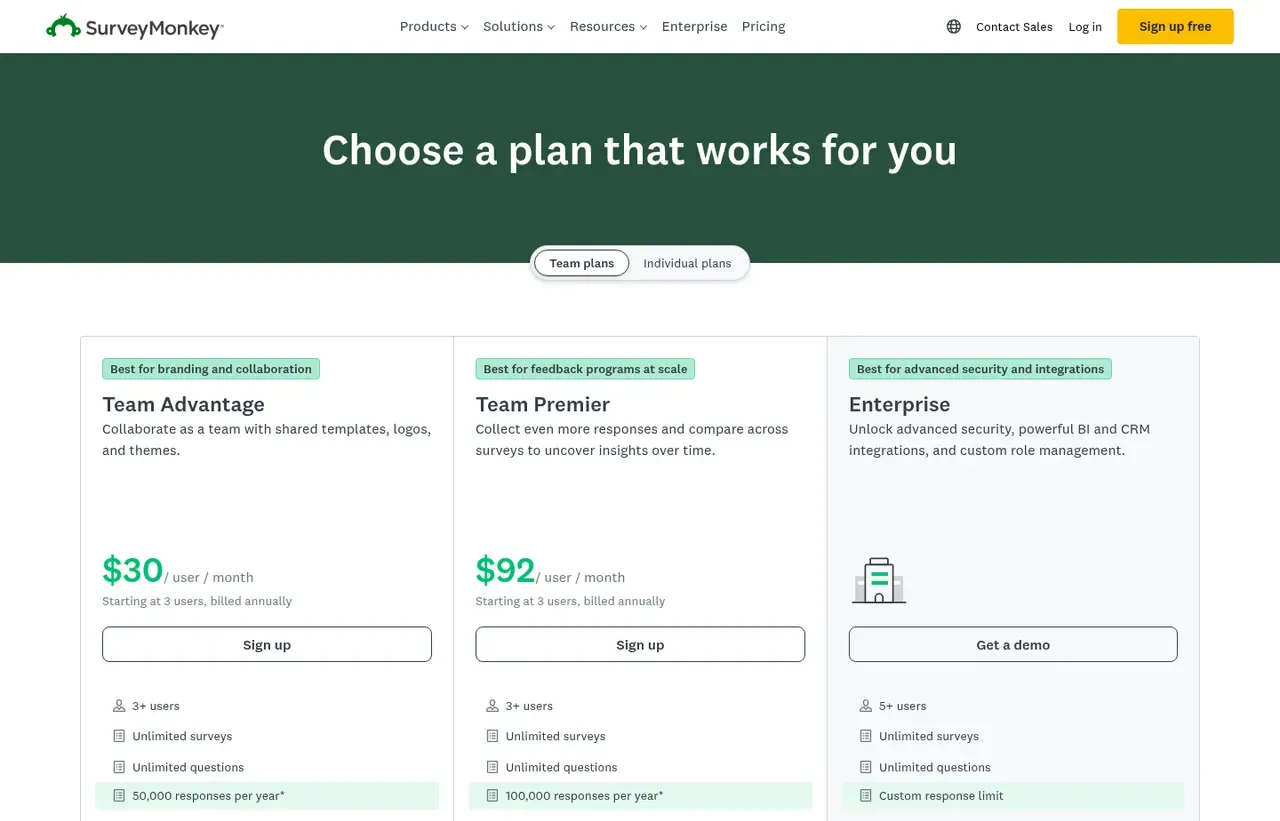
| Team Advantage | $30 | per month | per user, minimum 3 users, billed annually - 50,000 responses per year. The three-seat floor makes the real minimum $90 a month, not $30 |
| Team Premier | $92 | per month | per user, minimum 3 users, billed annually - 100,000 responses per year, white label branding, crosstabs |
| Enterprise | Custom | Negotiated | Custom response limits, SSO, governance and data residency |
| Additional responses | $0.15 | per usage | Per response beyond your plan's limit. SurveyMonkey Audience, the respondent panel, is sold separately and is not priced on this page |
What SurveyMonkey actually costs over a year
A monthly price is not the same thing as a monthly contract. These are the plans above resolved both ways, per seat or unit where the plan is charged that way. Where a vendor quotes only a yearly figure it is divided by twelve rather than left out, and the Quoted column says which figure the vendor actually publishes.
| Plan | Quoted | Monthly | Over 12 months |
|---|---|---|---|
| Standard Monthly | per month | $99 | $1,188 |
| Advantage Annual | per month | $39 | $468 |
| Premier Annual | per month | $139 | $1,668 |
| Team Advantageper user, minimum 3 users, billed annually | per month | $30 | $360 |
| Team Premierper user, minimum 3 users, billed annually | per month | $92 | $1,104 |
Which SurveyMonkey plan should you buy?
| Your situation | Recommended | Why |
|---|---|---|
| You need a quick internal poll | Free | 10 questions and 10 responses per survey. Adequate for a straw poll, nothing more. |
| You run regular customer or employee feedback | Team Advantage | $30 per user a month, minimum three users, so $90 a month before anyone collects anything. Note the three-seat minimum is the real floor. |
| You need white labelling and crosstab analysis | Team Premier | $92 per user a month, same three-user minimum, for 100,000 responses a year. |
| You need respondents you do not have | SurveyMonkey Audience | From $0.15 per response. Buying a panel is the capability few competitors offer at all, and often the real reason to be here. |
| You need advanced research statistics | Consider Qualtrics instead | Conjoint and MaxDiff are absent here, not merely weaker. |
| You want high completion rates on customer forms | Consider Typeform instead | One question per screen measurably lifts completion. |
Verdict by who you are
Team running periodic feedback surveysYes
Recognised branding that respondents trust, adequate analysis, and published pricing unlike Qualtrics.
Researcher needing a respondent panelYes
Audience is a genuine differentiator; most survey tools cannot sell you respondents at all.
Small team or solo userNo
The three-seat minimum means you pay for seats you do not use.
Marketer collecting leadsCompare first
Typeform converts better for customer-facing forms. SurveyMonkey is research-shaped.
Should you buy SurveyMonkey?
Buy SurveyMonkey if…
- Customer and employee feedback at moderate volume
- Research teams needing a purchasable respondent panel
- Organisations wanting recognised, trusted survey branding
Do not buy SurveyMonkey if…
- Simple internal polls, where free tools are sufficient
- Teams needing forms embedded deeply in a product
- Buyers wanting straightforward per-seat pricing
Key features
- Survey builder with question banks and logic
- Skip logic, piping and randomisation
- SurveyMonkey Audience for buying targeted responses
- Statistical significance testing and crosstabs
- Multilingual surveys on higher tiers
- AI-assisted survey design and analysis
- Payment collection within surveys
- Benchmarks against industry response data
Integrations
- Salesforce and HubSpot
- Microsoft Teams and Slack
- Google Sheets and Workspace
- Zapier
- SurveyMonkey API
SurveyMonkey screenshots
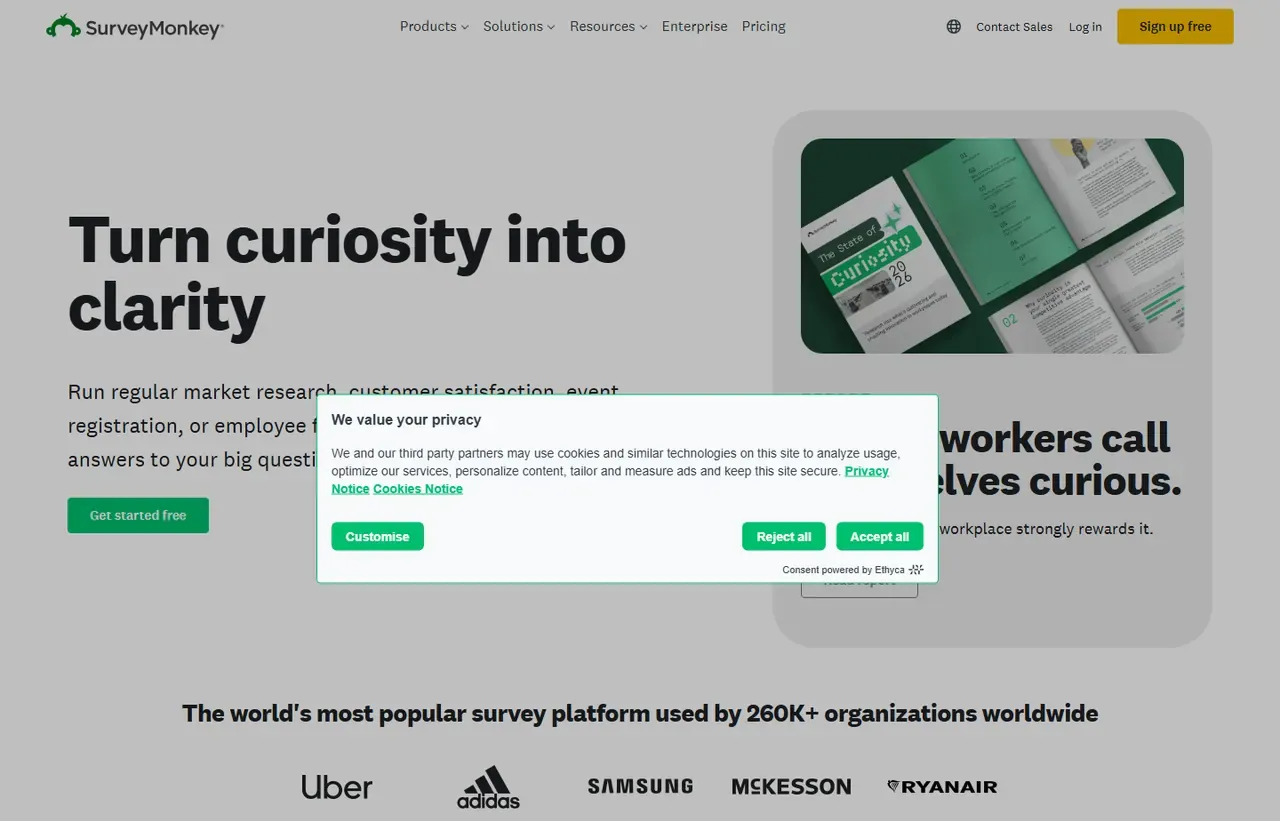
Captured by us in August 2026 at 1440px, unedited. Interfaces change, so these show the product as it looked on the date we verified this profile. Pricing pages are captured from a US vantage point, so the currency shown matches the USD figures recorded above.
Our assessment
SurveyMonkey occupies an odd position: too expensive for casual use, less rigorous than dedicated research platforms, and yet still the sensible default for a lot of feedback work. What justifies it is recognition and the Audience panel. Respondents know the interface and complete surveys they would abandon elsewhere, and being able to buy a targeted sample from $0.15 per response is genuinely useful for research nobody has a list for. The free tier is deliberately restrictive at ten questions and ten responses, and team plans require three seats, so the real entry cost is well above the advertised per-user figure.
What works in SurveyMonkey
- Universally recognised, which helps completion rates
- Audience panel lets you buy a targeted sample directly
- Solid analysis tools including significance testing and crosstabs
- Mature integrations with CRM and collaboration tools
What doesn't
- Free tier is very restrictive at 10 questions and 10 responses
- Team plans require a minimum of three users
- Response limits are annual, so a busy quarter can exhaust them
- Respondent experience is dated next to modern form tools
EveryAny Decision Score
3 of these 8 dimensions are calculated from verified facts; the rest are our judgement, shown as a band rather than a figure unless something specific sits behind them. How each score works.
- Cost position2.5/10
derivedentry tier at $39 a month against a category median of $39 a month across 4 comparable tools
- Portability5/10
derivedpublic API
- Subscription flexibility6/10
derivedfree plan, subscription, monthly billing
- Feature depthHigh
editorialour judgement, with no measurement behind it
- Ease of learningVery high
editorialour judgement, with no measurement behind it
- CollaborationHigh
editorialour judgement, with no measurement behind it
- AI capabilityModerate
editorialour judgement, with no measurement behind it
- Professional adoptionVery high
editorialour judgement, with no measurement behind it
What leaving SurveyMonkey would cost
moderate lock-in
SurveyMonkey scores on public API. Portability 5/10 ; lock-in is the inverse. How this is calculated.
SurveyMonkey competitors and alternatives
| Alternative | Why you might pick it instead |
|---|---|
| Typeform | Far better respondent experience, and better for conversational forms. |
| Google Forms | Free and entirely adequate for internal polls and simple collection. |
| Qualtrics | The enterprise research platform when methodology rigour is the requirement. |

Qualtrics
Analytics
Enterprise experience management, with no published price at all.
Checked Aug 2026
One user or three, and the gap between them
SurveyMonkey splits its pricing across two tabs, and the cheaper-looking number is on the one most people do not click. Team Advantage advertises $30 per user per month, which reads as the entry price until you notice the three-seat floor: the smallest invoice is $90 a month. A single user paying for Advantage Annual instead pays $39 a month, or $468 for the year.
So the honest comparison depends on how many of you there are. One person: $39. Two people: still $39 each on individual plans, because Team starts at three. Three or more: $30 each, and the team features - shared brand assets, roles and permissions, multi-survey analysis - start to earn the difference.
SurveyMonkey also localises pricing by visitor region, and a browser in the EU is shown euros. The figures here were read from the page as served in the United States. Check the price in your own region before budgeting; the plan structure and the seat minimums are the same either way.
Responses per year is the real limit
Seats determine who can build surveys. Responses determine whether you can run them. Team Advantage allows 50,000 responses a year and Team Premier 100,000, and those are annual pools rather than monthly allowances. A single large customer survey can consume a substantial share of a year’s quota in a fortnight, so plan the research calendar against the pool rather than assuming a steady rate.
Audience is the underrated product
Most survey tools assume you already have people to ask. SurveyMonkey Audience sells you a targeted sample from around $0.15 per response, filtered by demographics and region. For market research, concept testing or any question where you have no list, that removes the hardest part of the job and is difficult to replicate cheaply elsewhere.
Where cheaper or better tools win
For an internal poll, Google Forms is free and nobody will complain. For anything customer-facing where completion rate matters more than familiarity, Typeform’s respondent experience is substantially better. And for genuine academic or commercial research requiring methodological control, Qualtrics is the tool that specialists actually ask for.
SurveyMonkey questions, answered
- Is SurveyMonkey worth it?
- SurveyMonkey occupies an odd position: too expensive for casual use, less rigorous than dedicated research platforms, and yet still the sensible default for a lot of feedback work.
- How much does SurveyMonkey cost?
- Free plan available; Advantage Annual $39/month for one user, or Team Advantage $30 per user/month with a three-user minimum. The cheapest paid tier we recorded is Advantage Annual, published at $39 a month, which works out at $39 a month or $468 over a year. Verified against the vendor's pricing page.
- Does SurveyMonkey have a free plan or free trial?
- SurveyMonkey has a free plan. No free trial is offered.
- What is the best SurveyMonkey alternative?
- It depends on the job. Typeform: Far better respondent experience, and better for conversational forms. Google Forms: Free and entirely adequate for internal polls and simple collection. Qualtrics: The enterprise research platform when methodology rigour is the requirement.
- Can I self-host SurveyMonkey?
- No. SurveyMonkey is a hosted service only, so your data lives on the vendor's infrastructure.
What this profile is based on
Every claim below is about our work, not about SurveyMonkey. A "no" is recorded rather than omitted, because the difference between a tested review and careful desk research is the reader's to weigh. How we research a profile.
-
Prices read from the vendor : yes
Read from SurveyMonkey's own pricing page on 18 August 2026
-
Plans and terms recorded : yes
8 rows, each with its billing period
-
Original screenshots : yes
2 captured by us: homepage, pricing page
-
Sources cited and dated : yes
1 primary source, each with the date it was read
-
Product used first-hand : no
Not tested. This profile is desk research from primary sources
-
Alternatives used first-hand : no
None, so comparisons here rest on published facts rather than use
-
Vendor contacted : no
Not contacted for this profile
Where SurveyMonkey appears on this site
3 other pages here reference SurveyMonkey. Every one is listed below, so the figure can be checked rather than taken.
- Article Founder Digital Hygiene Is a Procurement Habit listed as related
- Another profile Qualtrics names it as a competitor
- Another profile Typeform names it as a competitor
Counts pages on this site that name the product by choice - buyer guides, articles, deal records and other profiles. Category and directory indexes list everything automatically and are not counted.
One-click Google setting
Get our writing surfaced first on Google
If this was useful, add EveryAny.One as a preferred source in Google. Our profiles and best-of guides will appear ahead of the rest in Top Stories, AI Mode and AI Overviews when you search for software.
- Our reviews get a "preferred" badge in Top Stories and AI Overviews.
- AI Mode leans on the sources you've chosen when it answers.
- Change it back any time from the same Google page.

Opens Google's source preferences in a new tab.
Provenance and freshness
When each fact was last checked
- Pricing ·
- Plans ·
- Free trial
- Features
- Platforms
- Integrations
- Affiliate programme
- Company details
What has changed
-
August 2026
- Re-read the pricing page from US egress and recorded it in USD. The August figures were euros: SurveyMonkey resolves currency by visitor region on the server, so a local read cannot see the dollar prices at all
- Team Premier corrected from a euro figure to $92 per user a month
- Added the four individual plans, which sit on a separate tab and were missing entirely. Advantage Annual at $39 is the cheapest way for one person to buy
- Corrected a mislabelled row: the $0.15 per-response charge is the overage on paid plans, not SurveyMonkey Audience pricing. Audience is sold separately and is not priced on this page
- Recorded the Basic response allowance as unpublished rather than as ten per survey
-
August 2026
- Pricing recorded in the currency shown to us, with the three-user minimum noted
- Added plan picker and verdicts
Sources & verification
Facts on this page were read from the sources below on the dates shown. Where a vendor does not publish a figure, we record it as not disclosed rather than estimating it.
- SurveyMonkey pricing - checked 18 August 2026
Spotted something out of date? Email [email protected] and we will re-check it. Corrections are logged on the page.


