
SaaS buying
What a SaaS Affiliate Programme Reveals
A vendor's affiliate programme is a compressed disclosure of what they believe about their own churn, deliberation cycle and ideal customer. Read as a buyer, five design choices carry more signal than the marketing site above them.
Every “best affiliate programme” round-up I’ve read stops at the commission rate and cookie window. Both are the fields a vendor states in the first paragraph of its own page, so the round-up adds nothing a screenshot wouldn’t.
What’s actually interesting on an affiliate page isn’t the comparison shop. It’s what the shape of the programme - the pieces most round-ups skip past - tells you about the software as a buyer. Affiliate pages are one of the few places a vendor is candid about how long they think you’ll take to decide, how long they expect you to stay, and which acquisition channels they’ll trust with the brand. A marketing site is written to close a sale. An affiliate page has to compensate a stranger, which is a stronger truth serum than most.
So I pulled every affiliate-programme record we track - 62 verified against the vendor’s own page in August 2026, of which 54 are active - and read what the pattern of design choices actually says. Five of them carry more signal than the marketing site above them. If you’re on a vendor’s site with a card in hand, the affiliate page is worth two minutes before you sign.
The affiliate page is a disclosure the marketing site doesn’t repeat
A vendor’s marketing site is written to close a sale. Its affiliate programme is written to tell a stranger, in numbers, what the vendor believes about its own customers - how long they take to decide, how long they stay, and which acquisition channels can be trusted with the brand. Those two documents rarely agree, and the affiliate one is usually more candid. It has to be, because a publisher won’t send traffic against a vague promise.
The figures below come from 62 verified affiliate-programme records, of which 54 are active. All were checked against the vendor’s own affiliate page in August 2026; where a figure isn’t published, we record it as not disclosed and it drops out of the count. The dataset is an internal catalogue we maintain against the same nullable-versus-omitted rule as our software profiles - a null field means we checked, an absent field means we haven’t.
Recurring versus one-time is a confidence disclosure
Of 54 active programmes, 35 pay recurring commission and 19 pay a one-time bounty. Within the recurring set, 16 are lifetime and 14 are capped at 12 months, with a handful of other durations besides. The cap is the interesting number.
A 12-month cap says the vendor is confident about first-year retention and unwilling to share revenue on the second-year cohort - which is another way of saying the second year is uncertain enough that the accountants would prefer to keep it. HubSpot caps at 12 months on a 30% share. ActiveCampaign and GetResponse do the same. Kit caps the 50% headline at 12 months and pays a 10 to 20% tail only to affiliates who cross a status threshold. I’ve been an affiliate for two of these three at different points over the past decade, and the 12-month structure isn’t hostile - it’s a vendor being specific about which risk it wants to price.
Lifetime recurring is the opposite claim. Systeme.io pays 60% recurring for the lifetime of the customer; Kajabi, Thinkific and AWeber all pay lifetime shares in the 30 to 50% range. This is a vendor telling the market that its churn is low enough to keep sharing revenue with a third party forever, and it’s verifiable: if churn were high, the arithmetic wouldn’t work for the vendor.
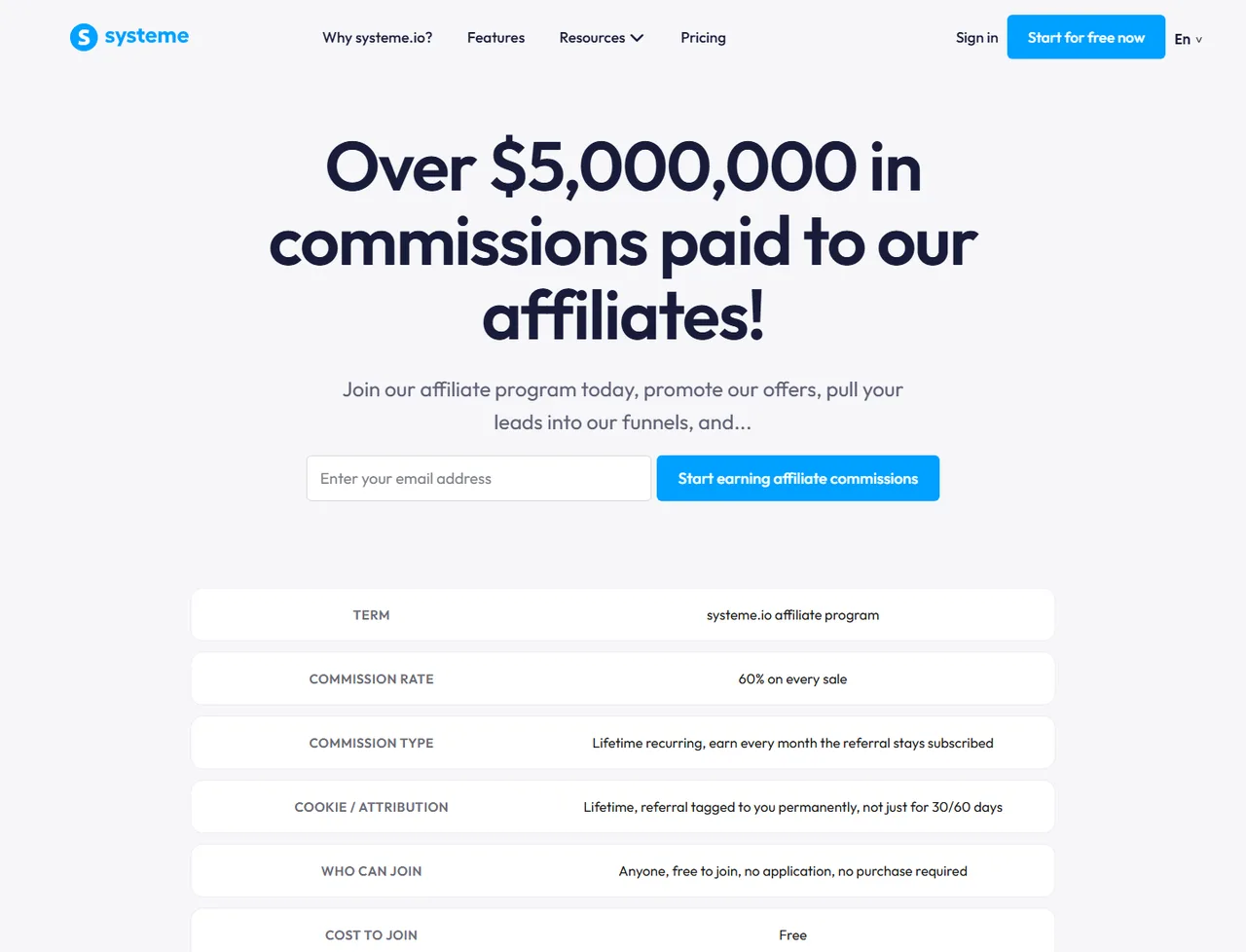
Systeme.io’s affiliate page, read 24 August 2026. Three lines settle it - “60% on every sale”, “Lifetime recurring, earn every month the referral stays subscribed”, “Lifetime, referral tagged to you permanently, not just for 30/60 days”. A vendor that pays a share of every recurring month for the life of a customer is disclosing something specific about churn.
A one-time bounty (Semrush at $50 to $450 per sale, Adobe at 85% of one month, Elementor at 55% on the first purchase of Elementor One) inverts the same signal. The vendor doesn’t want a publisher paid on retained revenue. That’s either because the product is largely a first-year purchase, because the direct channel is strong enough to make attribution costly, or because subscription revenue isn’t the accounting unit the vendor wants to share on. In practice it’s usually the first two.
None of this proves anything on its own. It’s one signal about how the vendor thinks.
Cookie duration is the vendor’s estimated deliberation length
43 of the 54 active programmes disclose a cookie duration. The range is 30 to 180 days, the median is 60, and the distribution isn’t random. Consumer and prosumer tools (Adobe, 1Password, Miro, ClickUp, Honeybook, Namecheap) cluster at 30 days. Enterprise or long-cycle B2B tools (HubSpot, WP Engine) sit at 180. Everything in between tracks the deliberation length a vendor assumes for its buyer - a self-serve credit card in one session, or a procurement cycle involving a manager, an evaluator and finance.
Cookie duration is set to match, or to slightly overshoot, that cycle. If a vendor’s cookie is 30 days, they don’t expect a buyer to still be reading reviews in month two. 180 says the opposite.
11 active programmes disclose no cookie duration at all. That’s itself a piece of information; it’s common on in-house programmes where the terms are settled after approval.
Promotional restrictions describe the customer the vendor doesn’t want
Most programmes leave the promotional-rules fields blank until you apply, but the ones stated publicly are load-bearing. Kinsta prohibits coupon-code promotion. That’s a vendor deciding a discount-shopping customer is the wrong customer for a premium managed hosting product; it’s also a fair prediction about who churns first. Cloudways permits paid search but forbids bidding on the Cloudways brand terms, which protects the branded SERP from being resold back to the vendor.
I’ve run traffic to Kinsta’s programme for years, and the coupon rule isn’t posturing - it maps to a real friction. The customer who signs on a discount code is the customer who calls support about a $5 monthly overage six weeks later. The vendor is pricing for who they’d rather have, and the affiliate agreement is where they say it out loud.
Read as a buyer, restrictions like these are the vendor’s operational definition of an ideal account. If the profile they describe isn’t you, you’ll feel the same friction in support, onboarding and renewal - the affiliate agreement is just the version the vendor was willing to write down.
The absence of a programme is also information
Four vendors in the sample publish no public affiliate programme: Xero, Airtable, Basecamp and Zapier. Read as a red flag this reads wrong. Xero runs a formal partner programme for accountants and bookkeepers who implement the product; Airtable’s referral partner addendum is a contract between Airtable and existing customers, not an open publisher scheme. Both choices say the same thing, which is that the direct channel and the practitioner channel are sufficient. A vendor that doesn’t need publisher acquisition has usually earned that position.
The signal reverses when a programme changes. Three vendors in the sample currently show their affiliate programme as paused: Notion, Canva and Loom. Neither a pause nor a closure means the product is worse this year than last, but each is a vendor pulling back on publisher-attributed acquisition, and it’s worth noticing. Ahrefs closed its programme outright, and the company has said publicly it has no plans to reopen.
I watched the Ahrefs closure in real time as an active affiliate, and the public reasoning was that the channel was compensating publishers for demand the brand had already generated. That is a specific claim about how the company has come to see its own acquisition mix, and it’s the sort of statement a marketing site is almost never going to make. A closure isn’t a defect - it is a repositioning, and a paused programme usually resolves one way or the other within a year.
Five questions the affiliate page answers about the vendor
If you’re already on a vendor’s site and undecided, the affiliate page is a shortcut worth two minutes. Open it and answer:
- Is commission recurring, and for how long? Lifetime says the vendor is confident about churn; 12 months says they aren’t, past year one.
- How long is the cookie? 30 days is a self-serve tool. 120+ days is a considered purchase, and if you’re treating it as impulse, you’re pricing it wrong.
- Which promotional methods are restricted? The disallowed ones name the customer the vendor doesn’t want. Check whether they mean you.
- Is there a programme at all? If no, the vendor is telling you they win through direct sales or a practitioner network. That’s a real position, not an omission.
- Has the programme changed recently? A recent pause, cut or restructuring is a business trajectory signal that doesn’t appear on the pricing page.
These five won’t tell you whether the software fits your use case. They’ll tell you what the vendor believes about the customer, which is often the thing the pricing page is trying not to say out loud.
Why we record this as data, not as a ranking
Every software profile on this site records the vendor’s affiliate terms as structured fields: commission structure, cookie duration, whether it’s recurring, the network, and the date the record was verified. The terms sit on the profile because they’re part of what the vendor discloses about itself. They never influence coverage, assessment or ranking - the reasoning is set out in our methodology, and this is the point of publishing verified figures rather than sponsored placements. A vendor with a generous programme doesn’t become a better product for it, and one without a programme isn’t being penalised.
Frequently asked questions
Why does a vendor's affiliate programme reveal anything about the software?
Because the design choices on an affiliate page are the vendor's own model of their customers - how long they take to decide, how long they stay, and which acquisition channels the vendor trusts. That model is rarely stated on the marketing site, and often the two disagree.
Is lifetime recurring commission always a good sign?
It is a signal, not proof. It says the vendor is confident enough in retention to keep sharing revenue with a third party for the full customer lifetime. A vendor that caps at twelve months is quietly saying the second year is uncertain. Neither structure is dishonest; the cap is the information.
What does a short cookie duration mean for the buyer?
Cookie duration is the vendor's estimate of how long a considered purchase takes. 30 days suggests a self-serve tool a buyer decides on in one session; 180 days suggests an enterprise cycle involving multiple stakeholders. It is a rough proxy, but a consistent one across the 62 programmes we verified.
Is no public affiliate programme a red flag?
No. It usually means the vendor has an established direct or partner channel and does not need publisher-driven acquisition. Xero and Airtable both run structured partner programmes for accountants and consultants rather than open affiliate schemes, and that is a positioning choice, not a weakness.
Should I let affiliate commissions influence which SaaS I buy?
No. The programme is a signal about the vendor, not a discount to you. On this site, commission terms are recorded as data on every profile and never influence coverage or ranking, which is set out in our methodology.
One-click Google setting
Get our writing surfaced first on Google
If this was useful, add EveryAny.One as a preferred source in Google. Our profiles and best-of guides will appear ahead of the rest in Top Stories, AI Mode and AI Overviews when you search for software.
- Our reviews get a "preferred" badge in Top Stories and AI Overviews.
- AI Mode leans on the sources you've chosen when it answers.
- Change it back any time from the same Google page.

Opens Google's source preferences in a new tab.
Sources & verification
Facts on this page were read from the sources below on the dates shown. Where a vendor does not publish a figure, we record it as not disclosed rather than estimating it.
- HubSpot affiliate programme - checked 12 August 2026
- Kit affiliate programme documentation - checked 12 August 2026
- Systeme.io affiliate programme - checked 12 August 2026
- Semrush affiliate programme - checked 12 August 2026
- Adobe affiliate programme - checked 12 August 2026
- Kinsta affiliate programme - checked 12 August 2026
- Xero partner programme - checked 12 August 2026
- Airtable referral partner addendum - checked 12 August 2026
- Notion affiliate programme - checked 12 August 2026
- ActiveCampaign affiliate programme - checked 12 August 2026
- GetResponse affiliate programme - checked 12 August 2026
- Kajabi partner programme overview - checked 12 August 2026
- Thinkific affiliate programme - checked 12 August 2026
- AWeber Advocates affiliate programme - checked 12 August 2026
- Elementor affiliate programme - checked 12 August 2026
- Cloudways affiliate programme - checked 12 August 2026
- WP Engine affiliate programme - checked 12 August 2026
- Ahrefs affiliate programme closure - Tim Soulo announcement - checked 12 August 2026
Spotted something out of date? Email [email protected] and we will re-check it. Corrections are logged on the page.


