
SaaS buying
When to Use a SaaS Free Trial vs a Free Plan
Free trials and free plans answer different questions. Use a trial to test whether a tool works at your real volume; use a free plan to test whether you will adopt it at all.
Every “how to use a free trial” article says the same thing: sign up, try it out, cancel if you don’t like it. That’s advice for buying a jumper. For SaaS, the harder question is which of the two things a vendor offers - a free trial or a free plan - is the right way to answer the specific decision you’re trying to make. They look identical on a pricing page. They answer completely different questions.
Get the two the wrong way round and you’ve either burned two weeks running a trial on a demo dataset because the row cap blocked your real data, or lived on a free plan for a year without testing the feature that decides the purchase. So this piece measures both against what you’re actually trying to learn about the tool, and closes with a way to run a trial that tells you something - because from experience, most don’t.
They are not the same offer
A free trial and a free plan look like the same thing on a pricing page and answer completely different questions.
| Free trial | Free plan | |
|---|---|---|
| Duration | Fixed, 7–30 days | Indefinite |
| Functionality | Full or near-full | Deliberately reduced |
| Card required | Often | Rarely |
| Tests | Whether it works at your volume | Whether you form the habit |
| Fails when | You have no time to use it properly | The missing feature is the one you needed |
Use a trial when the answer depends on volume
Trials exist to let you hit the product with reality. Reach for one when your question is quantitative:
- Does the crawler handle our 40,000-URL site without falling over?
- Is the contact data accurate for our industry and country?
- Do the reports contain the numbers our board asks for?
- Can it import our existing records without manual cleanup?
None of these can be answered on a free tier, because free tiers cap exactly the dimensions you need to test. Ahrefs is a useful example in the other direction - it offers no trial at all, which means the only honest evaluation is a paid month you treat as the trial.
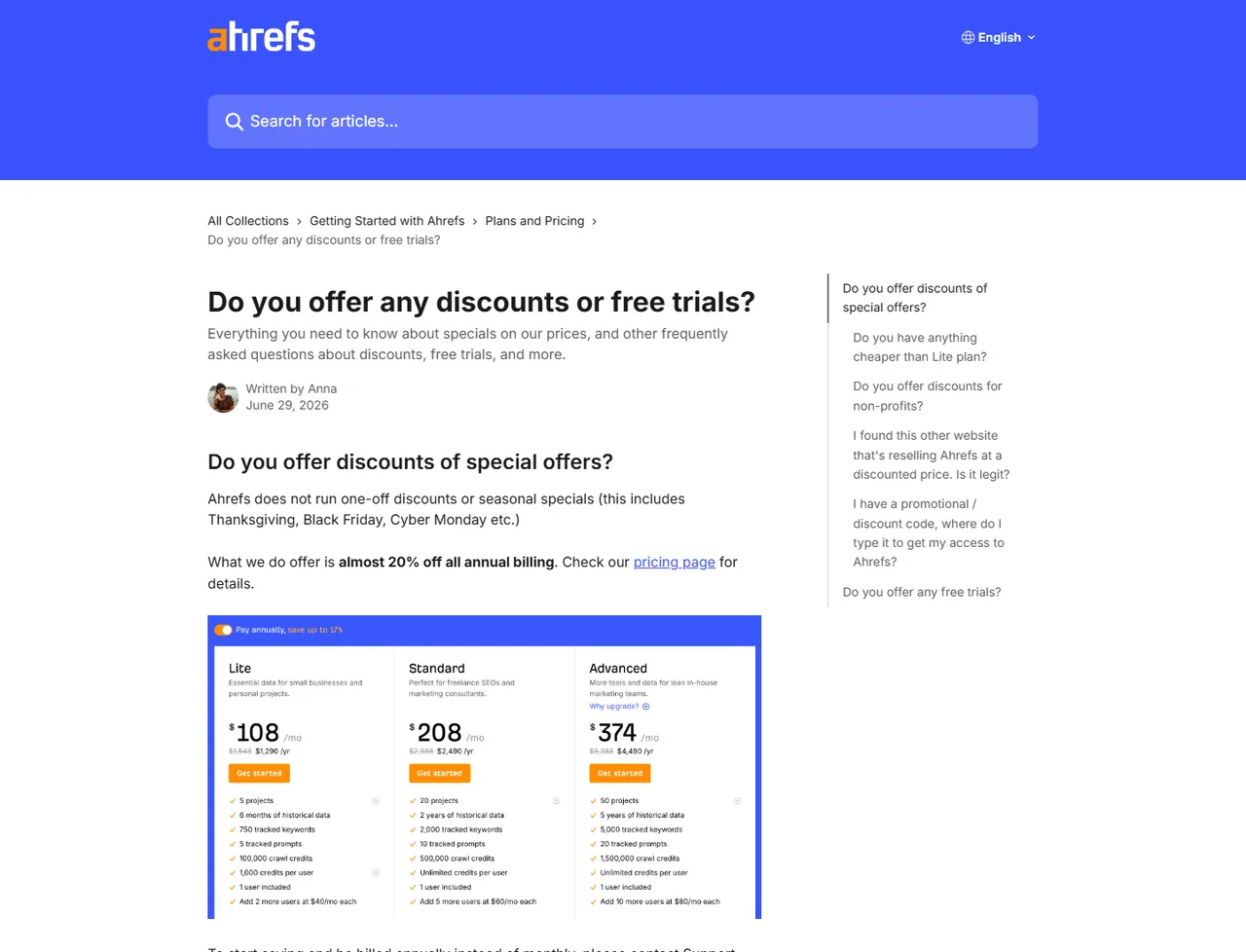
Ahrefs’s own help centre, read 25 August 2026. Both the article title and the sidebar entry lower down carry the trial question as a standing FAQ, and the vendor’s answer is no. A vendor that publishes “we don’t run trials” as an evergreen page is saying something specific about how they expect their product to be evaluated, and the article’s advice - a paid month treated as the trial - follows from that.
Use a free plan when the answer depends on habit
Some purchases fail not because the tool was bad but because nobody opened it. A free plan tests that for as long as you need. Reach for one when your question is behavioural:
- Will the team actually log in every day?
- Does this fit how we already work, or does it need a new process?
- Is one person going to own it?
Canva and Notion both run persistent free tiers that people can keep using indefinitely without ever starting a paid subscription. The free tier is generous enough that adoption happens before anyone considers the invoice.
How to run a trial that tells you something
Most trials are wasted. A structure that works:
- Write the decision down first. One sentence: “We will buy this if it can X by date.” Vague evaluations always end in a renewal nobody chose.
- Do not start until you have time. A trial begun the week before a launch is a trial thrown away. Start it on a Monday you have actually protected.
- Import real data in the first hour. Not the sample dataset. Yours, with its inconsistencies.
- Attempt the one task you are buying it for. If that takes more than a day, that is your answer.
- Check the export before the end. Verify you can get your data out while you still have access.
- Set a reminder two days before it expires. Decide deliberately rather than by default.
The restrictions that quietly ruin evaluations
Read these before you start, because each one blocks a specific test:
- Row and export caps. You cannot validate data quality on 25 rows.
- No API access. You cannot test the integration that justifies the purchase.
- Single seat. You cannot test collaboration, which for many tools is the point.
- No historical data. You cannot check whether the trend reporting is any use.
- Watermarks or vendor branding. You cannot put the output in front of a client.
Extend the trial - it usually works
Ask. Sales teams extend trials routinely, particularly if you explain what you still need to test. I’ve asked for and got extensions on Semrush, Ahrefs and half a dozen others over the years, and the highest hit rate has always been the same line: “I’ve imported everything but haven’t been able to run the one report I need to see before deciding - can I get another seven days?” A vendor who refuses a reasonable extension when you have a specific, articulated test remaining is telling you something about how the relationship will go after you sign.
What we look for when we record trial terms
On every software profile here we record the trial length, whether a card is required, and whether a free plan exists - because those three facts change how a buyer should approach the product, and vendors bury them. If we have a field marked as not disclosed, it means we looked and the vendor does not publish it. See our methodology for how that verification works.
Trial or free plan? Work down this list
-
Do you need a paid feature to evaluate it at all?
API access, SSO, team permissions, integrations, higher limits. Yes, take the trial. Free plans almost always withhold exactly these, so a free plan cannot answer the question.
-
Are you testing whether your team will actually adopt it?
Habits form over weeks, not days. Use the free plan, because a 14-day clock measures your enthusiasm rather than their behaviour.
-
Does the thing you need to verify happen monthly?
Month-end reporting, invoicing runs, renewal cycles. You need at least 30 days, so a 14-day trial cannot show you the one event that matters.
-
Is the risk mainly about your data rather than the features?
Import fidelity, export quality, migration effort. Either works, but do the import on day one instead of exploring the demo content.
-
Is there neither a trial nor a free plan?
Some vendors offer only limited free access instead. Buy one month, monthly, and treat the first month as the trial. Do not sign an annual term to evaluate something.
Trial evaluation worksheet
Decide what success looks like before you start, because a trial spent exploring feels productive and proves nothing. Nothing here is saved or sent anywhere.
Before you start the clock
During the trial
If the export failed or nobody but you used it, the answer is no regardless of how good the product felt.
Frequently asked questions
What is the difference between a free trial and a free plan?
A free trial gives full or near-full access for a fixed period, usually 7 to 30 days, then stops. A free plan is a permanently free tier with reduced limits or missing features. A trial tests capability; a free plan tests adoption.
How long should a SaaS free trial be?
Long enough to complete one real cycle of the work. For a daily-use tool, 7 days is enough. For anything measured monthly - reporting, email campaigns, rank tracking - 14 to 30 days is the minimum honest length, because a shorter trial cannot show you a result.
Should I give a credit card for a free trial?
It is normal and usually fine, but set a calendar reminder for two days before the trial ends. Card-required trials convert automatically by design. If a vendor makes cancellation harder than signup, treat that as information about the company.
Do free trials of SaaS tools give you the full product?
Often not. Common restrictions are export limits, capped rows or records, no API access and no integrations. Check the restrictions before you start, because they frequently block the exact test you intended to run.
What should I do in the first hour of a trial?
Import your own real data and attempt the single task you are buying the tool for. Demo data and guided tours are designed to succeed. Your data is the only test that predicts anything.
One-click Google setting
Get our writing surfaced first on Google
If this was useful, add EveryAny.One as a preferred source in Google. Our profiles and best-of guides will appear ahead of the rest in Top Stories, AI Mode and AI Overviews when you search for software.
- Our reviews get a "preferred" badge in Top Stories and AI Overviews.
- AI Mode leans on the sources you've chosen when it answers.
- Change it back any time from the same Google page.

Opens Google's source preferences in a new tab.
Sources & verification
Facts on this page were read from the sources below on the dates shown. Where a vendor does not publish a figure, we record it as not disclosed rather than estimating it.
- Semrush trial terms - checked 25 July 2026
- HubSpot product trials - checked 9 August 2026
- Ahrefs on discounts and free trials - checked 9 August 2026
- Canva pricing, including the free plan - checked 9 August 2026
- Notion pricing, including the free plan - checked 25 July 2026
Spotted something out of date? Email [email protected] and we will re-check it. Corrections are logged on the page.


