

Netlify
Git-driven hosting for the front end, now billed in credits.
- Development
- Design
- Productivity
- from $9/mo
Netlify hosts front-end sites and applications, building from a Git repository and deploying to a global CDN with preview URLs for every branch and pull request. It popularised the deploy-on-push workflow that competitors copied, and in 2025 moved from fixed per-seat tiers to a credit-based model that changes how you should budget for it.
Netlify: the short answer
Every line below is drawn from facts verified on 9 August 2026.
- What it is
- Git-driven hosting for the front end, now billed in credits
- Best for
- Static sites and front-end applications built from Git
- Starts at
- Free with a 300-credit limit; Personal $9/month, Pro from $20/month
- Free option
- Free plan available, no trial
- Biggest strength
- Deploy previews per pull request, which changed how front-end teams review
- Biggest drawback
- Credit-based billing is hard to forecast before a full month of use
- Based on
- Primary-source research, not hands-on use
- Closest alternative
- Vercel - Better if you build with Next.js, since both come from the same team
- True annual cost
- from $108 a year on Personal, the cheapest paid tier ($9 a month)
Netlify at a glance
| Best for | Static sites and front-end applications built from Git, Teams that review work through deploy previews, Projects wanting hosting without infrastructure work |
|---|---|
| Category | Development, Design, Productivity |
| Starting price | Free with a 300-credit limit; Personal $9/month, Pro from $20/month |
| Free plan | Yes |
| Free trial | No trial offered |
| Pricing model | usage based |
| Company | Netlify, Inc. |
| Founded | 2014 |
| Headquarters | San Francisco, California, United States |
| Founders | Mathias Biilmann Christensen, Christian Bach |
| Platforms | Web, CLI |
| Public API | Yes |
| Browser extension | No |
| Mobile apps | None |
| Self-hosting | No |
| Affiliate programme | No |
| Data source | Vendor pricing page and public records |
| Last checked | August 2026 |
Netlify pricing
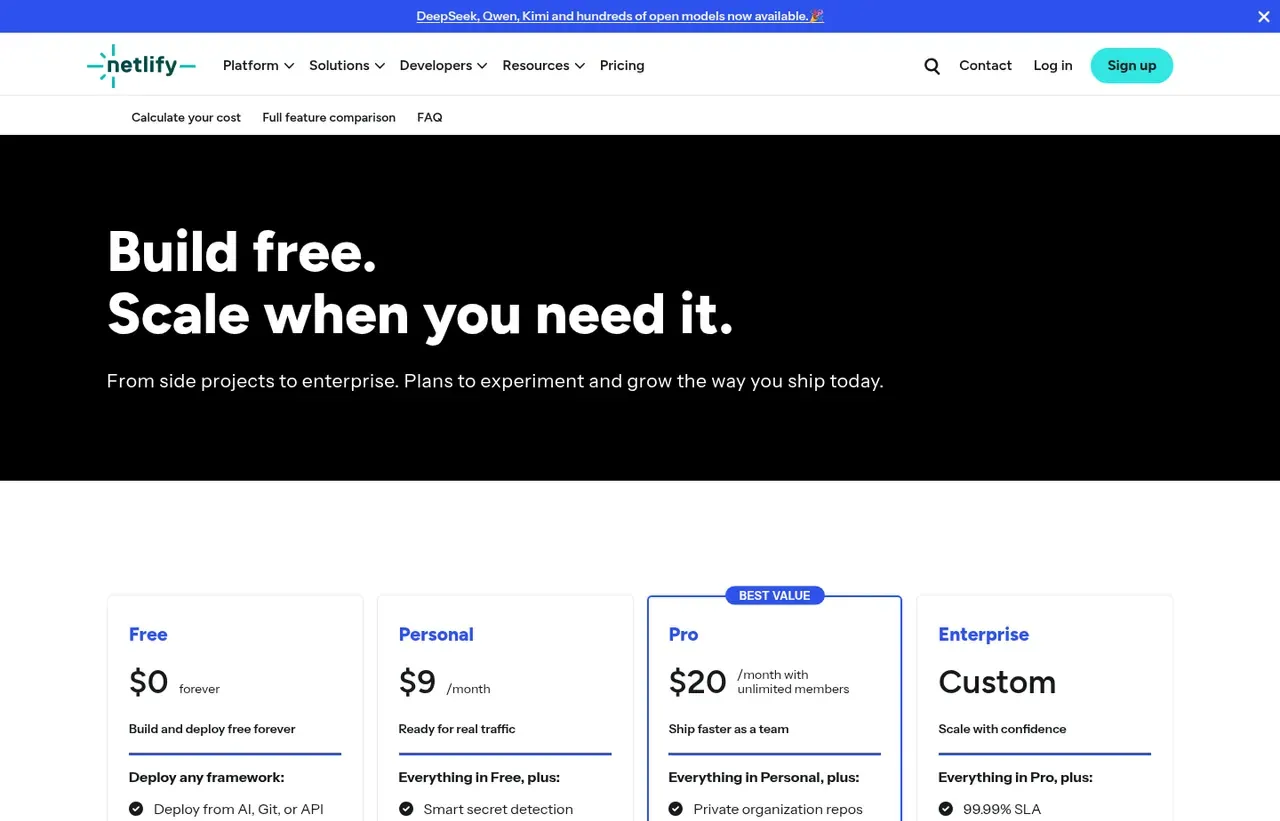
Prices below were read from the vendor's own pricing page on 9 August 2026. Pricing model: usage based. No free trial is offered.
| Plan | Price | Billing | Notes |
|---|---|---|---|
| Free | $0 | per month | 300 credit limit, 1 member, 1 concurrent build, 1-day observability |
| Personal | $9 | per month | 1,000 credits included, 1 member. Extra credits $5 per 500 |
| Pro | From $20 | per month | From 3,000 credits, tiers up to 20,000. Unlimited members. Extra credits $10 per 1,500 |
| Enterprise | Custom | Negotiated | Custom credits, SAML SSO, SCIM, 30-day observability |
| Add-ons | $40 | per month | Per extra concurrent build. Preview Servers $15 each beyond the first |
What Netlify actually costs over a year
A monthly price is not the same thing as a monthly contract. These are the plans above resolved both ways, per seat or unit where the plan is charged that way. Where a vendor quotes only a yearly figure it is divided by twelve rather than left out, and the Quoted column says which figure the vendor actually publishes.
| Plan | Quoted | Monthly | Over 12 months |
|---|---|---|---|
| Personal | per month | $9 | $108 |
| Pro | per month | $20 | $240 |
| Add-ons add-on | per month | $40 | $480 |
Which Netlify plan should you buy?
| Your situation | Recommended | Why |
|---|---|---|
| You are deploying a personal project | Free | A 300-credit limit rather than a generous allowance. Evaluate with your real traffic in mind. |
| You host one production site with modest traffic | Personal | $9 a month with 1,000 credits included. Extra credits are $5 per 500. |
| A team ships together | Pro | From $20 with unlimited members and credit tiers up to 20,000. Unlimited members is unusual and genuinely valuable. |
| You cannot forecast your usage | Run a month on Personal first | Credits cover deploys, compute, forms, bandwidth and requests from one pool. No amount of reading the page substitutes for a month of your own data. |
| Your costs are dominated by bandwidth | Consider Cloudflare Pages instead | Cheaper at volume with a more generous free tier. |
| You build with Next.js | Consider Vercel instead | Same team as the framework, so the fit is tighter for ISR and image optimisation. |
Verdict by who you are
Front-end team reviewing work visuallyYes
Deploy previews per pull request changed how front-end review works, and Netlify's remains the most frictionless implementation.
Team with many members on one siteYes
Unlimited members on Pro, where competitors charge per seat.
Site with heavy bandwidthCompare first
Credits cover bandwidth, so traffic spikes draw on the same pool as builds. Cloudflare is cheaper here.
Next.js applicationCompare first
Works, with more configuration. Vercel is smoother for that specific framework.
Buyer wanting predictable monthly costsNo
Credit-based billing is hard to forecast before you have run a full month.
Should you buy Netlify?
Buy Netlify if…
- Static sites and front-end applications built from Git
- Teams that review work through deploy previews
- Projects wanting hosting without infrastructure work
Do not buy Netlify if…
- Predictable flat-rate budgeting
- Backend-heavy applications needing long-running processes
- Teams already standardised on Vercel or Cloudflare
Key features
- Deploy on push from GitHub, GitLab or Bitbucket
- Deploy Previews for every branch and pull request
- Global CDN with instant cache invalidation
- Serverless and Edge Functions
- Netlify Forms with submission handling built in
- Netlify Database, a provisioned Postgres instance
- One-click rollback to any previous deploy
- Redirects, rewrites and headers as repository config
Integrations
- GitHub, GitLab and Bitbucket
- Astro, Next.js, Nuxt, SvelteKit and most frameworks
- Contentful, Sanity and headless CMS platforms
- Slack and Sentry
- Netlify API and CLI
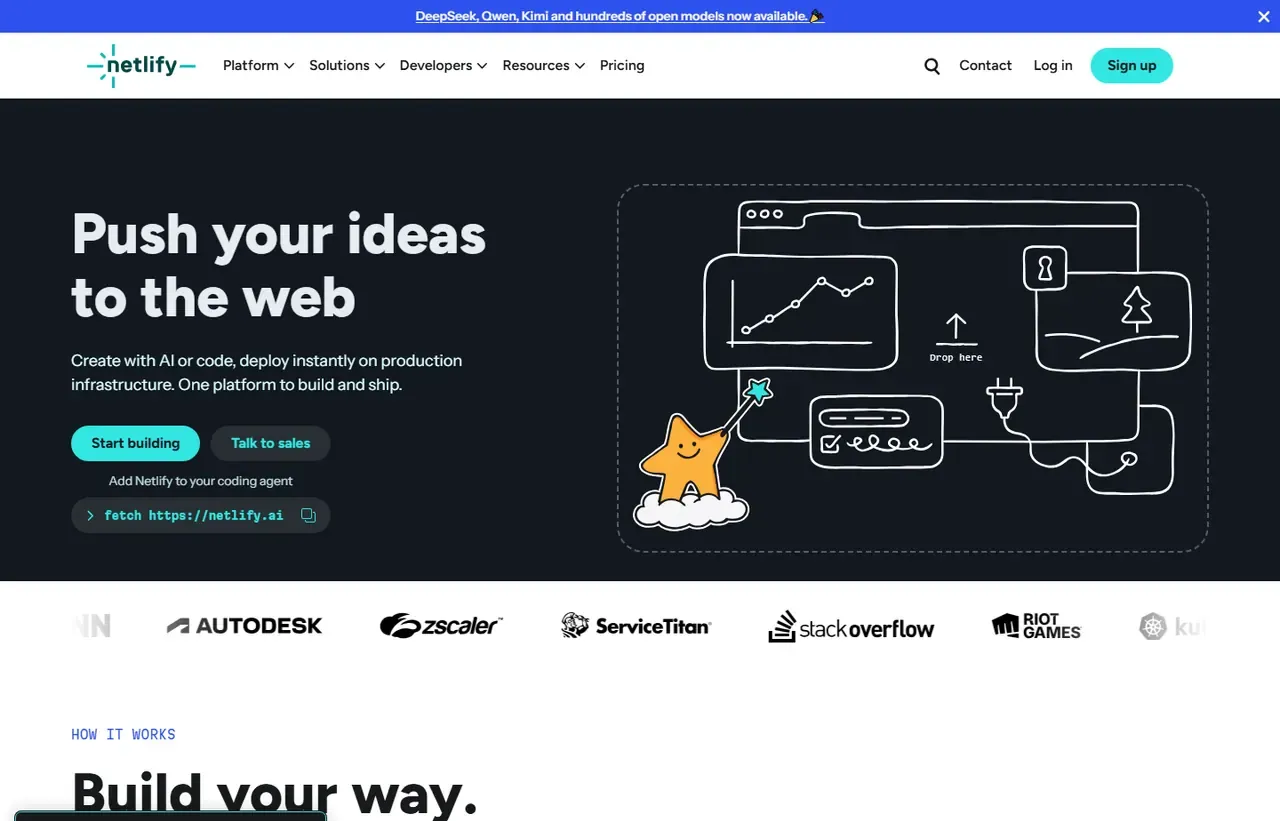
Netlify screenshots
Captured by us in August 2026 at 1440px, unedited. Interfaces change, so these show the product as it looked on the date we verified this profile. Pricing pages are captured from a US vantage point, so the currency shown matches the USD figures recorded above.
Our assessment
Netlify invented the workflow most front-end teams now take for granted, and the developer experience remains excellent: connect a repository, get a URL, get a preview for every pull request. The reservation is the pricing change. Credits now cover production deploys, compute, form submissions, bandwidth and web requests from one pool, so a traffic spike, a chatty build schedule and a busy contact form all draw on the same balance. That is more honest about where cost comes from than per-seat pricing was, and much harder to forecast before you have run a month. The Free plan is a 300-credit limit rather than a generous allowance, so evaluate with your real traffic in mind.
What works in Netlify
- Deploy previews per pull request, which changed how front-end teams review
- Excellent framework support and near-zero configuration
- Instant rollback to any previous deploy
- Unlimited members on Pro, unlike per-seat competitors
What doesn't
- Credit-based billing is hard to forecast before a full month of use
- Free plan is a 300-credit limit rather than a generous allowance
- Bandwidth costs more than Cloudflare at scale
- Extra concurrent builds are $40 each
EveryAny Decision Score
3 of these 8 dimensions are calculated from verified facts; the rest are our judgement, shown as a band rather than a figure unless something specific sits behind them. How each score works.
- Cost position6.3/10
derivedentry tier at $9 a month against a category median of $15 a month across 16 comparable tools
- Portability5/10
derivedpublic API
- Subscription flexibility6/10
derivedfree plan, usage based, monthly billing
- Feature depthHigh
editorialour judgement, with no measurement behind it
- Ease of learningHigh
editorialour judgement, with no measurement behind it
- CollaborationVery high
editorialour judgement, with no measurement behind it
- AI capabilityModerate
editorialour judgement, with no measurement behind it
- Professional adoptionHigh
editorialour judgement, with no measurement behind it
What leaving Netlify would cost
moderate lock-in
Netlify scores on public API. Portability 5/10 ; lock-in is the inverse. How this is calculated.
Netlify competitors and alternatives
| Alternative | Why you might pick it instead |
|---|---|
| Vercel | Better if you build with Next.js, since both come from the same team. |
| Cloudflare Pages | More generous free limits and cheaper bandwidth at scale. |
| GitHub Pages | Free and sufficient for genuinely static documentation. |

Vercel
Development
Deployment platform for frontend frameworks, built by the team behind Next.js.
Checked Aug 2026
Credits replaced seats, and that changes the maths
Netlify no longer prices primarily per member. One pool of monthly credits covers production deploys, compute, form submissions, bandwidth and web requests, and each plan includes an allowance: 300 as a hard limit on Free, 1,000 included on Personal, and from 3,000 on Pro with selectable tiers up to 20,000.
Overage is priced per plan rather than uniformly: $5 per 500 additional credits on Personal, $10 per 1,500 on Pro. Auto-recharge is disabled by default, which is the right default and worth leaving alone until you know your baseline.
The practical consequence is that a marketing site with heavy traffic and a small team can now cost more than a quiet application with a large team. If your last mental model of Netlify was “free for small projects, $19 a seat above that”, it is out of date.
Deploy previews are still the reason to choose it
Every pull request gets its own live URL. Reviewers see the change rather than reading a diff, and feedback syncs back to the pull request. Competitors offer this now, but Netlify’s implementation is still the most frictionless, and for teams with designers or stakeholders in the review loop it removes a genuine bottleneck.
Where Vercel and Cloudflare win
If you build with Next.js, Vercel made both and the fit is tighter, particularly for incremental static regeneration and image optimisation. If your costs are dominated by bandwidth, Cloudflare’s network is cheaper at volume and its free tier is materially more generous. Netlify’s argument is neither raw price nor framework alignment; it is that the workflow is excellent and framework-agnostic.
What to check before committing
Run a full month on Free or Personal and watch the credit burn before choosing a Pro tier. Credits are the whole cost model now, and no amount of reading the pricing page substitutes for seeing your own deploy frequency, build minutes and traffic converted into a number.
Netlify questions, answered
- Is Netlify worth it?
- Netlify invented the workflow most front-end teams now take for granted, and the developer experience remains excellent: connect a repository, get a URL, get a preview for every pull request.
- How much does Netlify cost?
- Free with a 300-credit limit; Personal $9/month, Pro from $20/month. The cheapest paid tier we recorded is Personal, published at $9 a month, which works out at $9 a month or $108 over a year. Verified against the vendor's pricing page.
- Does Netlify have a free plan or free trial?
- Netlify has a free plan. No free trial is offered.
- What is the best Netlify alternative?
- It depends on the job. Vercel: Better if you build with Next.js, since both come from the same team. Cloudflare Pages: More generous free limits and cheaper bandwidth at scale. GitHub Pages: Free and sufficient for genuinely static documentation.
- Can I self-host Netlify?
- No. Netlify is a hosted service only, so your data lives on the vendor's infrastructure.
What this profile is based on
Every claim below is about our work, not about Netlify. A "no" is recorded rather than omitted, because the difference between a tested review and careful desk research is the reader's to weigh. How we research a profile.
-
Prices read from the vendor : yes
Read from Netlify's own pricing page on 9 August 2026
-
Plans and terms recorded : yes
5 rows, each with its billing period
-
Original screenshots : yes
2 captured by us: homepage, pricing page
-
Sources cited and dated : yes
1 primary source, each with the date it was read
-
Product used first-hand : no
Not tested. This profile is desk research from primary sources
-
Alternatives used first-hand : no
None, so comparisons here rest on published facts rather than use
-
Vendor contacted : no
Not contacted for this profile
One-click Google setting
Get our writing surfaced first on Google
If this was useful, add EveryAny.One as a preferred source in Google. Our profiles and best-of guides will appear ahead of the rest in Top Stories, AI Mode and AI Overviews when you search for software.
- Our reviews get a "preferred" badge in Top Stories and AI Overviews.
- AI Mode leans on the sources you've chosen when it answers.
- Change it back any time from the same Google page.

Opens Google's source preferences in a new tab.
Provenance and freshness
When each fact was last checked
- Pricing ·
- Plans ·
- Free trial
- Features
- Platforms
- Integrations
- Affiliate programme
- Company details
What has changed
-
August 2026
- Recorded the move to credit-based pricing, replacing per-seat tiers
- Added plan picker and verdicts
Sources & verification
Facts on this page were read from the sources below on the dates shown. Where a vendor does not publish a figure, we record it as not disclosed rather than estimating it.
- Netlify pricing - checked 9 August 2026
Spotted something out of date? Email [email protected] and we will re-check it. Corrections are logged on the page.

