

Obsidian is a knowledge base that works on a local folder of plain Markdown files. There is no account and no server unless you buy Sync, so the notes remain readable by any text editor and outlive the software. Bidirectional links and a graph view turn that folder into a connected body of thought.
Obsidian: the short answer
Every line below is drawn from facts verified on 9 August 2026.
- What it is
- Markdown files on your own disk, with a graph on top
- Best for
- Personal knowledge management and research
- Starts at
- Free for personal and commercial use; Sync $4 per user/month billed annually
- Free option
- Free plan available, no trial
- Biggest strength
- Plain Markdown files on your own disk, with no lock-in
- Biggest drawback
- Not built for real-time team collaboration
- Based on
- Primary-source research, not hands-on use
- Closest alternative
- Notion - Far better for collaboration and databases, hosted on their servers
- True annual cost
- from $48 a year on Sync, the cheapest paid tier ($4 a month)
Obsidian at a glance
| Best for | Personal knowledge management and research, Anyone who wants their notes to outlast the app, Writers and academics working with long-lived reference material |
|---|---|
| Category | Productivity, Development |
| Starting price | Free for personal and commercial use; Sync $4 per user/month billed annually |
| Free plan | Yes |
| Free trial | No trial offered |
| Pricing model | freemium |
| Company | Dynalist Inc. |
| Founded | 2020 |
| Headquarters | Remote, incorporated in Canada |
| Founders | Shida Li, Erica Xu |
| Platforms | Windows, macOS, Linux, iOS, Android |
| Public API | No |
| Browser extension | Yes |
| Mobile apps | iOS + Android |
| Self-hosting | Yes |
| Affiliate programme | No |
| Data source | Vendor pricing page and public records |
| Last checked | August 2026 |
Obsidian pricing
Prices below were read from the vendor's own pricing page on 9 August 2026. Pricing model: freemium. No free trial is offered.
| Plan | Price | Billing | Notes |
|---|---|---|---|
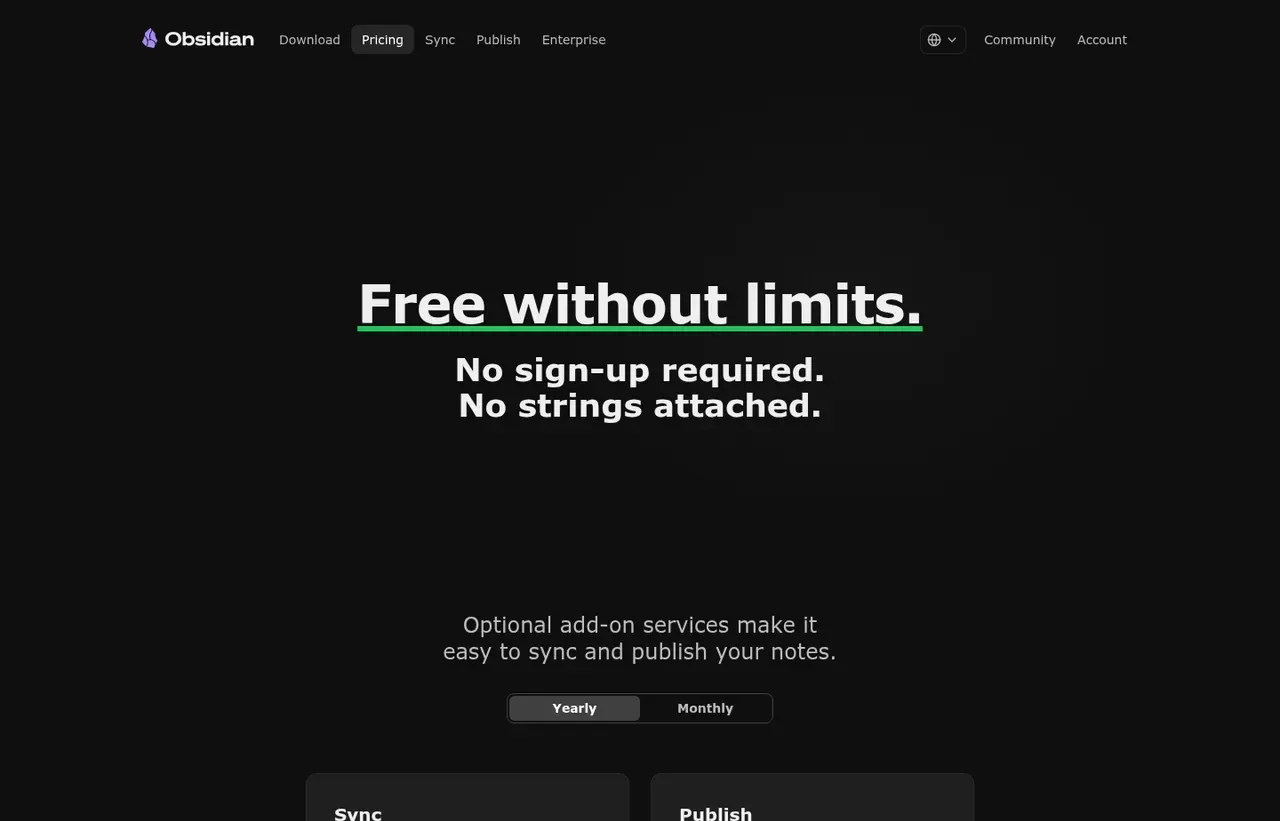
| Obsidian app | $0 | per one-time | Free without limits, no sign-up. Commercial licence is optional, not required |
| Sync | $4 | per month | per user - Billed annually, or $5 monthly. End-to-end encrypted, with version history |
| Publish | $8 | per month | Per site, billed annually, or $10 monthly |
| Catalyst | $25 | per one-time | Optional supporter licence for beta access and community badges |
| Commercial | $50 | per year | per user - Optional. Obsidian states it is not required for commercial use |
What Obsidian actually costs over a year
A monthly price is not the same thing as a monthly contract. These are the plans above resolved both ways, per seat or unit where the plan is charged that way. Where a vendor quotes only a yearly figure it is divided by twelve rather than left out, and the Quoted column says which figure the vendor actually publishes.
| Plan | Quoted | Monthly | Over 12 months |
|---|---|---|---|
| Syncper user | per month | $4 | $48 |
| Publish | per month | $8 | $96 |
| Commercialper user | per year | $4.17 | $50 |
Which Obsidian plan should you buy?
| Your situation | Recommended | Why |
|---|---|---|
| You want a personal knowledge base at no cost | Obsidian app | Free without limits and no sign-up. The commercial licence is explicitly optional, including at work. |
| You need notes synced across devices reliably | Sync | $4 per user a month billed annually, with end-to-end encryption. You can use iCloud or Dropbox free instead, at the cost of conflict handling. |
| You want to publish notes as a website | Publish | $8 per site a month billed annually. |
| You are a student, teacher or non-profit employee | Ask for the 40% discount | Applies to both Sync and Publish. |
| You want to support the project | Catalyst or Commercial | $25 once, or $50 per user a year. Both are voluntary; neither unlocks functionality you lack. |
| Several people must edit the same page at once | Do not use Obsidian | This is a single-person tool. Notion or Confluence for real-time collaboration. |
Verdict by who you are
Researcher or writer keeping long-lived notesYes
Plain Markdown files on your own disk means the notes outlast the software, the company and any pricing change. For a twenty-year reference library nothing else compares.
Privacy-conscious individualYes
Works fully offline, collects no telemetry, and stores nothing on their servers unless you buy Sync.
Team needing shared documentationNo
Shared vaults exist but are not comparable to real-time collaborative editing.
Non-technical user wanting defaultsCompare first
The flexibility is the risk. It is genuinely possible to spend weeks configuring plugins instead of writing.
Company worried about commercial licensingYes
Obsidian's own FAQ states you are not required to pay for commercial use. Using it at work is free.
Should you buy Obsidian?
Buy Obsidian if…
- Personal knowledge management and research
- Anyone who wants their notes to outlast the app
- Writers and academics working with long-lived reference material
Do not buy Obsidian if…
- Real-time collaborative team documentation
- Non-technical users who want defaults rather than choices
- Structured databases and project tracking
Key features
- Notes stored as plain Markdown files in a local folder
- Bidirectional links and backlinks between notes
- Graph view of the connections in a vault
- Very large community plugin ecosystem
- Works entirely offline with no account
- Canvas for spatial arrangement of notes
- Web Clipper extension for saving pages
- Optional end-to-end encrypted Sync across devices
Integrations
- Any tool that reads Markdown files
- Git, for versioning a vault yourself
- Zotero, through community plugins
- iCloud, Dropbox or OneDrive as a free sync alternative
- Obsidian Web Clipper
Obsidian screenshots
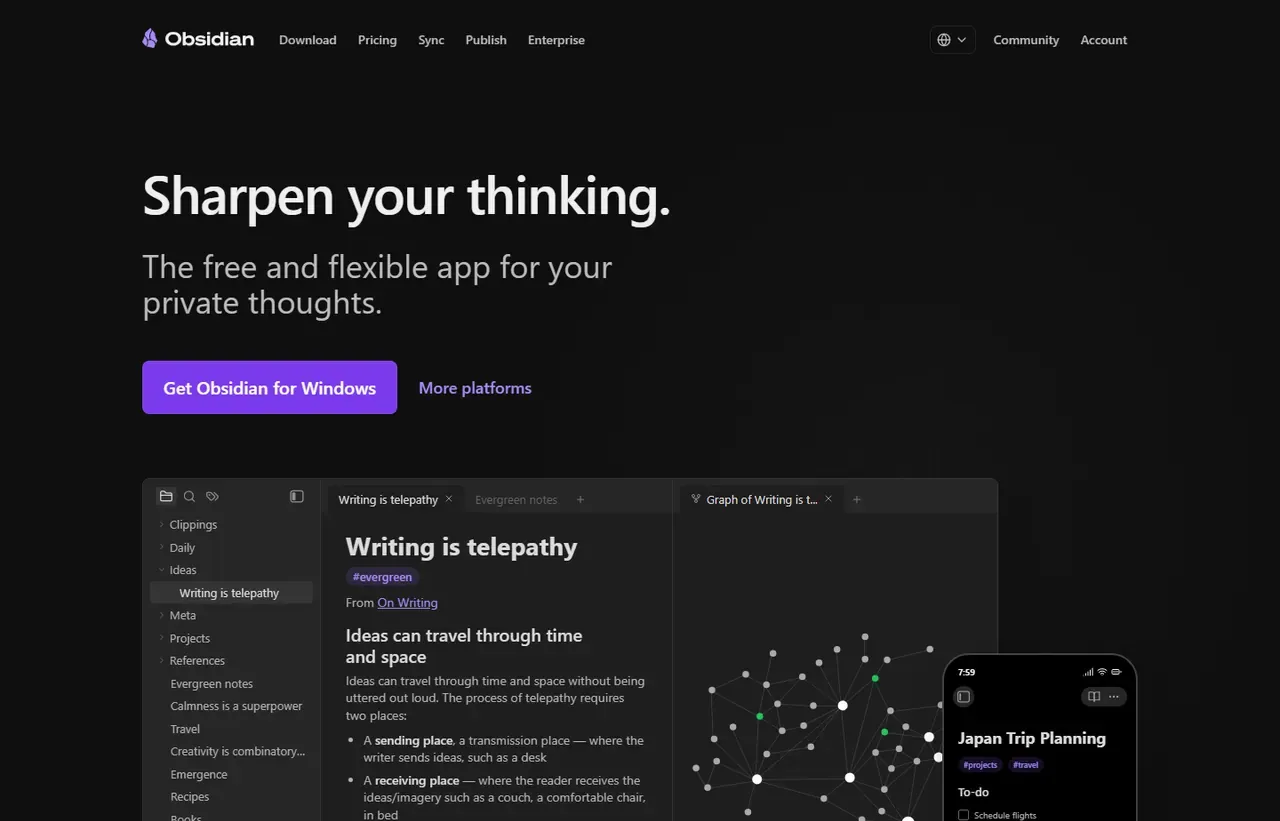
Captured by us in August 2026 at 1440px, unedited. Interfaces change, so these show the product as it looked on the date we verified this profile. Pricing pages are captured from a US vantage point, so the currency shown matches the USD figures recorded above.
Our assessment
Obsidian's central promise is unusual and worth taking seriously: your notes are ordinary Markdown files in a folder you control, so nothing is hostage to the company's survival, pricing or roadmap. For long-lived personal knowledge that matters more than any feature. The linking and graph genuinely change how connected notes feel, and the plugin ecosystem is enormous. The honest trade is that it is a tool for one person. Collaboration is not really there, shared vaults on Sync are limited compared with any web app, and the flexibility that makes it powerful means you can spend weeks configuring plugins instead of writing. Note also that the commercial licence is explicitly optional, which is often reported wrongly.
What works in Obsidian
- Plain Markdown files on your own disk, with no lock-in
- Works fully offline with no account required
- Bidirectional linking and graph view are genuinely useful
- Bootstrapped and user-funded, with no investor pressure
What doesn't
- Not built for real-time team collaboration
- Plugin configuration can become a hobby in itself
- No databases or structured project tracking
- Sync and Publish are separate paid subscriptions
EveryAny Decision Score
3 of these 8 dimensions are calculated from verified facts; the rest are our judgement, shown as a band rather than a figure unless something specific sits behind them. How each score works.
- Cost position8.9/10
derivedentry tier at $4 a month against a category median of $9.99 a month across 28 comparable tools
- Portability6/10
derivedself-hostable
- Subscription flexibility7/10
derivedfree plan, freemium, monthly billing
- Feature depthHigh
editorialour judgement, with no measurement behind it
- Ease of learningModerate
editorialour judgement, with no measurement behind it
- CollaborationLow
editorialour judgement, with no measurement behind it
- AI capabilityLow
editorialour judgement, with no measurement behind it
- Professional adoptionHigh
editorialour judgement, with no measurement behind it
What leaving Obsidian would cost
moderate lock-in
Obsidian scores on self-hostable. Portability 6/10 ; lock-in is the inverse. How this is calculated.
Obsidian competitors and alternatives
| Alternative | Why you might pick it instead |
|---|---|
| Notion | Far better for collaboration and databases, hosted on their servers. |
| Logseq | Similar local-first philosophy with an outliner structure. |
| Apple Notes | Free, synced and sufficient if you do not need linking or plugins. |

Notion
Productivity
Connected workspace combining docs, databases, wikis and project tracking.
Checked Aug 2026
The commercial licence is optional, and they say so
This gets reported incorrectly often enough to correct directly. Obsidian’s own FAQ answers “Do I have to pay for commercial use?” with: “No. You are not required to pay for a commercial license.” It goes on to encourage organisations to buy one at $50 per user per year to keep the project user-funded.
So using Obsidian at work is free. The $50 licence is a voluntary contribution with some recognition attached, and the $25 Catalyst licence is the same idea for individuals, buying early access to betas and community badges rather than any functional unlock.
What actually costs money
Two optional services:
- Sync: $4 per user per month billed annually, or $5 monthly. End-to-end encrypted with AES-256, version history, and shared vaults.
- Publish: $8 per site per month billed annually, or $10 monthly. Turns a vault into a website.
Students, faculty and non-profit employees get 40% off both. Refunds are available within 7 days on Sync and Publish; Catalyst and Commercial licences are non-refundable.
You can skip Sync entirely by putting your vault in iCloud, Dropbox or OneDrive, or by versioning it with Git. That works and many people do it. What you give up is end-to-end encryption, reliable mobile behaviour and conflict handling, which is what the $4 buys.
Files you own is the whole point
A vault is a folder. Notes are .md files. Attachments sit beside them. There is no database, no
proprietary format and no export step, because there is nothing to export from.
The consequences are worth spelling out. If Obsidian were discontinued tomorrow, your notes would open in any text editor. If a future version changed in ways you disliked, you could stop updating. If you want to process your notes with a script, they are already plain text. Obsidian also collects no telemetry and stores nothing on its servers unless you use Sync.
For a reference library you expect to keep for twenty years, that architecture is the feature, and no hosted competitor can match it.
Where it is the wrong tool
Teams. Obsidian is built around one person’s vault, and while Sync supports shared vaults, it is not comparable to real-time collaborative editing. If several people need to write the same page at once, Notion or Confluence is the right answer and Obsidian will frustrate everyone.
It also has no databases, no boards and no project tracking. And because almost everything is configurable through community plugins, there is a genuine risk of optimising your note-taking setup instead of taking notes. That is a real failure mode, not a joke, and worth watching for.
Obsidian questions, answered
- Is Obsidian worth it?
- Obsidian's central promise is unusual and worth taking seriously: your notes are ordinary Markdown files in a folder you control, so nothing is hostage to the company's survival, pricing or roadmap.
- How much does Obsidian cost?
- Free for personal and commercial use; Sync $4 per user/month billed annually. The cheapest paid tier we recorded is Sync, published at $4 a month, which works out at $4 a month or $48 over a year. Verified against the vendor's pricing page.
- Does Obsidian have a free plan or free trial?
- Obsidian has a free plan. No free trial is offered.
- What is the best Obsidian alternative?
- It depends on the job. Notion: Far better for collaboration and databases, hosted on their servers. Logseq: Similar local-first philosophy with an outliner structure. Apple Notes: Free, synced and sufficient if you do not need linking or plugins.
- Can I self-host Obsidian?
- Yes. Obsidian can be run on your own infrastructure, so the data stays under your control.
What this profile is based on
Every claim below is about our work, not about Obsidian. A "no" is recorded rather than omitted, because the difference between a tested review and careful desk research is the reader's to weigh. How we research a profile.
-
Prices read from the vendor : yes
Read from Obsidian's own pricing page on 9 August 2026
-
Plans and terms recorded : yes
5 rows, each with its billing period
-
Original screenshots : yes
2 captured by us: homepage, pricing page
-
Sources cited and dated : yes
1 primary source, each with the date it was read
-
Product used first-hand : no
Not tested. This profile is desk research from primary sources
-
Alternatives used first-hand : no
None, so comparisons here rest on published facts rather than use
-
Vendor contacted : no
Not contacted for this profile
One-click Google setting
Get our writing surfaced first on Google
If this was useful, add EveryAny.One as a preferred source in Google. Our profiles and best-of guides will appear ahead of the rest in Top Stories, AI Mode and AI Overviews when you search for software.
- Our reviews get a "preferred" badge in Top Stories and AI Overviews.
- AI Mode leans on the sources you've chosen when it answers.
- Change it back any time from the same Google page.

Opens Google's source preferences in a new tab.
Provenance and freshness
When each fact was last checked
- Pricing ·
- Plans ·
- Free trial
- Features
- Platforms
- Integrations
- Affiliate programme
- Company details
What has changed
-
August 2026
- Sync and Publish pricing verified, along with the optional commercial licence
- Added plan picker and verdicts
Sources & verification
Facts on this page were read from the sources below on the dates shown. Where a vendor does not publish a figure, we record it as not disclosed rather than estimating it.
- Obsidian pricing - checked 9 August 2026
Spotted something out of date? Email [email protected] and we will re-check it. Corrections are logged on the page.

