
Airtable Pricing
- Productivity pricing
- $20/mo at the smallest
- Free plan
Airtable pricing starts at $20 a month, which is $240 over twelve months. There is a free plan, and a trial on the paid tiers: 14 days on Business. Every figure below was read from the vendor's pricing page on 9 August 2026, and one charge that the headline price does not include is set out below.
Opens the vendor's own pricing page. Figures here were read from it on 9 August 2026.
Airtable ranking and coverage
- In Productivity
- #25 of 28 tied
- Overall
- #101 of 122 tied
- Terms score
- 4.5 /10
- Referenced here
- 1 page
Cost position 1.1 · Portability 3.5 · Subscription flexibility 9 - Ranked on published terms only: entry price against category peers, portability and subscription flexibility, equally weighted. This is not a quality score.How the rank is calculated.
Airtable pricing at a glance
| Entry price | Free plan available; Team from $20 per seat/month billed annually |
|---|---|
| Smallest invoice | $20 a month, or $240 a year |
| How that is reached | Team at $20 a month |
| Seat minimum | None on the entry plan |
| Free plan | Yes |
| Free trial | 14 days on Business |
| How it charges | freemium |
| Priced plans published | 4 rows on the vendor's page |
| Affiliate programme | No |
| Prices read from | The vendor's own pricing page |
| Last checked | 9 August 2026 |
Every Airtable plan and what it costs
Read from the vendor's own pricing page on 9 August 2026. Charged as freemium. Free trial: 14 days on Business.
| Plan | Price | Billing | What it is |
|---|---|---|---|
| Free | $0 | per month | Up to 5 editors, 1,000 records per base, limited automation runs |
| Team | $20 | per month | per seat, billed annually - $24 billed monthly. 50,000 records per base, standard sync |
| Business | $45 | per month | per seat, billed annually - $54 billed monthly. 125,000 records, SSO, admin panel |
| Enterprise Scale | Custom | Negotiated | Higher limits, enterprise governance and audit logs |
What Airtable costs beyond the advertised price
Each of these is a figure you can check on the vendor's own page. The arithmetic is shown so you can redo it rather than take our word for it.
- Monthly billing costs more$48 a year
The advertised $20 on Team is the annual-payment rate. Paying monthly is $24, so the commitment is worth $48 a year per seat.
Working$24 - $20 = $4 a month, x 12 = $48 a year per seat.
Computed from the plan table on Airtable pricing , read 9 August 2026
What Airtable actually costs over a year
A monthly price is not the same thing as a monthly contract. These are the plans above resolved both ways, per seat or unit where the plan is charged that way. Where a vendor quotes only a yearly figure it is divided by twelve rather than left out, and the Quoted column says which figure the vendor actually publishes.
| Plan | Quoted | Monthly | Over 12 months |
|---|---|---|---|
| Teamper seat, billed annually | per month | $20 | $240 |
| Businessper seat, billed annually | per month | $45 | $540 |
Airtable pricing over time
Read from 12 archived captures of the vendor's pricing page , spanning March 2016 to September 2026. Every figure below links to the capture it came from, so you can check it against the page as it stood on the day.
- Business has been published at $45 per user in every capture we read, from 3 August 2024 to 1 September 2026.
- Team has been published at $20 per user in every capture we read, from 3 August 2024 to 1 September 2026.
Business
| Published price | Charged | Seen from | Last seen | Capture |
|---|---|---|---|---|
| $45 | per user | 3 August 2024 | 1 September 2026 | Archive |
Team
| Published price | Charged | Seen from | Last seen | Capture |
|---|---|---|---|---|
| $20 | per user | 3 August 2024 | 1 September 2026 | Archive |
6 archived captures with no price we could read
The capture exists, but the figures on it could not be extracted - usually a page that renders prices in JavaScript, or a currency selector the archive did not record. Listed rather than dropped, because a gap in a price history reads as "nothing changed" and these are not that.
- 4 March 2016 - capture - no plan name sat next to a published figure in this capture
- 7 March 2019 - capture - no plan name sat next to a published figure in this capture
- 11 May 2020 - capture - no plan name sat next to a published figure in this capture
- 19 June 2021 - capture - no plan name sat next to a published figure in this capture
- 2 July 2022 - capture - no plan name sat next to a published figure in this capture
- 4 July 2023 - capture - no plan name sat next to a published figure in this capture
Compiled 18 September 2026 from the Internet Archive Wayback Machine. Plan names were matched against the archived page text and the first currency-anchored figure within 160 characters was recorded, rejecting any figure with a competing plan name standing between it and the name it was matched to. The currency and the unit were read from each capture rather than assumed: captures served in a currency other than $, and captures where no plan name sat beside a figure, are listed as unread rather than dropped. Archived pages show the price as served to the archive's crawler, which may differ by region from the price you are shown.
Airtable pricing against its competitors
Compared on the smallest invoice each vendor will accept, not on the advertised per-seat rate. Where a product has a seat minimum, the figure below is the minimum times the rate, because that is the cheque you would actually write.
| Product | Cheapest paid entry | Free plan | Against Airtable |
|---|---|---|---|
| Notion | $10 a month | Yes | −$10 a month (−50%) |
| Airtable | $20 a month | Yes | This product |
| monday.com | $27 a month | Yes | +$7 a month (+35%) |
Which Airtable plan should you buy?
| Your situation | Recommended | Why |
|---|---|---|
| You are testing whether a database beats your spreadsheet | Free | Five editors and 1,000 records per base. Enough to prove the idea, not to run on. |
| A small team needs a shared operational database | Team | $20 per seat billed annually and 50,000 records per base. This is the working tier for most teams. |
| You need SSO, admin controls or 125,000 records | Business | $45 per seat. Bought for governance and record ceilings rather than new capability. |
| Your dataset runs to hundreds of thousands of rows | Do not buy Airtable | Record limits are the real constraint. Use a database with a proper front end. |
| You want the same thing without record ceilings | Consider Baserow or NocoDB | Open source and self-hostable, so limits are your hardware rather than your plan. |
Verdict by who you are
Operations or marketing teamYes
The best tool for turning a spreadsheet that has outgrown itself into something with structure, views and automation.
Non-technical person building an internal toolYes
Interfaces let you ship something usable without engineering involvement.
Engineering team needing an app backendNo
Airtable is not a database for production software. Record limits and API rates will bite.
Team wanting project management out of the boxCompare first
You can build it, but Asana or monday.com arrive with it already built.
Organisation with data residency rulesNo
No self-hosting. Baserow or NocoDB are the equivalents you can run yourself.
Should you buy Airtable?
Buy Airtable if…
- Teams whose spreadsheet has outgrown itself
- Content calendars, inventories, CRMs and applicant tracking
- Operations people building internal tools without engineering
Do not buy Airtable if…
- Very large datasets, where record limits bite
- Teams needing a genuine application backend
- Organisations that want project management out of the box
What leaving Airtable would cost
moderate lock-in
Airtable scores on public API, documented migration friction averaging 2.5 of 3. Portability 3.5/10 , after 1.5 off for documented migration friction; lock-in is the inverse. How this is calculated.
| What you would move | Friction | Risk |
|---|---|---|
| Table data | Low | CSV export per table works, so the raw records leave intact. |
| Linked records and lookups | High | Relationships flatten on export and must be rebuilt in the destination. |
| Formulas and rollups | High | Airtable's formula syntax has no direct equivalent, so logic is rewritten by hand. |
| Automations and scripts | High | Every automation and scripting block needs recreating. |
| Interfaces | High | Custom interfaces are Airtable-only and have to be rebuilt as forms or an app. |
| Attachments | Moderate | Exported as expiring URLs, so files must be downloaded before the links lapse. |
Airtable's lock-in is proportional to how much logic you put in it. A flat table leaves easily; a base with interfaces, rollups and automations is effectively a small application you would be rewriting.
Records per base is the number that matters
Not seats, not features. The free plan holds 1,000 records per base, Team 50,000 and Business 125,000. A content calendar will never trouble those numbers. A base logging web form submissions, inventory movements or anything synced from another system will, and the failure is abrupt rather than gradual.
Before choosing a tier, count the rows your largest table will hold in two years, then double it.
Interfaces changed what Airtable is for
Originally you shared the base and hoped nobody broke it. Interfaces let you build a screen showing only what a particular role needs, with controlled editing, so the underlying structure is protected. That single addition turned Airtable from a shared spreadsheet into something closer to an internal application platform, and it is the main reason to prefer it over a plain database tool.
Seat cost is the other ceiling
At $20 per seat on Team, a twenty-person department is $4,800 a year, and Business at $45 doubles that. Airtable’s read-only sharing helps, but anyone who needs to edit needs a seat. The economics work best with a small number of editors and a wider audience consuming through interfaces or shared views.
Airtable or Notion?
Notion is better when the work is mostly documents with some structure. Airtable is better when the work is mostly structured records with some documentation. Teams that pick wrongly usually discover it when they need rollups and lookups across tables, which is where Airtable is clearly stronger.
Airtable questions, answered
- Is Airtable worth it?
- Airtable's insight is that most business "spreadsheets" are really databases used badly, and giving ordinary users linked records, typed fields and views fixes a genuine problem.
- How much does Airtable cost?
- Free plan available; Team from $20 per seat/month billed annually. The cheapest paid tier we recorded is Team, published at $20 a month, which works out at $20 a month or $240 over a year. Verified against the vendor's pricing page.
- Does Airtable have a free plan or free trial?
- Airtable has a free plan. A free trial is available: 14 days on Business.
- What is the best Airtable alternative?
- It depends on the job. Notion: Better when documents matter as much as the data. Baserow or NocoDB: Open source and self-hostable, without the record ceilings. Google Sheets: Free and adequate until you genuinely need relationships between tables.
- Can I self-host Airtable?
- No. Airtable is a hosted service only, so your data lives on the vendor's infrastructure.
Opens the vendor's own pricing page. Figures here were read from it on 9 August 2026.
What this profile is based on
Every claim below is about our work, not about Airtable. A "no" is recorded rather than omitted, because the difference between a tested review and careful desk research is the reader's to weigh. How we research a profile.
-
Prices read from the vendor : yes
Read from Airtable's own pricing page on 9 August 2026
-
Plans and terms recorded : yes
4 rows, each with its billing period
-
Original screenshots : yes
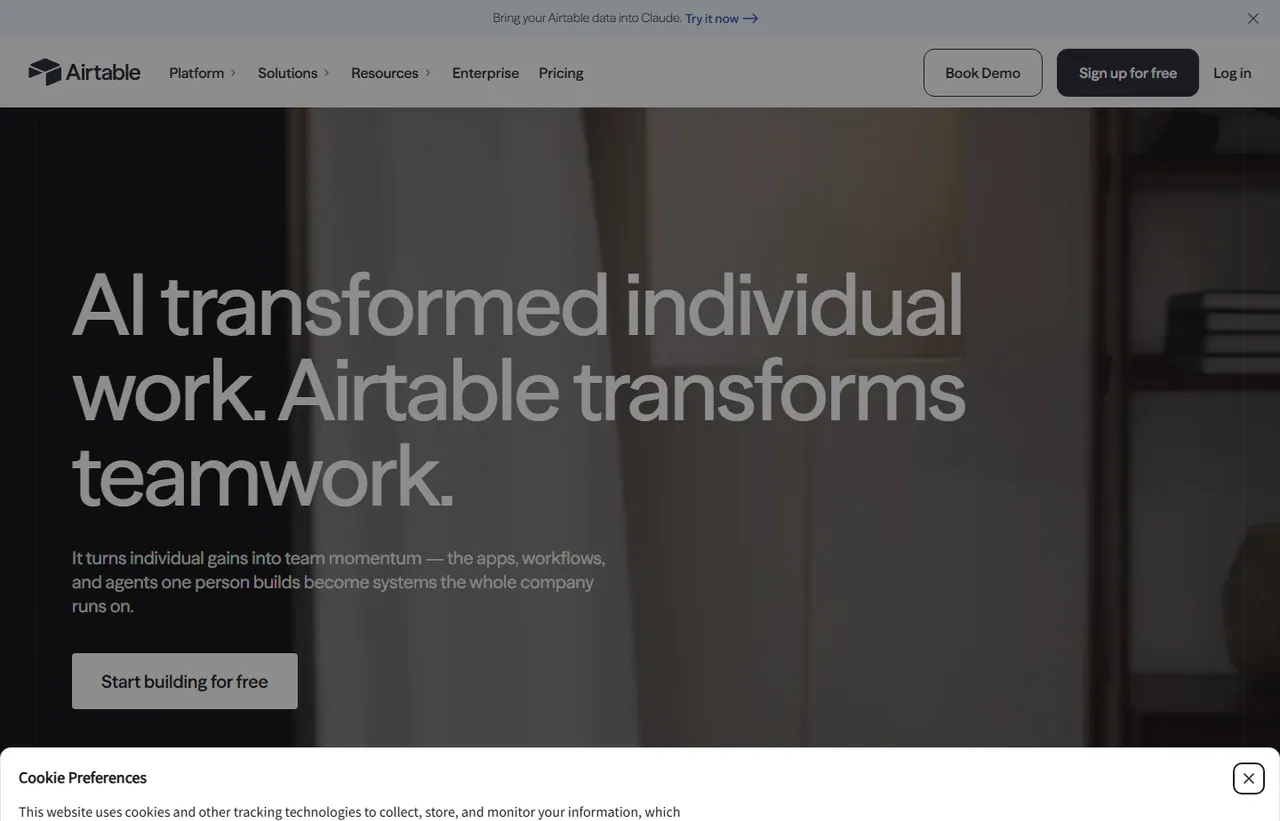
2 captured by us: pricing page, homepage
-
Sources cited and dated : yes
1 primary source, each with the date it was read
-
Product used first-hand : no
Not tested. This profile is desk research from primary sources
-
Alternatives used first-hand : no
None, so comparisons here rest on published facts rather than use
-
Vendor contacted : no
Not contacted for this profile
Where Airtable appears on this site
One other page here references Airtable, and it is listed below.
- Another profile Coda names it as a competitor
Counts pages on this site that name the product by choice - price guides, pricing question pages, deal records and other profiles. Category and directory indexes list everything automatically and are not counted.
One-click Google setting
Get our writing surfaced first on Google
If this was useful, add EveryAny.One as a preferred source in Google. Our pricing pages and price guides will appear ahead of the rest in Top Stories, AI Mode and AI Overviews when you search for what software costs.
- Our reviews get a "preferred" badge in Top Stories and AI Overviews.
- AI Mode leans on the sources you've chosen when it answers.
- Change it back any time from the same Google page.

Opens Google's source preferences in a new tab.
Provenance and freshness
When each fact was last checked
- Pricing ·
- Plans ·
- Free trial
- Features
- Platforms
- Integrations
- Affiliate programme
- Company details
What has changed
-
August 2026
- Per-seat pricing and record limits verified
- Added plan picker, verdicts and switching-cost breakdown
Sources & verification
Facts on this page were read from the sources below on the dates shown. Where a vendor does not publish a figure, we record it as not disclosed rather than estimating it.
- Airtable pricing - checked 9 August 2026
Spotted something out of date? Email [email protected] and we will re-check it. Corrections are logged on the page.

