

Astro is an open-source web framework that renders pages to static HTML at build time and sends no JavaScript unless a component explicitly needs it. That default is the whole product: for content-driven sites, it removes the performance cost that general-purpose application frameworks impose by design.
Astro ranking and coverage
- In Development
- #1 of 18 tied
- Overall
- #1 of 122 tied
- Terms score
- 9 /10
- Referenced here
- 3 pages
Cost position 10 · Portability 9 · Subscription flexibility 8 - Ranked on published terms only: entry price against category peers, portability and subscription flexibility, equally weighted. This is not a quality score.How the rank is calculated.
Astro: the short answer
Every line below is drawn from facts verified on 20 August 2026.
- What it is
- Ships HTML by default, which is why content sites are fast on it
- Best for
- Content sites, documentation, blogs and marketing sites at scale
- Starts at
- Free and open source (MIT licence)
- Free option
- Free plan available, no trial
- Biggest strength
- No JavaScript shipped unless a component needs it
- Biggest drawback
- Requires someone comfortable with a code editor and Git
- Based on
- Primary-source research, not hands-on use
- Closest alternative
- Next.js - The right choice if you are building an application rather than a site
Astro at a glance
| Best for | Content sites, documentation, blogs and marketing sites at scale, Teams that want to own their output and their content, Projects where page performance is a requirement, not a nice-to-have |
|---|---|
| Category | Development, Design, SEO |
| Starting price | Free and open source (MIT licence) |
| Free plan | Yes |
| Free trial | No trial offered |
| Pricing model | one time |
| Company | The Astro Technology Company |
| Founded | 2021 |
| Headquarters | Distributed, incorporated in the United States |
| Founders | Fred K. Schott, Matthew Phillips, Nate Moore |
| Platforms | Web, Windows, macOS, Linux, CLI |
| Public API | Yes |
| Browser extension | No |
| Mobile apps | None |
| Self-hosting | Yes |
| Affiliate programme | No |
| Data source | Vendor pricing page and public records |
| Last checked | August 2026 |
Astro pricing
Prices below were read from the vendor's own pricing page on 20 August 2026. Pricing model: one time. No free trial is offered.
| Plan | Price | Billing | Notes |
|---|---|---|---|
| Astro framework | $0 | per one-time | MIT licensed open source. The cost is developer time, not licensing |
| Hosting | From $0 | per month | Static output hosts free. Cloudflare's own documentation states that requests to static assets are free and unlimited on both its free and paid plans, so a static site has no request ceiling |
Which Astro plan should you buy?
| Your situation | Recommended | Why |
|---|---|---|
| You are building a content site, blog or documentation | Astro framework | Free and MIT licensed. Ships no JavaScript by default, which is the whole point. |
| You want it hosted for nothing | Astro plus Cloudflare Pages or Netlify | Static output fits the free tier of every major host, so a real site can cost nothing to run. |
| You are building an application with authentication and state | Consider Next.js instead | Astro is site-first. An app with sessions and client state fits Next.js better. |
| Nobody on the team writes code | Do not choose Astro | There is no visual editor. Webflow or Squarespace exist for exactly this case. |
Verdict by who you are
Developer building a content siteYes
Free, fast by default, and framework-agnostic for components. For pages rather than apps this is the strongest choice available.
Documentation team with developer supportYes
Starlight and MDX make this one of the best documentation stacks, at no licence cost.
Product team building a web appCompare first
Possible with islands, but Next.js is the better fit once most of the page is interactive.
Marketing team with no developerNo
There is no visual editing. You need a builder, not a framework.
Should you buy Astro?
Buy Astro if…
- Content sites, documentation, blogs and marketing sites at scale
- Teams that want to own their output and their content
- Projects where page performance is a requirement, not a nice-to-have
Do not buy Astro if…
- Non-technical teams without access to a developer
- Highly interactive applications and dashboards
- Anyone needing a visual editor for layout
Key features
- Zero JavaScript shipped by default
- Content collections with schema validation for Markdown
- Islands architecture for selectively hydrating components
- Use React, Vue, Svelte or Solid components in the same project
- Server-side rendering and on-demand routes when needed
- Built-in image optimisation and asset hashing
- File-based routing with dynamic route generation
- Adapters for Cloudflare, Netlify, Vercel and Node
Integrations
- Cloudflare Pages, Netlify and Vercel
- Markdown, MDX and headless CMS platforms
- Tailwind CSS and most styling approaches
- Sitemap, RSS and image integrations maintained officially
Astro screenshots
Captured by us in August 2026 at 1440px, unedited. Interfaces change, so these show the product as it looked on the date we verified this profile. Pricing pages are captured from a US vantage point, so the currency shown matches the USD figures recorded above.
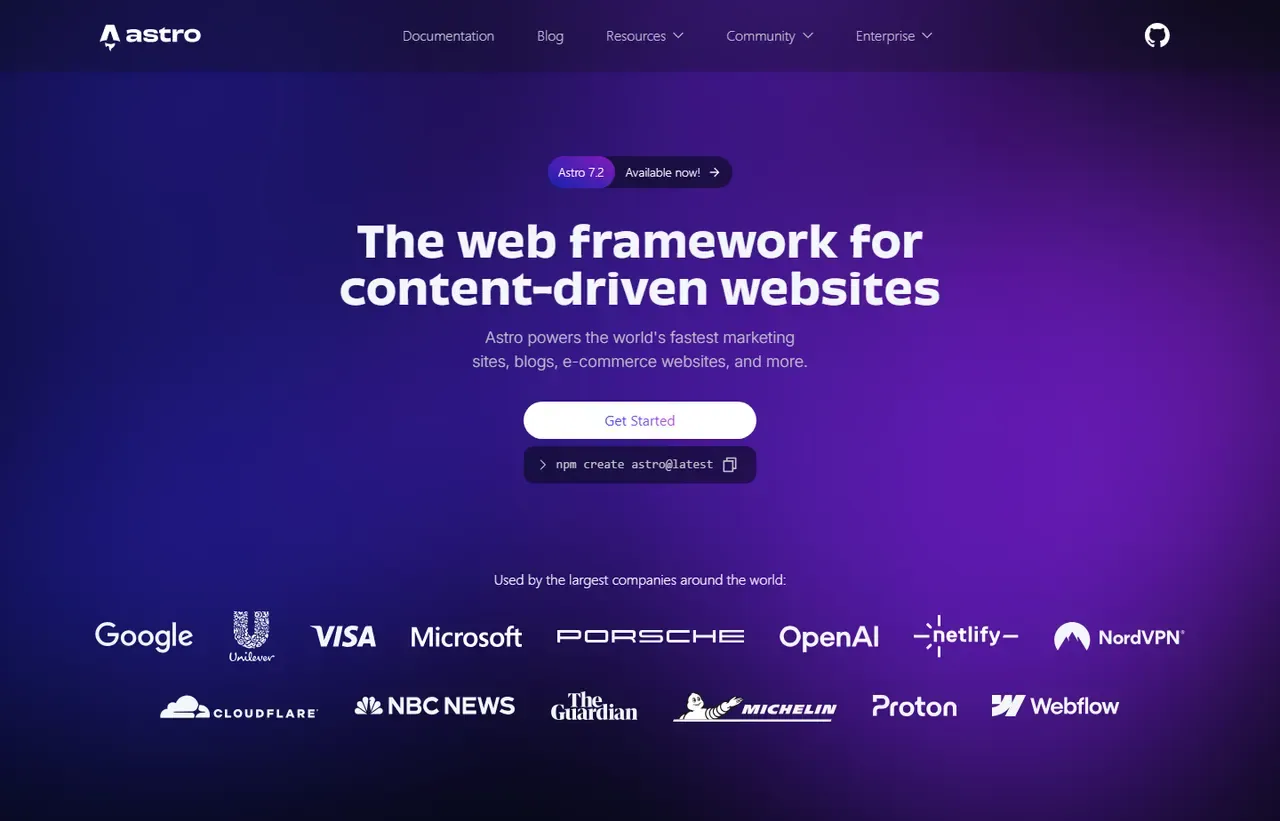
Our assessment
Astro made the correct default choice for the kind of site most organisations actually publish. Application frameworks ship a JavaScript runtime because they assume interactivity; Astro assumes content and adds interactivity only where you ask for it, which is why an Astro marketing site routinely outperforms the same site built in a general framework without anyone optimising anything. Content collections with schema validation are the other quietly important feature, because they make a large Markdown-based site enforceable rather than hopeful. The requirement is a developer, and that is a genuine disqualifier for some teams rather than a detail.
What works in Astro
- No JavaScript shipped unless a component needs it
- Content collections validate structured content at build time
- Framework-agnostic, so existing React or Vue components still work
- Free, open source, and hosts free on several platforms
What doesn't
- Requires someone comfortable with a code editor and Git
- Not the right tool for genuinely interactive applications
- No visual editor, so content people need Markdown or a CMS
- Smaller ecosystem than the largest application frameworks
EveryAny Decision Score
3 of these 8 dimensions are calculated from verified facts; the rest are our judgement, shown as a band rather than a figure unless something specific sits behind them. How each score works.
- Cost position10/10
derivedno paid tier required
- Portability9/10
derivedself-hostable, public API, open source
- Subscription flexibility8/10
derivedfree plan, one time, monthly billing
- Feature depthHigh
editorialour judgement, with no measurement behind it
- Ease of learningHigh
editorialour judgement, with no measurement behind it
- CollaborationLow
editorialour judgement, with no measurement behind it
- AI capabilityLow
editorialour judgement, with no measurement behind it
- Professional adoptionHigh
editorialour judgement, with no measurement behind it
What leaving Astro would cost
low lock-in
Astro scores on self-hostable, public API, open source. Portability 9/10 ; lock-in is the inverse. How this is calculated.
Astro competitors and alternatives
| Alternative | Why you might pick it instead |
|---|---|
| Next.js | The right choice if you are building an application rather than a site. |
| Hugo or Eleventy | Even leaner static generators, with smaller component ecosystems. |
| Webflow | If a non-technical team must own the site without a developer. |

Webflow
Development
Visual development that produces real HTML, CSS and a proper CMS.
Checked Aug 2026

Framer
Development
Design-led website builder that publishes production sites from a canvas.
Checked Aug 2026

Vercel
Development
Deployment platform for frontend frameworks, built by the team behind Next.js.
Checked Aug 2026
The disclosure
EveryAny.One is built with Astro and deployed to Cloudflare Pages, so treat the rating accordingly. We would rather state that plainly than pretend to neutrality we do not have. The reasoning is in our methodology: this site needs unlimited content, server-rendered HTML and fast pages, which is precisely the case Astro is built for, and precisely what rules out every visual builder we also cover.
Your requirements are probably different. Most organisations should not build their marketing site in code.
What “zero JavaScript by default” actually buys
A typical marketing page built with an application framework ships a framework runtime, a router and hydration data before it renders anything. Astro renders to HTML at build time and ships nothing unless you mark a component as interactive. The practical result is that performance is the starting condition rather than an optimisation project, which matters for Core Web Vitals and, increasingly, for whether AI crawlers can read your content at all.
Content collections are the underrated feature
Astro can validate your Markdown frontmatter against a schema at build time. That sounds administrative until you run a site with dozens of structured pages: a missing price, a malformed date or an absent verification field fails the build rather than publishing quietly. On this site that check is the reason fact tables can be trusted, and it is the feature we would miss most.
The real cost
Astro is free. Building with it is not. Budget developer time for the initial build and a small amount of ongoing maintenance, and be honest about who will edit content: Markdown in a repository suits engineers and frustrates marketers. Pairing Astro with a headless CMS solves that and adds cost, at which point Webflow deserves a fair comparison.
Hosting is the free part
Static output hosts at no cost on Cloudflare Pages, and on Netlify or Vercel Hobby for non-commercial use. For a commercial site on Cloudflare Pages, static requests remain unmetered, which is why the combination is the cheapest credible option in our website builders guide.
Astro questions, answered
- Is Astro worth it?
- Astro made the correct default choice for the kind of site most organisations actually publish.
- How much does Astro cost?
- Free and open source (MIT licence). Verified against the vendor's pricing page.
- Does Astro have a free plan or free trial?
- Astro has a free plan. No free trial is offered.
- What is the best Astro alternative?
- It depends on the job. Next.js: The right choice if you are building an application rather than a site. Hugo or Eleventy: Even leaner static generators, with smaller component ecosystems. Webflow: If a non-technical team must own the site without a developer.
- Can I self-host Astro?
- Yes. Astro can be run on your own infrastructure, so the data stays under your control.
What this profile is based on
Every claim below is about our work, not about Astro. A "no" is recorded rather than omitted, because the difference between a tested review and careful desk research is the reader's to weigh. How we research a profile.
-
Prices read from the vendor : yes
Read from Astro's own pricing page on 20 August 2026
-
Plans and terms recorded : yes
2 rows, each with its billing period
-
Original screenshots : yes
1 captured by us: homepage
-
Sources cited and dated : yes
1 primary source, each with the date it was read
-
Product used first-hand : no
Not tested. This profile is desk research from primary sources
-
Alternatives used first-hand : no
None, so comparisons here rest on published facts rather than use
-
Vendor contacted : no
Not contacted for this profile
This site is built with Astro and deployed to Cloudflare Pages, so unlike most profiles here the hosting claims are from daily use rather than desk research. The pricing figures were still re-read from Cloudflare's own documentation on 20 August 2026. No benchmark of Astro against other frameworks was run.
Where Astro appears on this site
3 other pages here reference Astro. Every one is listed below, so the figure can be checked rather than taken.
- Buyer guide Best ways to build a startup website in 2026 ranked #2
- Another profile Carrd picks it for free, unlimited and fully yours
- Another profile Next.js names it as a competitor
Counts pages on this site that name the product by choice - buyer guides, articles, deal records and other profiles. Category and directory indexes list everything automatically and are not counted.
One-click Google setting
Get our writing surfaced first on Google
If this was useful, add EveryAny.One as a preferred source in Google. Our profiles and best-of guides will appear ahead of the rest in Top Stories, AI Mode and AI Overviews when you search for software.
- Our reviews get a "preferred" badge in Top Stories and AI Overviews.
- AI Mode leans on the sources you've chosen when it answers.
- Change it back any time from the same Google page.

Opens Google's source preferences in a new tab.
Provenance and freshness
When each fact was last checked
- Pricing ·
- Plans ·
- Free trial
- Features
- Platforms
- Integrations
- Affiliate programme
- Company details
Individually sourced claims
-
Requests to static assets on Cloudflare Pages are free and unlimited on both the free and paid plans
Cloudflare Pages Functions pricing ↗ · checked
-
Requests to Pages Functions count against the Workers quota, which on the free plan is 100,000 requests a day
Cloudflare Pages Functions pricing ↗ · checked
What has changed
-
August 2026
- Recorded Cloudflare's own statement that static asset requests are free and unlimited on both plans, which is what makes a static Astro site genuinely free to host at any traffic level
- Recorded that Functions requests count against the Workers quota of 100,000 a day on the free plan
-
August 2026
- Licence and hosting position re-checked
- Added plan picker and verdicts
Sources & verification
Facts on this page were read from the sources below on the dates shown. Where a vendor does not publish a figure, we record it as not disclosed rather than estimating it.
- Astro documentation and licence - checked 20 August 2026
Spotted something out of date? Email [email protected] and we will re-check it. Corrections are logged on the page.

