

WooCommerce
Free ecommerce for WordPress, with no revenue share ever.
- Ecommerce
- Development
- Marketing
- from $25/mo
WooCommerce is an open-source ecommerce plugin for WordPress, turning a site into a store with products, cart, checkout and payments. The core platform is free with no revenue share and no features held back behind tiers; costs arrive through hosting and paid extensions instead.
WooCommerce ranking and coverage
- Terms rank
- Unranked
- Referenced here
- 1 page
WooCommerce is not ranked because there are too few same-currency products in its category to position its entry price honestly. How the rank is calculated.
WooCommerce: the short answer
Every line below is drawn from facts verified on 9 August 2026.
- What it is
- Free ecommerce for WordPress, with no revenue share ever
- Best for
- Stores already running on WordPress
- Starts at
- Core plugin free; hosting typically $25 to $350/month
- Free option
- Free plan available, no trial
- Biggest strength
- No revenue share and no features locked behind tiers
- Biggest drawback
- You own hosting, security, updates and performance
- Based on
- Primary-source research, not hands-on use
- Closest alternative
- Shopify - Hosting, security and support handled, at a monthly fee plus fees
- True annual cost
- from $300 a year on Hosting, the cheapest paid tier ($25 a month)
WooCommerce at a glance
| Best for | Stores already running on WordPress, Merchants who want to avoid revenue share, Anyone needing full control of checkout and data |
|---|---|
| Category | Ecommerce, Development, Marketing |
| Starting price | Core plugin free; hosting typically $25 to $350/month |
| Free plan | Yes |
| Free trial | No trial offered |
| Pricing model | freemium |
| Company | Automattic Inc. |
| Founded | 2011 |
| Headquarters | Distributed, part of Automattic |
| Founders | Mark Forrester, Magnus Jepson, Adii Pienaar |
| Platforms | Web, iOS, Android |
| Public API | Yes |
| Browser extension | No |
| Mobile apps | iOS + Android |
| Self-hosting | Yes |
| Affiliate programme | No |
| Data source | Vendor pricing page and public records |
| Last checked | August 2026 |
WooCommerce pricing
Prices below were read from the vendor's own pricing page on 9 August 2026. Pricing model: freemium. No free trial is offered.
| Plan | Price | Billing | Notes |
|---|---|---|---|
| WooCommerce core | $0 | per one-time | Free, open source, no revenue share and no feature gating |
| Hosting | $25 | per month | Stated as $25 to $350/month for most stores, scaling with traffic |
| Extensions | $29 | per year | Stated as $29 to $299 per year per extension |
| Payments | Per transaction | per usage | Processing fees charged by your chosen gateway, not by WooCommerce |
What WooCommerce actually costs over a year
A monthly price is not the same thing as a monthly contract. These are the plans above resolved both ways, per seat or unit where the plan is charged that way. Where a vendor quotes only a yearly figure it is divided by twelve rather than left out, and the Quoted column says which figure the vendor actually publishes.
| Plan | Quoted | Monthly | Over 12 months |
|---|---|---|---|
| Hosting | per month | $25 | $300 |
| Extensions add-on | per year | $2.42 | $29 |
Which WooCommerce plan should you buy?
| Your situation | Recommended | Why |
|---|---|---|
| You already run WordPress and want to sell | WooCommerce core | Free, open source, no revenue share and no features held behind tiers. |
| You need hosting for a real store | Budget $25 to $350 a month | WooCommerce's own stated range, scaling with traffic and performance needs. This is your actual monthly bill. |
| You need subscriptions, bookings or advanced shipping | Budget extensions separately | $29 to $299 per year each. Four or five of these plus hosting can reach $200 a month, at which point Shopify is a fair comparison. |
| Revenue share is a material cost at your volume | WooCommerce core | No percentage of sales goes to Woo, which is the strongest argument and grows stronger with turnover. |
| You want someone else responsible at 3am | Consider Shopify instead | Security patching, uptime and PCI become your problem here. |
| Nobody will maintain the site | Do not choose WooCommerce | An abandoned checkout is a breach, not just an embarrassment. |
Verdict by who you are
Content-led business selling productsYes
WordPress plus Woo fits a content site far better than bolting a blog onto a commerce platform.
High-turnover merchantYes
No revenue share means percentage costs do not scale with your success.
Merchant needing custom checkoutYes
You own the checkout entirely, which Shopify gates to Plus.
Business with no technical capabilityNo
Hosting, patching, backups and plugin conflicts are yours. Shopify exists precisely to remove this.
Buyer assuming free means cheapCompare first
Price your real extension list and hosting first. Sometimes Woo is far cheaper; sometimes it is not cheaper at all.
Should you buy WooCommerce?
Buy WooCommerce if…
- Stores already running on WordPress
- Merchants who want to avoid revenue share
- Anyone needing full control of checkout and data
Do not buy WooCommerce if…
- Merchants who want hosting and security handled for them
- Teams without WordPress maintenance capability
- High-volume stores needing guaranteed performance out of the box
Key features
- Free core platform with no revenue share
- Full control of checkout, data and hosting
- Very large extension marketplace
- Products, variations, coupons and tax rules
- REST API and webhooks for custom integration
- Blocks-based store editing inside WordPress
- Subscriptions and bookings available as extensions
- Complete data export and portability
Integrations
- WordPress and the WordPress plugin ecosystem
- Stripe, PayPal and WooPayments
- Mailchimp, Klaviyo and most email platforms
- Xero and QuickBooks
- WooCommerce REST API
WooCommerce screenshots
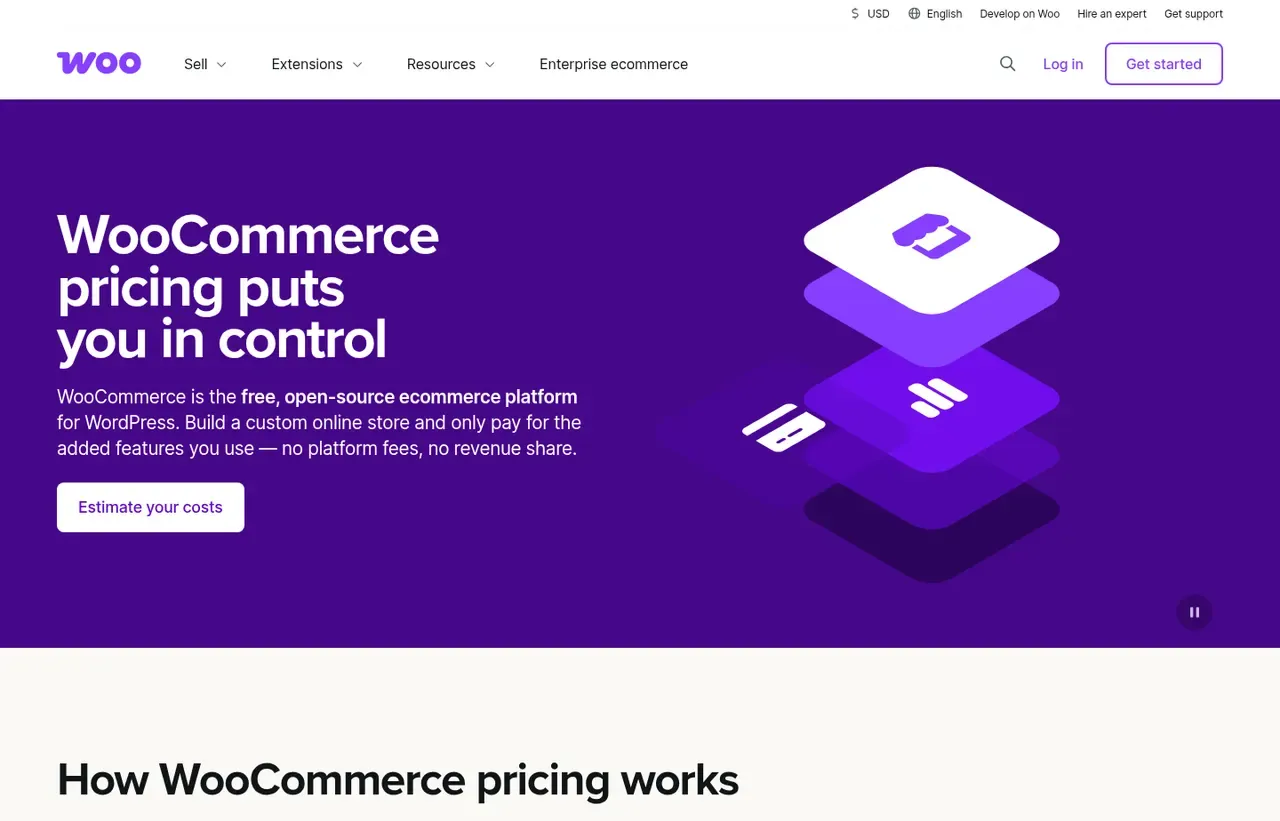
Captured by us in August 2026 at 1440px, unedited. Interfaces change, so these show the product as it looked on the date we verified this profile. Pricing pages are captured from a US vantage point, so the currency shown matches the USD figures recorded above.

Our assessment
WooCommerce is the right answer when control matters more than convenience. The core is free with no revenue share, which means a store doing serious volume keeps money that Shopify would take, and because it runs on your own WordPress install you own the checkout, the customer data and the ability to change anything. That freedom is genuine and not available from hosted platforms at any price. The cost is responsibility: hosting, performance, security patching, plugin conflicts and PCI considerations are yours, and the total bill assembled from hosting plus several extensions often lands near Shopify's while demanding far more attention. It rewards merchants with technical capability and punishes those without.
What works in WooCommerce
- No revenue share and no features locked behind tiers
- Complete control of checkout, data and hosting
- Huge extension ecosystem for niche requirements
- Full data portability, since it is your database
What doesn't
- You own hosting, security, updates and performance
- Extension costs accumulate quickly and renew annually
- Plugin conflicts are a recurring maintenance tax
- Total cost often approaches Shopify with more work
EveryAny Decision Score
2 of these 7 dimensions are calculated from verified facts; the rest are our judgement, shown as a band rather than a figure unless something specific sits behind them. How each score works.
- Portability10/10
derivedself-hostable, public API, open source, documented export
- Subscription flexibility7/10
derivedfree plan, freemium, monthly billing
- Feature depthVery high
editorialour judgement, with no measurement behind it
- Ease of learningModerate
editorialour judgement, with no measurement behind it
- CollaborationModerate
editorialour judgement, with no measurement behind it
- AI capabilityModerate
editorialour judgement, with no measurement behind it
- Professional adoptionVery high
editorialour judgement, with no measurement behind it
What leaving WooCommerce would cost
low lock-in
WooCommerce scores on self-hostable, public API, open source, documented export. Portability 10/10 ; lock-in is the inverse. How this is calculated.
WooCommerce competitors and alternatives
| Alternative | Why you might pick it instead |
|---|---|
| Shopify | Hosting, security and support handled, at a monthly fee plus fees. |
| Squarespace Commerce | Much simpler for a small catalogue you never intend to extend. |
| Medusa | Open-source headless commerce for developer-led builds. |

Shopify
Ecommerce
The default platform for running an online store without running infrastructure.
Checked Aug 2026

Squarespace
Development
Templates that are genuinely hard to make ugly.
Checked Aug 2026

Wix
Development
Drag-anything website building for people who do not want a web project.
Checked Aug 2026
Free core, and they mean it
WooCommerce states plainly that there is no revenue share and that features are not locked away behind higher tiers. The core plugin handles products, variations, cart, checkout, coupons, tax and shipping at no cost.
That is a real difference from Shopify, which charges a monthly fee and takes additional transaction fees unless you use its own payments. For a store turning over meaningful revenue, percentage-based costs are the largest line item, and removing them is the strongest argument for Woo.
Where the money actually goes
WooCommerce’s own page gives the ranges:
- Hosting: $25 to $350 a month for most stores, scaling with traffic and performance needs
- Extensions: $29 to $299 per year, each
- Payments: whatever your gateway charges, paid to the gateway
The extension line is the one that surprises people. Subscriptions, bookings, advanced shipping, better search and many other capabilities that hosted platforms include are separate annual purchases here. Four or five of them plus decent hosting can reach $200 a month, at which point the comparison with Shopify is about control rather than cost.
Price your actual extension list before concluding Woo is cheaper. Sometimes it is by a wide margin; sometimes it is not cheaper at all.
What you take on
Security patching, WordPress and plugin updates, backups, uptime, page speed and PCI considerations become your responsibility, or your host’s if you pay for managed hosting. A neglected WooCommerce store is a liability in a way a neglected Shopify store is not, because there is no vendor patching it for you.
This is the same trade described on the WordPress profile, with money attached: an abandoned blog is embarrassing, an abandoned checkout is a breach.
When to choose it
Choose WooCommerce if you already run WordPress, if revenue share is a material cost at your volume, if you need to customise checkout or own your customer data outright, or if a required capability only exists as a WordPress plugin.
Choose Shopify if you would rather pay a predictable fee and have someone else be responsible at 3am. Both are defensible. Pretending the free core makes Woo free is not.
WooCommerce questions, answered
- Is WooCommerce worth it?
- WooCommerce is the right answer when control matters more than convenience.
- How much does WooCommerce cost?
- Core plugin free; hosting typically $25 to $350/month. The cheapest paid tier we recorded is Hosting, published at $25 a month, which works out at $25 a month or $300 over a year. Verified against the vendor's pricing page.
- Does WooCommerce have a free plan or free trial?
- WooCommerce has a free plan. No free trial is offered.
- What is the best WooCommerce alternative?
- It depends on the job. Shopify: Hosting, security and support handled, at a monthly fee plus fees. Squarespace Commerce: Much simpler for a small catalogue you never intend to extend. Medusa: Open-source headless commerce for developer-led builds.
- Can I self-host WooCommerce?
- Yes. WooCommerce can be run on your own infrastructure, so the data stays under your control.
What this profile is based on
Every claim below is about our work, not about WooCommerce. A "no" is recorded rather than omitted, because the difference between a tested review and careful desk research is the reader's to weigh. How we research a profile.
-
Prices read from the vendor : yes
Read from WooCommerce's own pricing page on 9 August 2026
-
Plans and terms recorded : yes
4 rows, each with its billing period
-
Original screenshots : yes
2 captured by us: homepage, pricing page
-
Sources cited and dated : yes
1 primary source, each with the date it was read
-
Product used first-hand : no
Not tested. This profile is desk research from primary sources
-
Alternatives used first-hand : no
None, so comparisons here rest on published facts rather than use
-
Vendor contacted : no
Not contacted for this profile
Where WooCommerce appears on this site
One other page here references WooCommerce, and it is listed below.
- Another profile Shopify names it as a competitor
Counts pages on this site that name the product by choice - buyer guides, articles, deal records and other profiles. Category and directory indexes list everything automatically and are not counted.
One-click Google setting
Get our writing surfaced first on Google
If this was useful, add EveryAny.One as a preferred source in Google. Our profiles and best-of guides will appear ahead of the rest in Top Stories, AI Mode and AI Overviews when you search for software.
- Our reviews get a "preferred" badge in Top Stories and AI Overviews.
- AI Mode leans on the sources you've chosen when it answers.
- Change it back any time from the same Google page.

Opens Google's source preferences in a new tab.
Provenance and freshness
When each fact was last checked
- Pricing ·
- Plans ·
- Free trial
- Features
- Platforms
- Integrations
- Affiliate programme
- Company details
What has changed
-
August 2026
- Confirmed no revenue share and recorded the stated hosting and extension ranges
- Added plan picker and verdicts
Sources & verification
Facts on this page were read from the sources below on the dates shown. Where a vendor does not publish a figure, we record it as not disclosed rather than estimating it.
- WooCommerce pricing - checked 9 August 2026
Spotted something out of date? Email [email protected] and we will re-check it. Corrections are logged on the page.