

WordPress
The CMS that runs a large share of the web, and still the most flexible.
- Development
- Design
- Marketing
- from $4/mo
WordPress is free, open-source content management software released under the GPL, extensible through tens of thousands of themes and plugins. It powers a large share of all websites. The software itself costs nothing; what you pay for is hosting, and WordPress.com from Automattic is the managed option with the most confusing price list in the category.
WordPress ranking and coverage
- In Development
- #3 of 18 tied
- Overall
- #7 of 122 tied
- Terms score
- 8.2 /10
- Referenced here
- 2 pages
Cost position 7.5 · Portability 10 · Subscription flexibility 7 - Ranked on published terms only: entry price against category peers, portability and subscription flexibility, equally weighted. This is not a quality score.How the rank is calculated.
WordPress: the short answer
Every line below is drawn from facts verified on 20 August 2026.
- What it is
- The CMS that runs a large share of the web, and still the most flexible
- Best for
- Content sites and blogs of any size
- Starts at
- Free and open source; WordPress.com hosting from $4/month for the first year
- Free option
- Free plan available, no trial
- Biggest strength
- Free and open source, with genuinely no lock-in
- Biggest drawback
- WordPress.com advertised prices are first-year rates that rise sharply on renewal
- Based on
- Primary-source research, not hands-on use
- Closest alternative
- Webflow - Far more design control with no plugin maintenance, at a higher price
- True annual cost
- from $48 a year on Personal, the cheapest paid tier ($4 a month)
WordPress at a glance
| Best for | Content sites and blogs of any size, Projects needing a specific plugin or full code control, Anyone who wants to own and export their site outright |
|---|---|
| Category | Development, Design, Marketing |
| Starting price | Free and open source; WordPress.com hosting from $4/month for the first year |
| Free plan | Yes |
| Free trial | No trial offered |
| Pricing model | freemium |
| Company | WordPress Foundation (software); Automattic, Inc. (WordPress.com) |
| Founded | 2003 |
| Headquarters | San Francisco, California, United States |
| Founders | Matt Mullenweg, Mike Little |
| Platforms | Web, Windows, macOS, Linux, iOS, Android |
| Public API | Yes |
| Browser extension | No |
| Mobile apps | iOS + Android |
| Self-hosting | Yes |
| Affiliate programme | No |
| Data source | Vendor pricing page and public records |
| Last checked | August 2026 |
WordPress pricing
Prices below were read from the vendor's own pricing page on 20 August 2026. Pricing model: freemium. No free trial is offered.
| Plan | Price | Billing | Notes |
|---|---|---|---|
| WordPress software | $0 | per one-time | GPL licensed. Self-host anywhere; you pay only for hosting |
| WordPress.com Free | $0 | per month | WordPress.com subdomain and WordPress.com ads shown to visitors |
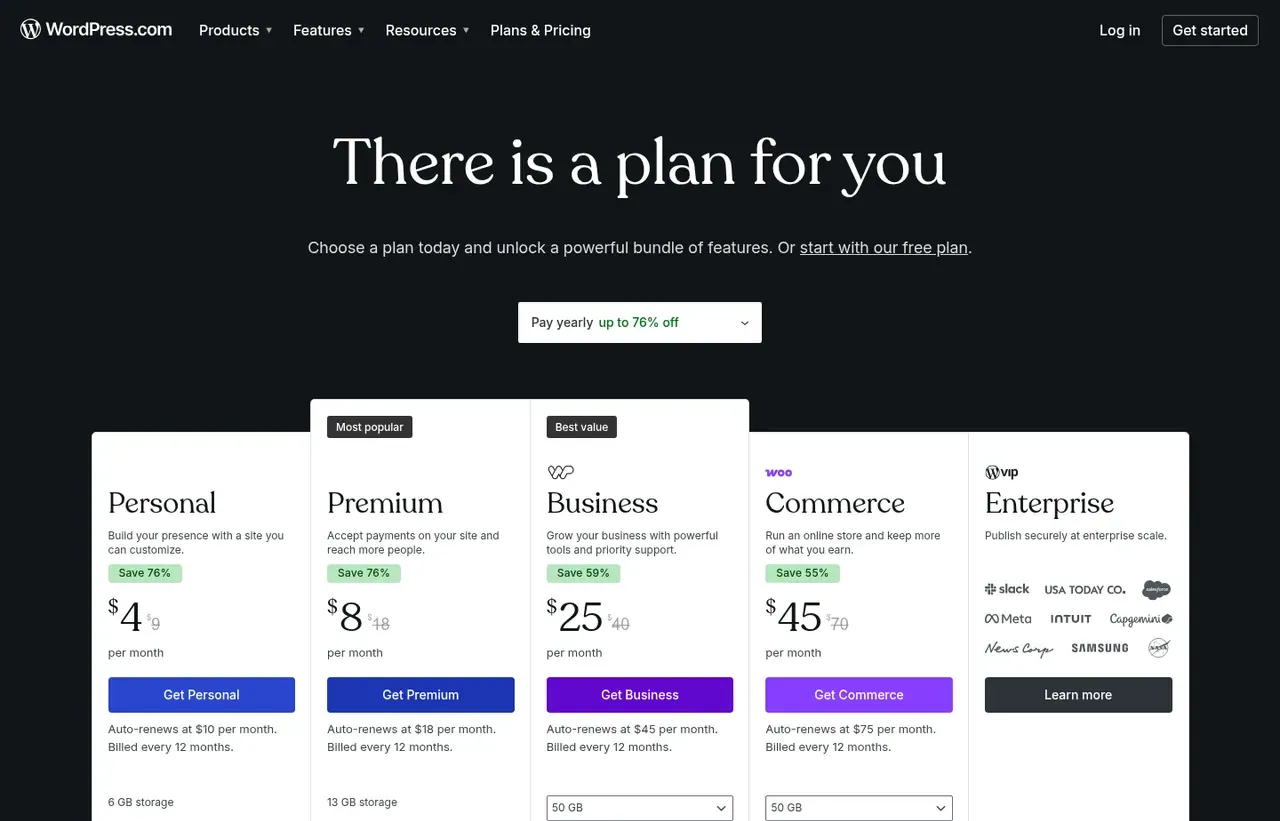
| Personal | $4 | per month | First 12 months, auto-renewing at $8 a month on annual billing, or $9 billed monthly. 6 GB storage, a free domain for one year, no ads for visitors, and unlimited pages, posts, users and visitors |
| Premium | $8 | per month | First 12 months. Auto-renews at $14/month. $18 if billed monthly |
| Business | $25 | per month | First 12 months. Auto-renews at $35/month. $40 if billed monthly. Plugins allowed |
| Commerce | $45 | per month | First 12 months. Auto-renews at $62/month. $70 if billed monthly |
| WordPress VIP | Contact sales | Negotiated | Enterprise hosting, quoted separately by Automattic |
What WordPress actually costs over a year
A monthly price is not the same thing as a monthly contract. These are the plans above resolved both ways, per seat or unit where the plan is charged that way. Where a vendor quotes only a yearly figure it is divided by twelve rather than left out, and the Quoted column says which figure the vendor actually publishes.
| Plan | Quoted | Monthly | Over 12 months |
|---|---|---|---|
| Personal | per month | $4 | $48 |
| Premium | per month | $8 | $96 |
| Business | per month | $25 | $300 |
| Commerce | per month | $45 | $540 |
Which WordPress plan should you buy?
| Your situation | Recommended | Why |
|---|---|---|
| You want full control and will manage the site | WordPress software, self-hosted | Free under the GPL. You pay only for hosting, and you own everything. |
| You want managed hosting and your own plugins | Business | $25 a month for the first year, then $35. Plugin installation requires this tier, which is the feature most people came for. |
| You want a simple hosted blog with no ads | Personal | $4 a month for the first year, then $8. Removes WordPress.com advertising. |
| You are budgeting for year two | Use the renewal price, not the advertised one | Every headline figure is a first-year rate. Personal renews at $8, Premium $14, Business $35 and Commerce $62. |
| You are outside the dollar zone | Check the renewal in your own currency | The renewal gap differs by currency, not just exchange rate. We were shown Business renewing at €44 against $35. |
| You want design control without plugin maintenance | Consider Webflow instead | More design control and nothing to patch. |
Verdict by who you are
Publisher or content businessYes
Still the right default for content at scale, and self-hosting means genuinely no lock-in and clean data export.
Anyone needing a specific pluginYes
The ecosystem covers essentially everything, and that is why WordPress persists.
WordPress.com customer on a cheap tierCompare first
Below Business you cannot install plugins, so you have WordPress without the thing that makes it worth choosing.
Business with no maintenance capacityNo
Self-hosted WordPress is not fire-and-forget. Neglected sites get compromised.
Owner wanting a simple brochure siteNo
Squarespace or Wix will take less of your weekend.
Should you buy WordPress?
Buy WordPress if…
- Content sites and blogs of any size
- Projects needing a specific plugin or full code control
- Anyone who wants to own and export their site outright
Do not buy WordPress if…
- Teams unwilling to manage updates, backups and security
- Simple brochure sites where a hosted builder is less work
- Applications rather than content
Key features
- Open source under the GPL, with no vendor lock-in
- Tens of thousands of themes and plugins
- Block editor for visual page composition
- Full data export, so migration is always possible
- REST API for headless use
- Multisite for running many sites from one install
- Roles and capabilities for editorial teams
- Very large ecosystem of developers and agencies
Integrations
- WooCommerce for ecommerce
- Yoast and Rank Math for SEO
- Jetpack for backups, security and statistics
- Mailchimp, Klaviyo and most email platforms
- Zapier and WordPress REST API
WordPress screenshots
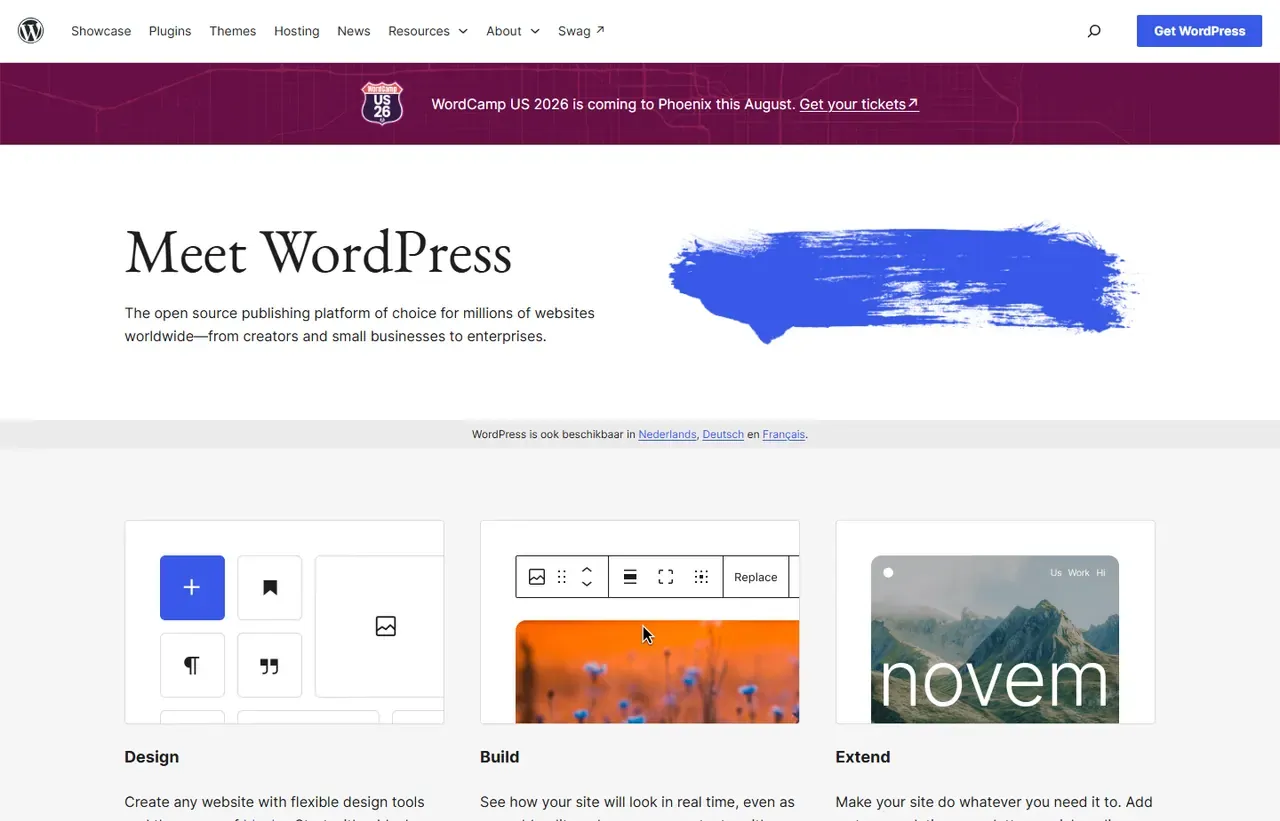
Captured by us in August 2026 at 1440px, unedited. Interfaces change, so these show the product as it looked on the date we verified this profile. Pricing pages are captured from a US vantage point, so the currency shown matches the USD figures recorded above.
Our assessment
WordPress remains the right default for content sites, and the reason is ownership. The software is GPL, the data exports cleanly, and there is a plugin for essentially anything, so you are never waiting for a vendor to ship a feature. The price of that freedom is maintenance: updates, backups, security and plugin conflicts are your responsibility, and a neglected install becomes a liability rather than a website. Two things deserve scrutiny. WordPress.com's advertised prices are first-year rates that roughly double on renewal, and installing your own plugins requires the Business plan, which is the point at which the main reason to use WordPress becomes available.
What works in WordPress
- Free and open source, with genuinely no lock-in
- Unmatched plugin and theme ecosystem
- Clean data export and a huge pool of available developers
- Self-host anywhere, or use managed hosting and switch later
What doesn't
- WordPress.com advertised prices are first-year rates that rise sharply on renewal
- Plugin installation requires the Business plan on WordPress.com
- Self-hosting means owning updates, backups and security
- Plugin conflicts and abandoned plugins are a recurring maintenance tax
EveryAny Decision Score
3 of these 8 dimensions are calculated from verified facts; the rest are our judgement, shown as a band rather than a figure unless something specific sits behind them. How each score works.
- Cost position7.5/10
derivedentry tier at $4 a month against a category median of $15 a month across 16 comparable tools
- Portability10/10
derivedself-hostable, public API, open source, documented export
- Subscription flexibility7/10
derivedfree plan, freemium, monthly billing
- Feature depthVery high
editorialour judgement, with no measurement behind it
- Ease of learningModerate
editorialour judgement, with no measurement behind it
- CollaborationHigh
editorialour judgement, with no measurement behind it
- AI capabilityModerate
editorialour judgement, with no measurement behind it
- Professional adoptionVery high
editorialour judgement, with no measurement behind it
What leaving WordPress would cost
low lock-in
WordPress scores on self-hostable, public API, open source, documented export. Portability 10/10 ; lock-in is the inverse. How this is calculated.
WordPress competitors and alternatives
| Alternative | Why you might pick it instead |
|---|---|
| Webflow | Far more design control with no plugin maintenance, at a higher price. |
| Squarespace | Much less work for a simple site you never intend to extend. |
| Ghost | Purpose-built for publishing and newsletters, with far less surface area. |

Webflow
Development
Visual development that produces real HTML, CSS and a proper CMS.
Checked Aug 2026

Squarespace
Development
Templates that are genuinely hard to make ugly.
Checked Aug 2026

Wix
Development
Drag-anything website building for people who do not want a web project.
Checked Aug 2026
Two different things share one name
WordPress is free software you can install on any host. WordPress.com is a commercial hosting service run by Automattic that runs that software for you. Almost every argument about WordPress being cheap or expensive comes from conflating the two.
If you self-host, the software costs nothing and your bill is whatever your host charges. If you use WordPress.com, you are buying managed hosting and the price list below applies.
The advertised price is a first-year price
This is the single most important thing to know before buying WordPress.com. Every headline figure is an introductory rate, and the renewal is substantially higher:
- Personal: $4 a month for the first 12 months, then $8
- Premium: $8 a month, then $14
- Business: $25 a month, then $35
- Commerce: $45 a month, then $62
Billing monthly instead costs more again: $9, $18, $40 and $70 respectively. Longer commitments of two or three years lower the introductory rate further and renew at their own higher figures.
Budget against the renewal number, not the one on the button. A Business site advertised at $25 a month is a $420-a-year commitment from year two.
The renewal gap is not the same in every currency
Worth flagging, because it is unusual. Reading the same page in dollars and in euros gives different ladders, and not merely by exchange rate. In euros we were shown Personal renewing at €9, Premium at €18, Business at €44 and Commerce at €78, against dollar renewals of $8, $14, $35 and $62 on identical introductory prices of 4, 8, 25 and 45.
In other words the euro renewal on Business is proportionally steeper than the dollar one. The figures recorded on this profile are the USD ones. Check your own currency on the page rather than converting ours, and check the renewal line specifically.
Plugins require the Business plan
The reason most people choose WordPress is the plugin ecosystem. On WordPress.com, installing your own plugins is a Business plan feature, so the cheaper tiers give you WordPress without the thing that makes WordPress worth choosing. At Business renewal pricing of $35 a month, self-hosting on ordinary shared hosting and installing plugins freely is often cheaper, at the cost of doing your own maintenance.
The Free plan also displays WordPress.com advertising to your visitors, which Personal removes.
The maintenance question, honestly
Self-hosted WordPress is not a fire-and-forget product. Core updates, plugin updates, backups, security hardening and the occasional plugin conflict are real ongoing work. Sites that are abandoned get compromised. Budget either time or a managed host, and treat anyone who tells you WordPress is free as having answered only the licensing question.
When to choose something else
If you want design control without plugin maintenance, Webflow is the stronger tool and prices accordingly. If you want a simple site that never needs extending, Squarespace or Wix will take less of your weekend. Choose WordPress when you need extensibility, ownership, or both.
WordPress questions, answered
- Is WordPress worth it?
- WordPress remains the right default for content sites, and the reason is ownership.
- How much does WordPress cost?
- Free and open source; WordPress.com hosting from $4/month for the first year. The cheapest paid tier we recorded is Personal, published at $4 a month, which works out at $4 a month or $48 over a year. Verified against the vendor's pricing page.
- Does WordPress have a free plan or free trial?
- WordPress has a free plan. No free trial is offered.
- What is the best WordPress alternative?
- It depends on the job. Webflow: Far more design control with no plugin maintenance, at a higher price. Squarespace: Much less work for a simple site you never intend to extend. Ghost: Purpose-built for publishing and newsletters, with far less surface area.
- Can I self-host WordPress?
- Yes. WordPress can be run on your own infrastructure, so the data stays under your control.
What this profile is based on
Every claim below is about our work, not about WordPress. A "no" is recorded rather than omitted, because the difference between a tested review and careful desk research is the reader's to weigh. How we research a profile.
-
Prices read from the vendor : yes
Read from WordPress's own pricing page on 20 August 2026
-
Plans and terms recorded : yes
7 rows, each with its billing period
-
Original screenshots : yes
2 captured by us: homepage, pricing page
-
Sources cited and dated : yes
2 primary sources, each with the date it was read
-
Product used first-hand : no
Not tested. This profile is desk research from primary sources
-
Alternatives used first-hand : no
None, so comparisons here rest on published facts rather than use
-
Vendor contacted : no
Not contacted for this profile
Desk research from WordPress.com's own pricing page, read on 20 August 2026 through a United States egress. WordPress.com advertises three different figures for the same plan - a first-term promotional rate, an annual renewal rate and a monthly rate - and this profile records all three because the middle one is what you actually pay from year two. Nobody here runs a site on WordPress.com.
Where WordPress appears on this site
2 other pages here reference WordPress. Every one is listed below, so the figure can be checked rather than taken.
- Buyer guide Best ways to build a startup website in 2026 ranked #1
- Another profile Carrd picks it for a marketing site with a blog, cheaply
Counts pages on this site that name the product by choice - buyer guides, articles, deal records and other profiles. Category and directory indexes list everything automatically and are not counted.
One-click Google setting
Get our writing surfaced first on Google
If this was useful, add EveryAny.One as a preferred source in Google. Our profiles and best-of guides will appear ahead of the rest in Top Stories, AI Mode and AI Overviews when you search for software.
- Our reviews get a "preferred" badge in Top Stories and AI Overviews.
- AI Mode leans on the sources you've chosen when it answers.
- Change it back any time from the same Google page.

Opens Google's source preferences in a new tab.
Provenance and freshness
When each fact was last checked
- Pricing ·
- Plans ·
- Free trial
- Features
- Platforms
- Integrations
- Affiliate programme
- Company details
Individually sourced claims
-
WordPress.com list prices are Personal $9, Premium $18, Business $40 and Commerce $70 a month billed monthly, with annual renewals at $8, $14 and $35
WordPress.com pricing ↗ · checked
-
Every plan, including the free one, allows unlimited pages, posts, users and visitors
WordPress.com pricing comparison table ↗ · checked
-
Personal includes 6 GB of storage, a free domain for one year and no ads for visitors
WordPress.com pricing ↗ · checked
-
Installing plugins requires the Business plan, which renews at $35 a month on annual billing
WordPress.com pricing comparison table ↗ · checked
What has changed
-
August 2026
- Recorded that unlimited pages, posts, users and visitors apply on every plan, which makes the third editor free where every visual builder charges for it
- Re-read the promotional, renewal and monthly rates, unchanged
- Recorded Personal's 6 GB storage and one-year domain
-
August 2026
- Recorded that advertised WordPress.com prices are first-year rates with higher renewals
- Noted the renewal gap differs by currency beyond exchange-rate effects
- Added plan picker and verdicts
Sources & verification
Facts on this page were read from the sources below on the dates shown. Where a vendor does not publish a figure, we record it as not disclosed rather than estimating it.
- WordPress.com pricing - checked 20 August 2026
- WordPress.org, the open-source project - checked 20 August 2026
Spotted something out of date? Email [email protected] and we will re-check it. Corrections are logged on the page.

