
Twenty
An open-source CRM you can self-host, priced from $9 a user on its managed cloud.
- Sales
- Development
- Productivity
- from $9/mo
Twenty is an open-source CRM built around customisable objects, run either on your own infrastructure or on the vendor's managed cloud. Its published plans start at $9 a user a month with unlimited seats and unlimited custom objects, and the self-hosting route means the software itself can be owned rather than rented.
Twenty: the short answer
Every line below is drawn from facts verified on 19 August 2026.
- What it is
- An open-source CRM you can self-host, priced from $9 a user on its managed cloud
- Best for
- Teams who want to own the CRM rather than rent it
- Starts at
- Pro $9 per user/month; Organization $19; self-hosting available
- Free option
- No free plan, Free trial with no credit card, length not stated on the pricing page trial
- Biggest strength
- Open source, with self-hosting documented as a supported route
- Biggest drawback
- The newest product here, with no adoption track record we can point at
- Based on
- Primary-source research, not hands-on use
- Closest alternative
- Attio - The other modern, object-model CRM, proprietary and dearer, with a free tier for three seats
- True annual cost
- from $108 a year on Pro, the cheapest paid tier ($9 a month)
Twenty at a glance
| Best for | Teams who want to own the CRM rather than rent it, Developers who will extend a CRM with code, Organisations with data-residency requirements |
|---|---|
| Category | Sales, Development, Productivity |
| Starting price | Pro $9 per user/month; Organization $19; self-hosting available |
| Free plan | No |
| Free trial | Free trial with no credit card, length not stated on the pricing page |
| Pricing model | subscription |
| Company | Twenty |
| Founded | Not disclosed |
| Headquarters | Not disclosed |
| Founders | Not disclosed |
| Platforms | Web |
| Public API | Yes |
| Browser extension | No |
| Mobile apps | None |
| Self-hosting | Yes |
| Affiliate programme | No |
| Data source | Vendor pricing page and public records |
| Last checked | August 2026 |
Twenty pricing
Prices below were read from the vendor's own pricing page on 19 August 2026. Pricing model: subscription. Free trial: Free trial with no credit card, length not stated on the pricing page.
| Plan | Price | Billing | Notes |
|---|---|---|---|
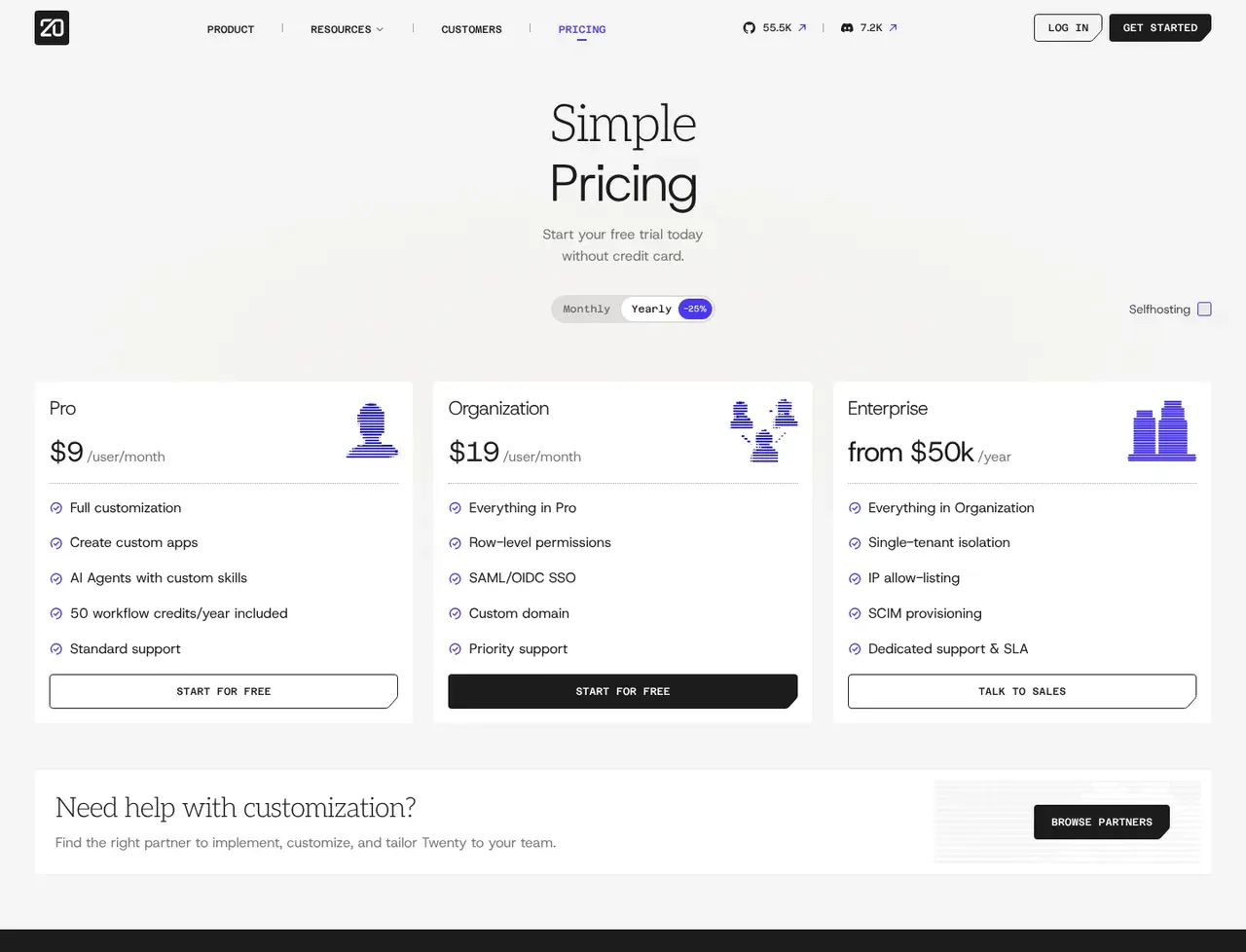
| Pro | $9 | per month | per user - Unlimited seats and unlimited custom objects, full customisation, custom apps, AI agents with custom skills, 50 workflow credits a year. The page's toggle offers 25% off for yearly billing |
| Organization | $19 | per month | per user - Adds row-level permissions, SAML and OIDC single sign-on, a custom domain and priority support |
| Enterprise | From $50,000 | per year | Single-tenant isolation, IP allow-listing, SCIM provisioning, dedicated support and an SLA |
| Self-hosting | Not disclosed | Negotiated | The pricing page carries a self-hosting tab whose terms were not readable from a server-side read; the FAQ states you can self-host to own your infrastructure |
What Twenty actually costs over a year
A monthly price is not the same thing as a monthly contract. These are the plans above resolved both ways, per seat or unit where the plan is charged that way. Where a vendor quotes only a yearly figure it is divided by twelve rather than left out, and the Quoted column says which figure the vendor actually publishes.
| Plan | Quoted | Monthly | Over 12 months |
|---|---|---|---|
| Proper user | per month | $9 | $108 |
| Organizationper user | per month | $19 | $228 |
| Enterprise | per year | $4,166.67 | $50,000 |
Which Twenty plan should you buy?
| Your situation | Recommended | Why |
|---|---|---|
| You want a modern CRM without per-seat maths | Pro | $9 a user a month, unlimited seats and unlimited custom objects, on the managed cloud. |
| You need SSO, row-level permissions or a custom domain | Organization | $19 a user a month. This is the tier most companies with an IT function will land on. |
| You must run the CRM on your own infrastructure | Self-hosting | Documented in the FAQ as a supported route, and the reason to choose this over Attio or HubSpot. Ask for the terms, because the pricing page's self-hosting tab is not readable. |
| You need single-tenant isolation, SCIM or an SLA | Enterprise | From $50,000 a year, which is a different conversation from the self-serve tiers. |
| Your team needs a dialler and quota tracking on day one | Consider Close instead | Close is built around calling and sequences; Twenty is built around the data model. |
Verdict by who you are
Team with data-residency requirementsYes
Self-hosting an open-source CRM is the only option here that removes the vendor from the data path entirely.
Developer-led startupYes
Unlimited custom objects, public code and documented API access make this the most malleable option at the price.
Sales team without engineering supportCompare first
The managed cloud removes the operations work, but you are buying a young product with no dialler and no quota tooling.
Enterprise replacing SalesforceCompare first
Technically plausible, and the Enterprise tier starts at $50,000 a year - price the migration and the missing consultant market honestly.
Anyone who needs a proven adoption recordNo
This is the newest product in the category and we have no evidence about whether reps keep it current.
Should you buy Twenty?
Buy Twenty if…
- Teams who want to own the CRM rather than rent it
- Developers who will extend a CRM with code
- Organisations with data-residency requirements
Do not buy Twenty if…
- Teams needing a large consultant ecosystem
- Sales orgs wanting built-in calling and quota management out of the box
- Anyone who needs a proven adoption track record before buying
Best Twenty alternative for each job
Chosen by what you are trying to do rather than by which product is closest overall, because the right replacement depends on the job.
| If you mainly need to… | Use | Why |
|---|---|---|
| Modern object-model CRM, fully managed | Attio | The proprietary equivalent, with a free tier for three seats and more polish. |
| Most built-in sales functionality per dollar | Zoho CRM | $14 a user with process automation and reporting Twenty does not attempt. |
| Pipeline a team will update this week | Pipedrive | Narrower on purpose, and the least likely to need anyone to configure it. |
| Marketing and sales on one record | HubSpot | A free tier for two users and the largest ecosystem in the category. |
Key features
- Open source, with the code and issues public on GitHub
- Self-hosting, or a managed cloud with no operations work
- Unlimited seats on every published plan
- Unlimited custom objects, so the data model is yours to shape
- Custom apps and AI agents with custom skills
- Row-level permissions and SSO on Organization
- Migration paths documented from Salesforce and HubSpot
- Works with AI coding tools, including Claude, ChatGPT and Cursor
Integrations
- REST and GraphQL APIs
- Custom apps built against the platform
- AI coding tools, per the vendor's own FAQ
- Self-hosted deployment
Twenty screenshots
Captured by us in August 2026 at 1440px, unedited. Interfaces change, so these show the product as it looked on the date we verified this profile. Pricing pages are captured from a US vantage point, so the currency shown matches the USD figures recorded above.
Our assessment
Twenty is the first credible open-source answer in a category where every serious option has been a subscription you cannot leave with. The licence is the argument: the code is public, self-hosting is documented, and unlimited seats plus unlimited custom objects on a $9 plan invert the two mechanics that make CRM expensive elsewhere - per-seat pricing and paying for the ability to model your own data. For a team with engineering capacity and a data-residency or ownership requirement, nothing else here does what this does. The honest caveats are about maturity rather than design. It is the newest product in this comparison by a wide margin, its consultant ecosystem is a partner directory rather than an industry, and built-in sales machinery that Close and Pipedrive treat as core - dialling, quotas, territory logic - is not what this is. We have not used it, and we do not know whether sales teams keep it updated, which is the question that decides a CRM. Judge it as an ownership decision first and a sales-tooling decision second.
What works in Twenty
- Open source, with self-hosting documented as a supported route
- Unlimited seats on every published plan, which no rival here offers
- Unlimited custom objects at the entry tier, where rivals reserve them for upper tiers
- $9 a user a month is the cheapest managed CRM we priced apart from HubSpot Starter
What doesn't
- The newest product here, with no adoption track record we can point at
- No built-in dialler, quota or territory management
- The consultant ecosystem is a partner list, not an industry
- Self-hosting terms are not readable from the pricing page
EveryAny Decision Score
3 of these 8 dimensions are calculated from verified facts; the rest are our judgement, shown as a band rather than a figure unless something specific sits behind them. How each score works.
- Cost position7.3/10
derivedentry tier at $9 a month against a category median of $24 a month across 11 comparable tools
- Portability9/10
derivedself-hostable, public API, open source
- Subscription flexibility6/10
derivedfree trial, subscription, monthly billing
- Feature depth6/10
editorialUnlimited custom objects, custom apps, AI agents and workflows, with no built-in dialler, quota or territory management.
- Ease of learningHigh
editorialour judgement, with no measurement behind it
- CollaborationHigh
editorialour judgement, with no measurement behind it
- AI capabilityModerate
editorialour judgement, with no measurement behind it
- Professional adoption4/10
editorialTwenty states 55,100 GitHub stars and describes itself as the leading open-source CRM on GitHub; there is no published customer count, and it is the newest product in this comparison.
What leaving Twenty would cost
low lock-in
Twenty scores on self-hostable, public API, open source. Portability 9/10 ; lock-in is the inverse. How this is calculated.
Twenty competitors and alternatives
| Alternative | Why you might pick it instead |
|---|---|
| Attio | The other modern, object-model CRM, proprietary and dearer, with a free tier for three seats. |
| Zoho CRM | Far more built-in sales functionality per dollar, and no self-hosting. |
| HubSpot | The safe default, with a free tier and a much larger ecosystem. |

HubSpot
Sales
CRM platform bundling marketing, sales, service and CMS around one contact record.
Checked Aug 2026

Pipedrive
Sales
A sales pipeline, done properly, and deliberately nothing else.
Checked Aug 2026
Unlimited seats is the mechanic that matters
Every other CRM in our CRM guide charges by the person, which makes headcount the cost driver and turns a growing team into a growing bill. Twenty’s published plans list seats as unlimited on Pro, Organization and Enterprise alike, and custom objects as unlimited on all three.
Set that against the pattern elsewhere: HubSpot reserves custom objects for its upper tiers, Folk puts them on Premium at $48 a member, and Salesforce’s ability to model your own data is the thing you buy Enterprise for at $175 a user.
Two ways to run it, and one of them removes the vendor
The FAQ is explicit: you can self-host to own your infrastructure, or use the managed cloud for a zero-operations setup. The code is public, and the page cites 55,100 GitHub stars.
That is the only genuine exit route in this category. Contacts export from anything as CSV; what does not normally travel is the configuration, the automation and the history. When the software is open source, the question changes from “can I get my data out” to “where do I want this running”.
The self-hosting tab on the pricing page did not yield terms to a server-side read, so we do not record what it costs. Ask, before you plan around it.
What $9 and $19 actually buy
| Plan | Price | The line that decides it |
|---|---|---|
| Pro | $9/user/month | Full customisation, custom apps, AI agents, 50 workflow credits a year |
| Organization | $19/user/month | Row-level permissions, SAML and OIDC SSO, custom domain |
| Enterprise | From $50,000/year | Single-tenant isolation, IP allow-listing, SCIM, SLA |
Most companies with an IT function will need Organization for the SSO alone, so budget $19 rather than $9. The page’s toggle advertises 25% off for yearly billing, and the figures above are the ones it served by default.
What we cannot tell you
Whether your reps will use it. Twenty is the newest product in this comparison, we have not used it, and no customer count is published. A CRM that nobody updates is worse than a spreadsheet - that is the argument running through our CRM guide - and it is the one thing no amount of licence generosity settles.
Nor is it a sales-machinery product. There is no built-in dialler, no quota tracking, no territory logic. If those are the reason you are buying, Close is built around them and this is not.
Twenty questions, answered
- Is Twenty worth it?
- Twenty is the first credible open-source answer in a category where every serious option has been a subscription you cannot leave with.
- How much does Twenty cost?
- Pro $9 per user/month; Organization $19; self-hosting available. The cheapest paid tier we recorded is Pro, published at $9 a month, which works out at $9 a month or $108 over a year. Verified against the vendor's pricing page.
- Does Twenty have a free plan or free trial?
- Twenty has no free plan. A free trial is available: Free trial with no credit card, length not stated on the pricing page.
- What is the best Twenty alternative?
- It depends on the job. Attio: The other modern, object-model CRM, proprietary and dearer, with a free tier for three seats. Zoho CRM: Far more built-in sales functionality per dollar, and no self-hosting. HubSpot: The safe default, with a free tier and a much larger ecosystem.
- Can I self-host Twenty?
- Yes. Twenty can be run on your own infrastructure, so the data stays under your control.
What this profile is based on
Every claim below is about our work, not about Twenty. A "no" is recorded rather than omitted, because the difference between a tested review and careful desk research is the reader's to weigh. How we research a profile.
-
Prices read from the vendor : yes
Read from Twenty's own pricing page on 19 August 2026
-
Plans and terms recorded : yes
4 rows, each with its billing period
-
Original screenshots : yes
1 captured by us: pricing page
-
Sources cited and dated : yes
1 primary source, each with the date it was read
-
Product used first-hand : no
Not tested. This profile is desk research from primary sources
-
Alternatives used first-hand : no
None, so comparisons here rest on published facts rather than use
-
Vendor contacted : no
Not contacted for this profile
Desk research from Twenty's own pricing page, read on 19 August 2026 through a United States egress. Nobody here has used Twenty, no self-hosted deployment was attempted, and we have no evidence about whether sales teams keep it updated - which this profile says plainly because it is the question that decides a CRM.
One-click Google setting
Get our writing surfaced first on Google
If this was useful, add EveryAny.One as a preferred source in Google. Our profiles and best-of guides will appear ahead of the rest in Top Stories, AI Mode and AI Overviews when you search for software.
- Our reviews get a "preferred" badge in Top Stories and AI Overviews.
- AI Mode leans on the sources you've chosen when it answers.
- Change it back any time from the same Google page.

Opens Google's source preferences in a new tab.
Provenance and freshness
When each fact was last checked
- Pricing ·
- Plans ·
- Free trial
- Features
- Platforms
- Integrations
- Affiliate programme
- Company details
Individually sourced claims
-
Pro is $9 a user a month and Organization $19, both with unlimited seats
Twenty pricing ↗ · checked
-
Enterprise starts at $50,000 a year
Twenty pricing ↗ · checked
-
Twenty is open source and can be self-hosted or run on its managed cloud, and states 55,100 GitHub stars
Twenty pricing FAQ ↗ · checked
What has changed
-
August 2026
- First published, with plans and limits read from the vendor pricing page
- Recorded that the self-hosting tab's terms are not readable from a server-side read
Sources & verification
Facts on this page were read from the sources below on the dates shown. Where a vendor does not publish a figure, we record it as not disclosed rather than estimating it.
- Twenty pricing - checked 19 August 2026
Spotted something out of date? Email [email protected] and we will re-check it. Corrections are logged on the page.

